


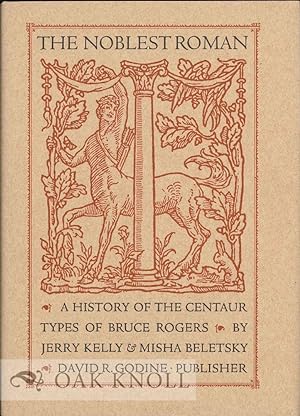
NOBLEST ROMAN: A HISTORY OF THE CENTAUR TYPES OF BRUCE ROGERS.|THE
Kelly, Jerry and Misha Beletsky
Edité par David R. Godine, Boston, MA, 2016
Ancien(s) ou d'occasion
Couverture rigide
Vendeur
Oak Knoll Books, ABAA, ILAB, NEW CASTLE, DE, Etats-Unis
Évaluation du vendeur 5 sur 5 étoiles

Honoris Librarius
Membre AbeBooks depuis 1996
Nous sommes désolés, cet exemplaire spécifique n'est plus disponible. Voici nos correspondances les plus proches pour NOBLEST ROMAN: A HISTORY OF THE CENTAUR TYPES OF BRUCE ROGERS.|THE de Kelly, Jerry and Misha Beletsky.
A propos de cet article
Description :
small 4to. paper-covered boards, dust jacket. 120, (2) pages. Roughly fifteen years after Gutenberg printed the first substantial book in Mainz in 1455, Nicolas Jenson of Venice produced what has been universally recognized among the most beautiful typefaces ever created. Based on the humanistic calligraphy of the Renaissance, an even and infinitely various set of lowercase letters that had evolved from the Carolingian minuscules of the ninth century, Jenson's types were a miracle of proportion and evenness of color. In the late nineteenth century, it was imitated by Morris in his Golden Type of 1892 (far too heavy), and in the next by Cobden-Sanderson with his Doves Type, Goudy with his Deepdene, and Hunter Middleton with his Eusebius. But it was really not until Bruce Rogers, following his stint at the Riverside Press in Cambridge, Massachusetts, where he first attempted a version of the type in his Montaigne font, tackled the challenge of creating a roman equal to (and in some ways surpassing) the Jenson original. The proof of his success is that it has been used, and held in high esteem, ever since. The story behind the type, the many permutations through which it went, the myths that accrued and surrounded it (many based on Rogers s somewhat erratic and chimerical memory) are all exposed in this fully documented account of the type's genesis and development. All the variations are included, from the 16-pt. roman originally produced for the exclusive use of the Metropolitan Museum of Art, to its conversion to the Monotype machine under the supervision of Stanley Morison, a typewriter version, a short-lived film version, and its ultimate appearance as a digital face. Included as well is a discussion of the Arrighi italic, developed to accompany the roman by Frederic Warde and Stanley Morison at the Monotype Corporation. The book has been designed and set in a new digital version of Centaur, often and justly called "the noblest roman of them all," created by Jerry Kelly. The authors have unearthed, mined, and refined a trove of typographic material to create the definitive history of what many consider the most beautiful typeface created by an American in the last century and used, to immortal effect, in two of the century's greatest books, T.E. Lawrence's Odyssey of Homer and the Oxford Lectern Bible. Illustrated with many examples in full color, with a dust jacket printed letterpress, issued in an edition of only 1,000 copies, this is a book no certified member of the lunatic fringe of type fanatics can afford to ignore. Table of contents, acknowledgments, foreword by Amelia Hugill-Fontanel, endnotes, index. Type specimens and bibliography of books in Original Foundry Centaur Type follow text. Frontispiece portrait of Bruce Rogers and illustrations throughout text. paper-covered boards, dust jacket. N° de réf. du vendeur 129302
Détails bibliographiques
Titre : NOBLEST ROMAN: A HISTORY OF THE CENTAUR ...
Éditeur : David R. Godine, Boston, MA
Date d'édition : 2016
Reliure : Couverture rigide
Etat de la jaquette : Jaquette
Meilleurs résultats de recherche sur AbeBooks

NOBLEST ROMAN: A HISTORY OF THE CENTAUR TYPES OF BRUCE ROGERS.|THE
Edité par
Book Club of California, San Francisco, CA, 2016
Ancien ou d'occasion
Couverture rigide
Signé
Vendeur : Oak Knoll Books, ABAA, ILAB, NEW CASTLE, DE, Etats-Unis
Évaluation du vendeur 5 sur 5 étoiles
Book Club of California (illustrateur). small 4to. paper-covered boards, paper spine label, paper covered slipcase. 138 pages. Limited to 300 signed and numbered copies. Includes the prospectus loosely inserted. Very minor uneven fading to the slipcase, minor bump to the top corner of the slipcase, else a fine copy in fine slipcase. Roughly fifteen years after Gutenberg printed the first substantial book in Mainz in 1455, Nicolas Jenson of Venice produced what has been universally recognized among the most beautiful typefaces ever created. Based on the humanistic calligraphy of the Renaissance, an even and infinitely various set of lowercase letters that had evolved from the Carolingian minuscules of the ninth century, Jenson's types were a miracle of proportion and evenness of color. In the late nineteenth century, it was imitated by Morris in his Golden Type of 1892 (far too heavy), and in the next by Cobden-Sanderson with his Doves Type, Goudy with his Deepdene, and Hunter Middleton with his Eusebius. But it was really not until Bruce Rogers, following his stint at the Riverside Press in Cambridge, Massachusetts, where he first attempted a version of the type in his Montaigne font, tackled the challenge of creating a roman equal to (and in some ways surpassing) the Jenson original. The proof of his success is that it has been used, and held in high esteem, ever since. The story behind the type, the many permutations through which it went, the myths that accrued and surrounded it (many based on Rogers's somewhat erratic and chimerical memory) are all exposed in this fully documented account of the type's genesis and development. All the variations are included, from the 16-pt. roman originally produced for the exclusive use of the Metropolitan Museum of Art, to its conversion to the Monotype machine under the supervision of Stanley Morison, a typewriter version, a short-lived film version, and its ultimate appearance as a digital face. Included as well is a discussion of the Arrighi italic, developed to accompany the roman by Frederic Warde and Stanley Morison at the Monotype Corporation. The book has been designed and set in a new digital version of Centaur, often and justly called "the noblest roman of them all," created by Jerry Kelly. The authors have unearthed, mined, and refined a trove of typographic material to create the definitive history of what many consider the most beautiful typeface created by an American in the last century and used, to immortal effect, in two of the century's greatest books, T.E. Lawrence's Odyssey of Homer and the Oxford Lectern Bible. Illustrated with many examples in full color, with a dust jacket printed letterpress, issued in an edition of only 1,000 copies, this is a book no certified member of the lunatic fringe of type fanatics can afford to ignore. Table of contents, acknowledgments, foreword by Amelia Hugill-Fontanel, endnotes, index. Type specimens and bibliography of books in Original Foundry Centaur Type follow text. Frontispiece portrait of Bruce Rogers and illustrations throughout text. paper-covered boards, paper spine label, paper covered slipcase. N° de réf. du vendeur 129681
Acheter D'occasion
EUR 112,74
Expédition à EUR 7,44
Expédition nationale : Etats-Unis
Expédition nationale : Etats-Unis
Quantité disponible : 1 disponible(s)
The Noblest Roman: A History of the Centaur Types of Bruce Rogers.
Edité par
San Francisco: The Book Club of California, 2016, 2016
Ancien ou d'occasion
Couverture rigide
Signé
Vendeur : Michael R. Thompson Books, A.B.A.A., Los Angeles, CA, Etats-Unis
Évaluation du vendeur 1 sur 5 étoiles

ÒWriting about the work of Bruce Rogers, and his celebrated Centaur type in particular, presents a special challenge todayÉ[F]ew other designers and types have ever been written about, examined, adulated, and described at such length and breadthÉIn this book we will endeavor to unravel some of the key elements of the story and set the record straight. Examining the muddled origination of the design, the intellectual property issues involved, and the curious story of the fontÕs recutting for machine composition, we hope to shed new light on the evolution of this seminal typeface. Along the way, we address the aesthetic legacy of the typeÉand how the various iterations of Centaur that Bruce Rogers produced reflect not only the evolution of his tastes, but also shed light on the history of twentieth-century typographyÓ (p. 9). Large octavo. [5], 6-94, [16], 95-120 pp . Frontisportrait of Rogers. With many type specimens, reproductions of pages from books printed with Centaur, and color photo reproductions chronicling the design process of the type. Text set in three digital versions of Bruce RogersÕ types (a Foundry Centaur revival by Jerry Kelly, a new caption Centaur by Toshi Omagari, and Monotype Centaur) and printed in black and red. Design and typography by Kelly. Buff paper boards stamped in gilt with Bruce RogersÕ device. Includes a laid-in supplement printed by Kelly for the Book Club of California (reproducing a quote from Joseph BlumenthalÕs biography of Rogers). In the publisherÕs brown paper slipcase, which is somewhat sunned. Otherwise, a fine copy. One of three hundred copies printed for the Book Club of California. Signed and numbered by Jerry Kelly and Misha Beletsky. N° de réf. du vendeur 17872
Acheter D'occasion
EUR 135,29
Expédition à EUR 13,14
Expédition nationale : Etats-Unis
Expédition nationale : Etats-Unis
Quantité disponible : 1 disponible(s)

The Noblest Roman. A History of the Centaur Types of Bruce Rogers.
Edité par
The Book Club of California, San Francisco, 2016
Ancien ou d'occasion
Couverture rigide
Edition originale
Signé
Vendeur : Blue Sky Rare Books, Palm Springs, CA, Etats-Unis
Évaluation du vendeur 5 sur 5 étoiles
Hardcover. Etat : Fine. Etat de la jaquette : near fine. First Edition. Fine. Hardcover. 207 of 300 copies, signed by both authors. Book as new, includes the prospectus. Minor wear/aging to slipcase, still near fine, no paper splits. N° de réf. du vendeur 6236
Acheter D'occasion
EUR 157,84
Expédition à EUR 4,82
Expédition nationale : Etats-Unis
Expédition nationale : Etats-Unis
Quantité disponible : 1 disponible(s)
The Noblest Roman: A History of the Centaur Types of Bruce Rogers
Edité par
The Book Club of California, San Francisco, 2016
ISBN 10 : 0981959792
ISBN 13 : 9780981959795
Ancien ou d'occasion
Couverture rigide
Edition originale
Signé
Vendeur : The Kelmscott Bookshop, ABAA, Savage, MD, Etats-Unis
Évaluation du vendeur 5 sur 5 étoiles
Hardcover. Etat : Fine. First Edition. Hardcover. 105 of 300 copies, signed by both authors. "In this book we will endeavor to unravel some of the key elements of the story [of Bruce Rogers's Centaur typeface] and set the record straight. Examining the muddled origination of the design, the intellectual property issues involved, and the curious story of the font's recutting for machine composition, we hope to shed new light on the evolution of this seminal typeface" (introduction). Set in three digital versions of Bruce Rogers's Centaur Type: the text in a recent revival of the original foundry Centaur, rendered by Jerry Kelly, and a new caption Centaur by Toshi Omagari, used in this book for the first time, with monotype Centaur used fro display. Design and typography by Jerry Kelly. Printed in black and dark red. Bound in speckled cream paper covered boards with paper title label to spine panel. Bruce Rogers design to front board in brown. Clean and bright. Housed in a brown paper covered slipcase with minor sunning to edges and light rubbing to panels. 120 pages. PRI/102323. Signed. N° de réf. du vendeur 36844
Acheter D'occasion
EUR 180,39
Expédition à EUR 7,01
Expédition nationale : Etats-Unis
Expédition nationale : Etats-Unis
Quantité disponible : 1 disponible(s)