


Quantifying Human Information Processing
Dennis K. McBride (u. a.)
ISBN 10: 0739112015 ISBN 13: 9780739112014
Edité par Jason Aronson, Inc., 2005
Neuf(s)
Buch
Vendeur
preigu, Osnabrück, Allemagne
Évaluation du vendeur 5 sur 5 étoiles

Vendeur AbeBooks depuis 5 août 2024
Cet article spécifique n'est plus disponible.
A propos de cet article
Description :
Quantifying Human Information Processing | Dennis K. McBride (u. a.) | Buch | Gebunden | Englisch | 2005 | Jason Aronson, Inc. | EAN 9780739112014 | Verantwortliche Person für die EU: Libri GmbH, Europaallee 1, 36244 Bad Hersfeld, gpsr[at]libri[dot]de | Anbieter: preigu Print on Demand. N° de réf. du vendeur 102055866
Synopsis :
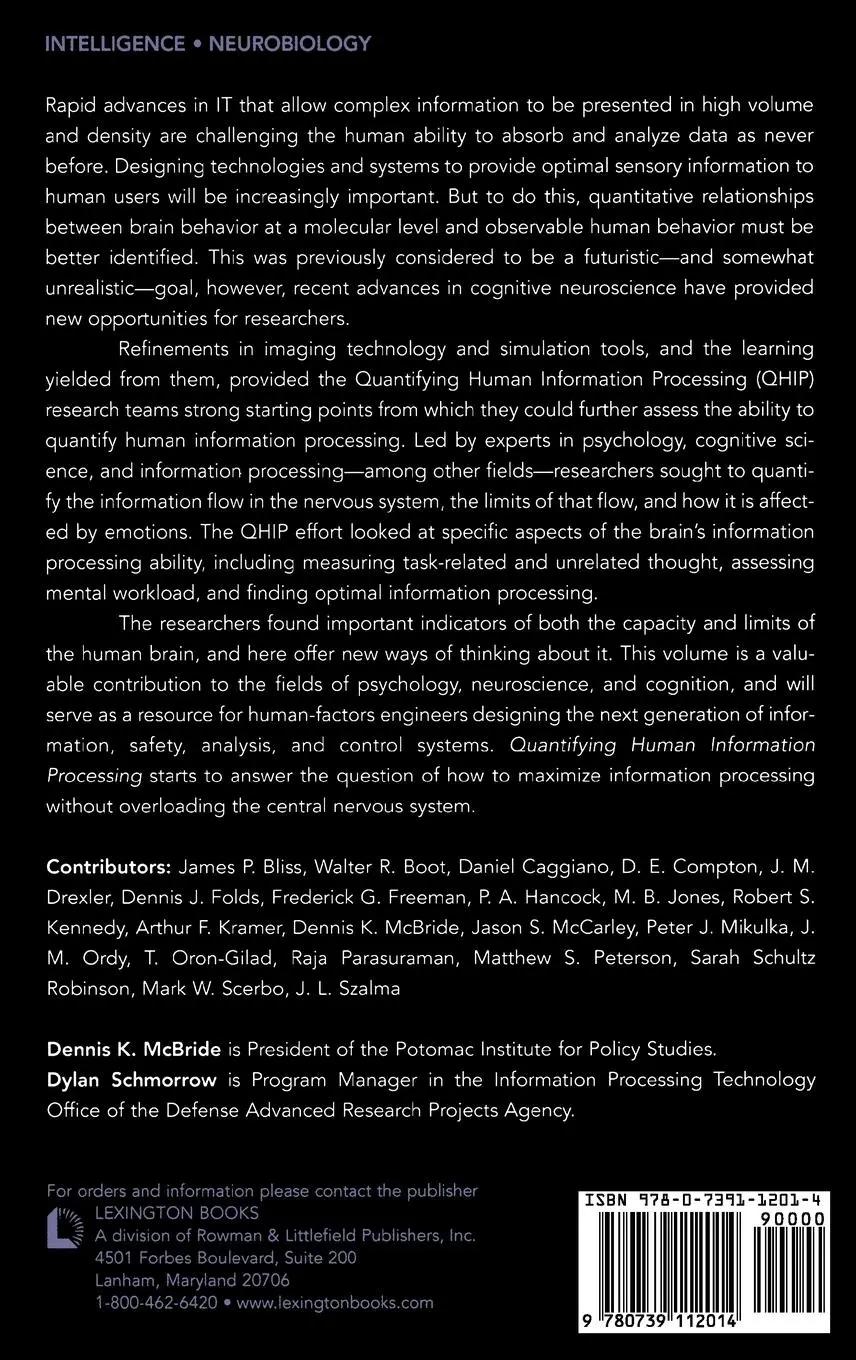
Rapid advances in IT that allow complex information to be presented in high volume and density are challenging human ability to absorb and analyze data as never before. Designing technologies and systems to provide optimal sensory information to human users will be increasingly important. But to do this, quantitative relationships between brain behavior at a molecular level and observable human behavior must be better identified. This was previously considered to be a futuristic, and somewhat unrealistic, goal, however, recent advances in cognitive neuroscience have provided new opportunities for researchers.
Refinements in imaging technology and simulation tools, and the learning yielded from them, provided the Quantifying Human Information Processing (QHIP) research teams strong starting points from which to further assess the ability to quantify human information processing. Led by experts in psychology, cognitive science, and information processing, among other fields, researchers sought to quantify the information flow in the nervous system, the limits of that flow, and how it is affected by emotions. The QHIP effort looked at specific aspects of the brains information processing ability including measuring task-related and unrelated thought, assessing mental workload, and finding optimal information processing.
The researchers found important indicators of both the capacity and limits of the human brain, and offer new ways to think about the brain. This work is a valuable contribution to the fields of psychology, neuroscience, and cognition, and will serve as a resource for human factors engineers designing the next generation of information, safety, analysis, and control systems because it starts to answer how to maximize information processing without overloading the central nervous system.
À propos de l?auteur: Dennis K. McBride is president of the Potomac Institute for Policy Studies. Dylan Schmorrow is program manager in the Information Processing Technology Office of the Defense Advanced Research Projects Agency.
Les informations fournies dans la section « A propos du livre » peuvent faire référence à une autre édition de ce titre.
Détails bibliographiques
Titre : Quantifying Human Information Processing
Éditeur : Jason Aronson, Inc.
Date d'édition : 2005
Reliure : Buch
Etat : Neu
Meilleurs résultats de recherche sur AbeBooks

Image fournie par le vendeur
Quantifying Human Information Processing (Potomac Institute for Policy Studies)
Edité par
Jason Aronson, Inc., 2005
ISBN 10 : 0739112015
ISBN 13 : 9780739112014
Ancien ou d'occasion
Couverture rigide
Edition originale
Vendeur : Tefka, Albuquerque, NM, Etats-Unis
Évaluation du vendeur 5 sur 5 étoiles
Hardcover. Etat : Fine. No Jacket. 1st Edition. Fine and unread hardcover in like new condition with minimal shelf wear to boards, tight and square binding, crisp, white pages, no marks. N° de réf. du vendeur 11424MCB
Acheter D'occasion
EUR 43,27
Expédition à EUR 5,90
Expédition nationale : Etats-Unis
Expédition nationale : Etats-Unis
Quantité disponible : 1 disponible(s)
Image fournie par le vendeur
Quantifying Human Information Processing (Potomac Institute for Policy Studies)
Edité par
Jason Aronson, Inc., 2005
ISBN 10 : 0739112015
ISBN 13 : 9780739112014
Ancien ou d'occasion
Couverture rigide
Vendeur : Greenworld Books, Arlington, TX, Etats-Unis
Évaluation du vendeur 5 sur 5 étoiles
Etat : good. Fast Free Shipping â" Good condition. It may show normal signs of use, such as light writing, highlighting, or library markings, but all pages are intact and the book is fully readable. A solid, complete copy that's ready to enjoy. N° de réf. du vendeur GWV.0739112015.G
Acheter D'occasion
EUR 56,57
Livraison gratuite
Expédition nationale : Etats-Unis
Expédition nationale : Etats-Unis
Quantité disponible : 1 disponible(s)
Image d'archives
Quantifying Human Information Processing (Potomac Institute for Policy Studies)
Edité par
Jason Aronson, Inc., 2005
ISBN 10 : 0739112015
ISBN 13 : 9780739112014
Ancien ou d'occasion
Couverture rigide
Vendeur : Wonder Book, Frederick, MD, Etats-Unis
Évaluation du vendeur 5 sur 5 étoiles
Etat : Very Good. INSCRIBED! Lanham: Lexington Books, 2005. 8vo hardcover. xii+270pp. Illustrations. Inscribed by one of the editors on front endpage. Near Fine book. (Human Information Processing, Cognition, Memory) Inquire if you need further information. N° de réf. du vendeur MC00C-00350
Acheter D'occasion
EUR 83,01
Livraison gratuite
Expédition nationale : Etats-Unis
Expédition nationale : Etats-Unis
Quantité disponible : 1 disponible(s)
Image d'archives
Quantifying Human Information Processing (Potomac Institute for Policy Studies)
Edité par
Jason Aronson, Inc., 2005
ISBN 10 : 0739112015
ISBN 13 : 9780739112014
Neuf
Couverture rigide
Vendeur : Ria Christie Collections, Uxbridge, Royaume-Uni
Évaluation du vendeur 5 sur 5 étoiles
Etat : New. In. N° de réf. du vendeur ria9780739112014_new
Acheter neuf
EUR 117,48
Expédition à EUR 13,72
Expédition depuis Royaume-Uni vers Etats-Unis
Expédition depuis Royaume-Uni vers Etats-Unis
Quantité disponible : Plus de 20 disponibles
Image d'archives
Quantifying Human Information Processing
Edité par
Bloomsbury Publishing (UK), 2005
ISBN 10 : 0739112015
ISBN 13 : 9780739112014
Neuf
Couverture rigide
Vendeur : PBShop.store UK, Fairford, GLOS, Royaume-Uni
Évaluation du vendeur 4 sur 5 étoiles

HRD. Etat : New. New Book. Delivered from our UK warehouse in 4 to 14 business days. THIS BOOK IS PRINTED ON DEMAND. Established seller since 2000. N° de réf. du vendeur L1-9780739112014
Acheter neuf
EUR 121,61
Expédition à EUR 5,75
Expédition depuis Royaume-Uni vers Etats-Unis
Expédition depuis Royaume-Uni vers Etats-Unis
Quantité disponible : Plus de 20 disponibles
Image d'archives
Quantifying Human Information Processing (Potomac Institute for Policy Studies)
Edité par
Jason Aronson, Inc., 2005
ISBN 10 : 0739112015
ISBN 13 : 9780739112014
Neuf
Couverture rigide
Vendeur : California Books, Miami, FL, Etats-Unis
Évaluation du vendeur 5 sur 5 étoiles
Etat : New. N° de réf. du vendeur I-9780739112014
Acheter neuf
EUR 125
Livraison gratuite
Expédition nationale : Etats-Unis
Expédition nationale : Etats-Unis
Quantité disponible : Plus de 20 disponibles
Image d'archives
Quantifying Human Information Processing
Edité par
Bloomsbury Publishing (UK), 2005
ISBN 10 : 0739112015
ISBN 13 : 9780739112014
Neuf
Couverture rigide
Vendeur : PBShop.store US, Wood Dale, IL, Etats-Unis
Évaluation du vendeur 5 sur 5 étoiles
HRD. Etat : New. New Book. Shipped from UK. THIS BOOK IS PRINTED ON DEMAND. Established seller since 2000. N° de réf. du vendeur L1-9780739112014
Acheter neuf
EUR 127,55
Livraison gratuite
Expédition nationale : Etats-Unis
Expédition nationale : Etats-Unis
Quantité disponible : Plus de 20 disponibles
Image d'archives
Quantifying Human Information Processing
impression à la demandeVendeur : THE SAINT BOOKSTORE, Southport, Royaume-Uni
Évaluation du vendeur 5 sur 5 étoiles
Hardback. Etat : New. This item is printed on demand. New copy - Usually dispatched within 5-9 working days. N° de réf. du vendeur C9780739112014
Acheter neuf
EUR 142,39
Expédition à EUR 19,41
Expédition depuis Royaume-Uni vers Etats-Unis
Expédition depuis Royaume-Uni vers Etats-Unis
Quantité disponible : Plus de 20 disponibles
Image fournie par le vendeur
Quantifying Human Information Processing
Edité par
Bloomsbury Publishing Plc, US, 2005
ISBN 10 : 0739112015
ISBN 13 : 9780739112014
Neuf
Couverture rigide
Vendeur : Rarewaves.com UK, London, Royaume-Uni
Évaluation du vendeur 5 sur 5 étoiles
Hardback. Etat : New. Rapid advances in IT that allow complex information to be presented in high volume and density are challenging human ability to absorb and analyze data as never before. Designing technologies and systems to provide optimal sensory information to human users will be increasingly important. But to do this, quantitative relationships between brain behavior at a molecular level and observable human behavior must be better identified. This was previously considered to be a futuristic, and somewhat unrealistic, goal, however, recent advances in cognitive neuroscience have provided new opportunities for researchers. Refinements in imaging technology and simulation tools, and the learning yielded from them, provided the Quantifying Human Information Processing (QHIP) research teams strong starting points from which to further assess the ability to quantify human information processing. Led by experts in psychology, cognitive science, and information processing, among other fields, researchers sought to quantify the information flow in the nervous system, the limits of that flow, and how it is affected by emotions. The QHIP effort looked at specific aspects of the brain's information processing ability including measuring task-related and unrelated thought, assessing mental workload, and finding optimal information processing. The researchers found important indicators of both the capacity and limits of the human brain, and offer new ways to think about the brain. This work is a valuable contribution to the fields of psychology, neuroscience, and cognition, and will serve as a resource for human factors engineers designing the next generation of information, safety, analysis, and control systems because it starts to answer how to maximize information processing without overloading the central nervous system. N° de réf. du vendeur LU-9780739112014
Acheter neuf
EUR 143,87
Expédition à EUR 74,42
Expédition depuis Royaume-Uni vers Etats-Unis
Expédition depuis Royaume-Uni vers Etats-Unis
Quantité disponible : Plus de 20 disponibles
Image fournie par le vendeur
Quantifying Human Information Processing
Edité par
Bloomsbury Publishing Plc, US, 2005
ISBN 10 : 0739112015
ISBN 13 : 9780739112014
Neuf
Couverture rigide
Vendeur : Rarewaves.com USA, London, LONDO, Royaume-Uni
Évaluation du vendeur 5 sur 5 étoiles
Hardback. Etat : New. Rapid advances in IT that allow complex information to be presented in high volume and density are challenging human ability to absorb and analyze data as never before. Designing technologies and systems to provide optimal sensory information to human users will be increasingly important. But to do this, quantitative relationships between brain behavior at a molecular level and observable human behavior must be better identified. This was previously considered to be a futuristic, and somewhat unrealistic, goal, however, recent advances in cognitive neuroscience have provided new opportunities for researchers. Refinements in imaging technology and simulation tools, and the learning yielded from them, provided the Quantifying Human Information Processing (QHIP) research teams strong starting points from which to further assess the ability to quantify human information processing. Led by experts in psychology, cognitive science, and information processing, among other fields, researchers sought to quantify the information flow in the nervous system, the limits of that flow, and how it is affected by emotions. The QHIP effort looked at specific aspects of the brain's information processing ability including measuring task-related and unrelated thought, assessing mental workload, and finding optimal information processing. The researchers found important indicators of both the capacity and limits of the human brain, and offer new ways to think about the brain. This work is a valuable contribution to the fields of psychology, neuroscience, and cognition, and will serve as a resource for human factors engineers designing the next generation of information, safety, analysis, and control systems because it starts to answer how to maximize information processing without overloading the central nervous system. N° de réf. du vendeur LU-9780739112014
Acheter neuf
EUR 152,55
Livraison gratuite
Expédition depuis Royaume-Uni vers Etats-Unis
Expédition depuis Royaume-Uni vers Etats-Unis
Quantité disponible : Plus de 20 disponibles