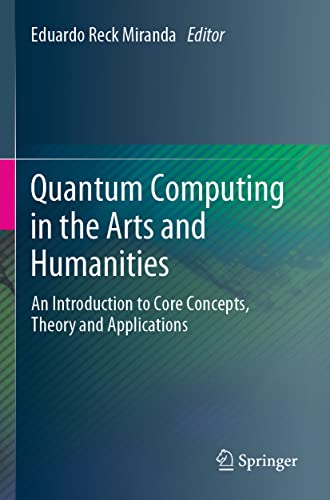
Quantum Computing in the Arts and Humanities (Paperback)
Eduardo Reck Miranda
ISBN 10: 3030955400 ISBN 13: 9783030955403
Edité par Springer Nature Switzerland AG, Cham, 2023
Neuf(s)
Paperback
Vendeur
AussieBookSeller, Truganina, VIC, Australie
Évaluation du vendeur 5 sur 5 étoiles

Vendeur AbeBooks depuis 22 juin 2007
Cet article spécifique n'est plus disponible.
A propos de cet article
Description :
Paperback. Computers are essential for the functioning of our society. Despite the incredible power of existing computers, computing technology is progressing beyond todays conventional models. Quantum Computing (QC) is surfacing as a promising disruptive technology. QC is built on the principles of quantum mechanics. QC can run algorithms that are not trivial to run on digital computers. QC systems are being developed for the discovery of new materials and drugs and improved methods for encoding information for secure communication over the Internet. Unprecedented new uses for this technology are bound to emerge from ongoing research.The development of conventional digital computing technology for the arts and humanities has been progressing in tandem with the evolution of computers since the 1950s. Today, computers are absolutely essential for the arts and humanities. Therefore, future developments in QC are most likely to impact on the way in which artists will create andperform, and how research in the humanities will be conducted.This book presents a comprehensive collection of chapters by pioneers of emerging interdisciplinary research at the crossroads of quantum computing, and the arts and humanities, from philosophy and social sciences to visual arts and music.Prof. Eduardo Reck Miranda is a composer and a professor in Computer Music at Plymouth University, UK, where he is a director of the Interdisciplinary Centre for Computer Music Research (ICCMR). His previous publications include the Springer titles Handbook of Artificial Intelligence for Music, Guide to Unconventional Computing for Music, Guide to Brain-Computer Music Interfacing and Guide to Computing for Expressive Music Performance. Unprecedented new uses for this technology are bound to emerge from ongoing research.The development of conventional digital computing technology for the arts and humanities has been progressing in tandem with the evolution of computers since the 1950s. Shipping may be from our Sydney, NSW warehouse or from our UK or US warehouse, depending on stock availability. N° de réf. du vendeur 9783030955403
Synopsis :
Computers are essential for the functioning of our society. Despite the incredible power of existing computers, computing technology is progressing beyond today’s conventional models. Quantum Computing (QC) is surfacing as a promising disruptive technology. QC is built on the principles of quantum mechanics. QC can run algorithms that are not trivial to run on digital computers. QC systems are being developed for the discovery of new materials and drugs and improved methods for encoding information for secure communication over the Internet. Unprecedented new uses for this technology are bound to emerge from ongoing research.
The development of conventional digital computing technology for the arts and humanities has been progressing in tandem with the evolution of computers since the 1950s. Today, computers are absolutely essential for the arts and humanities. Therefore, future developments in QC are most likely to impact on the way in which artists will create andperform, and how research in the humanities will be conducted.
This book presents a comprehensive collection of chapters by pioneers of emerging interdisciplinary research at the crossroads of quantum computing, and the arts and humanities, from philosophy and social sciences to visual arts and music.
Prof. Eduardo Reck Miranda is a composer and a professor in Computer Music at Plymouth University, UK, where he is a director of the Interdisciplinary Centre for Computer Music Research (ICCMR). His previous publications include the Springer titles Handbook of Artificial Intelligence for Music, Guide to Unconventional Computing for Music, Guide to Brain-Computer Music Interfacing and Guide to Computing for Expressive Music Performance.
À propos de l?auteur: Prof. Eduardo Reck Miranda is a composer and professor in Computer Music at Plymouth University, UK, where he is a director of the Interdisciplinary Centre for Computer Music Research (ICCMR). His previous publications include the Springer titles Handbook of Artificial Intelligence for Music, Guide to Unconventional Computing for Music, Guide to Brain-Computer Music Interfacing and Guide to Computing for Expressive Music Performance.
Les informations fournies dans la section « A propos du livre » peuvent faire référence à une autre édition de ce titre.
Détails bibliographiques
Titre : Quantum Computing in the Arts and Humanities...
Éditeur : Springer Nature Switzerland AG, Cham
Date d'édition : 2023
Reliure : Paperback
Etat : new
Meilleurs résultats de recherche sur AbeBooks

Image d'archives
Quantum Computing in the Arts and Humanities : An Introduction to Core Concepts, Theory and Applications
Edité par
Springer, 2023
ISBN 10 : 3030955400
ISBN 13 : 9783030955403
Ancien ou d'occasion
Couverture souple
Vendeur : Buchpark, Trebbin, Allemagne
Évaluation du vendeur 5 sur 5 étoiles
Etat : Hervorragend. Zustand: Hervorragend | Seiten: 380 | Sprache: Englisch | Produktart: Bücher | Computers are essential for the functioning of our society. Despite the incredible power of existing computers, computing technology is progressing beyond today¿s conventional models. Quantum Computing (QC) is surfacing as a promising disruptive technology. QC is built on the principles of quantum mechanics. QC can run algorithms that are not trivial to run on digital computers. QC systems are being developed for the discovery of new materials and drugs and improved methods for encoding information for secure communication over the Internet. Unprecedented new uses for this technology are bound to emerge from ongoing research.The development of conventional digital computing technology for the arts and humanities has been progressing in tandem with the evolution of computers since the 1950s. Today, computers are absolutely essential for the arts and humanities. Therefore, future developments in QC are most likely to impact on the way in which artists will create andperform, and how research in the humanities will be conducted.This book presents a comprehensive collection of chapters by pioneers of emerging interdisciplinary research at the crossroads of quantum computing, and the arts and humanities, from philosophy and social sciences to visual arts and music.Prof. Eduardo Reck Miranda is a composer and a professor in Computer Music at Plymouth University, UK, where he is a director of the Interdisciplinary Centre for Computer Music Research (ICCMR). His previous publications include the Springer titles Handbook of Artificial Intelligence for Music, Guide to Unconventional Computing for Music, Guide to Brain-Computer Music Interfacing and Guide to Computing for Expressive Music Performance. N° de réf. du vendeur 41693933/1
Acheter D'occasion
EUR 93,38
Expédition à EUR 105
Expédition depuis Allemagne vers Etats-Unis
Expédition depuis Allemagne vers Etats-Unis
Quantité disponible : 1 disponible(s)
Image fournie par le vendeur
Quantum Computing in the Arts and Humanities
Edité par
Springer International Publishing, 2023
ISBN 10 : 3030955400
ISBN 13 : 9783030955403
Neuf
Kartoniert / Broschiert
Vendeur : moluna, Greven, Allemagne
Évaluation du vendeur 4 sur 5 étoiles

Kartoniert / Broschiert. Etat : New. Dieser Artikel ist ein Print on Demand Artikel und wird nach Ihrer Bestellung fuer Sie gedruckt. Presents the first work dedicated to the topic of quantum computing in the arts and humanitiesIs accessible to audiences without a strong background in quantum physics and mathematicsProvides insights from scholars in the arts and humanitie. N° de réf. du vendeur 851835202
Acheter neuf
EUR 127,40
Expédition à EUR 48,99
Expédition depuis Allemagne vers Etats-Unis
Expédition depuis Allemagne vers Etats-Unis
Quantité disponible : Plus de 20 disponibles
Quantum Computing in the Arts and Humanities | An Introduction to Core Concepts, Theory and Applications
Edité par
Springer Nature Switzerland, 2023
ISBN 10 : 3030955400
ISBN 13 : 9783030955403
Neuf
Taschenbuch
Vendeur : preigu, Osnabrück, Allemagne
Évaluation du vendeur 5 sur 5 étoiles
Taschenbuch. Etat : Neu. Quantum Computing in the Arts and Humanities | An Introduction to Core Concepts, Theory and Applications | Eduardo Reck Miranda | Taschenbuch | ix | Englisch | 2023 | Springer Nature Switzerland | EAN 9783030955403 | Verantwortliche Person für die EU: Springer Verlag GmbH, Tiergartenstr. 17, 69121 Heidelberg, juergen[dot]hartmann[at]springer[dot]com | Anbieter: preigu Print on Demand. N° de réf. du vendeur 126815240
Acheter neuf
EUR 132,10
Expédition à EUR 70
Expédition depuis Allemagne vers Etats-Unis
Expédition depuis Allemagne vers Etats-Unis
Quantité disponible : 5 disponible(s)
Image d'archives
Quantum Computing in the Arts and Humanities: An Introduction to Core Concepts, Theory and Applications
Vendeur : Ria Christie Collections, Uxbridge, Royaume-Uni
Évaluation du vendeur 5 sur 5 étoiles
Etat : New. In. N° de réf. du vendeur ria9783030955403_new
Acheter neuf
EUR 135,91
Expédition à EUR 13,83
Expédition depuis Royaume-Uni vers Etats-Unis
Expédition depuis Royaume-Uni vers Etats-Unis
Quantité disponible : Plus de 20 disponibles
Image fournie par le vendeur
Quantum Computing in the Arts and Humanities
ISBN 10 : 3030955400
ISBN 13 : 9783030955403
Neuf
Taschenbuch
Vendeur : buchversandmimpf2000, Emtmannsberg, BAYE, Allemagne
Évaluation du vendeur 5 sur 5 étoiles
Taschenbuch. Etat : Neu. This item is printed on demand - Print on Demand Titel. Neuware -Computers are essential for the functioning of our society. Despite the incredible power of existing computers, computing technology is progressing beyond today¿s conventional models. Quantum Computing (QC) is surfacing as a promising disruptive technology. QC is built on the principles of quantum mechanics. QC can run algorithms that are not trivial to run on digital computers. QC systems are being developed for the discovery of new materials and drugs and improved methods for encoding information for secure communication over the Internet. Unprecedented new uses for this technology are bound to emerge from ongoing research.The development of conventional digital computing technology for the arts and humanities has been progressing in tandem with the evolution of computers since the 1950s. Today, computers are absolutely essential for the arts and humanities. Therefore, future developments in QC are most likely to impact on the way in which artists will create andperform, and how research in the humanities will be conducted.This book presents a comprehensive collection of chapters by pioneers of emerging interdisciplinary research at the crossroads of quantum computing, and the arts and humanities, from philosophy and social sciences to visual arts and music.Prof. Eduardo Reck Miranda is a composer and a professor in Computer Music at Plymouth University, UK, where he is a director of the Interdisciplinary Centre for Computer Music Research (ICCMR). His previous publications include the Springer titles Handbook of Artificial Intelligence for Music, Guide to Unconventional Computing for Music, Guide to Brain-Computer Music Interfacing and Guide to Computing for Expressive Music Performance.Springer Verlag GmbH, Tiergartenstr. 17, 69121 Heidelberg 380 pp. Englisch. N° de réf. du vendeur 9783030955403
Acheter neuf
EUR 149,79
Expédition à EUR 60
Expédition depuis Allemagne vers Etats-Unis
Expédition depuis Allemagne vers Etats-Unis
Quantité disponible : 1 disponible(s)
Image fournie par le vendeur
Quantum Computing in the Arts and Humanities : An Introduction to Core Concepts, Theory and Applications
Edité par
Springer International Publishing, 2023
ISBN 10 : 3030955400
ISBN 13 : 9783030955403
Neuf
Taschenbuch
Vendeur : AHA-BUCH GmbH, Einbeck, Allemagne
Évaluation du vendeur 5 sur 5 étoiles
Taschenbuch. Etat : Neu. Druck auf Anfrage Neuware - Printed after ordering - Computers are essential for the functioning of our society. Despite the incredible power of existing computers, computing technology is progressing beyond today's conventional models. Quantum Computing (QC) is surfacing as a promising disruptive technology. QC is built on the principles of quantum mechanics. QC can run algorithms that are not trivial to run on digital computers. QC systems are being developed for the discovery of new materials and drugs and improved methods for encoding information for secure communication over the Internet. Unprecedented new uses for this technology are bound to emerge from ongoing research.The development of conventional digital computing technology for the arts and humanities has been progressing in tandem with the evolution of computers since the 1950s. Today, computers are absolutely essential for the arts and humanities. Therefore, future developments in QC are most likely to impact on the way in which artists will create andperform, and how research in the humanities will be conducted.This book presents a comprehensive collection of chapters by pioneers of emerging interdisciplinary research at the crossroads of quantum computing, and the arts and humanities, from philosophy and social sciences to visual arts and music.Prof. Eduardo Reck Mirandais a composer and a professor in Computer Music at Plymouth University, UK, where he is a director of the Interdisciplinary Centre for Computer Music Research (ICCMR). His previous publications include the Springer titlesHandbook of Artificial Intelligence for Music,Guide to Unconventional Computing for Music,Guide to Brain-Computer Music Interfacingand Guide to Computing for Expressive Music Performance. N° de réf. du vendeur 9783030955403
Acheter neuf
EUR 149,79
Expédition à EUR 62,88
Expédition depuis Allemagne vers Etats-Unis
Expédition depuis Allemagne vers Etats-Unis
Quantité disponible : 1 disponible(s)
Image fournie par le vendeur
Quantum Computing in the Arts and Humanities
Edité par
Springer International Publishing Mai 2023, 2023
ISBN 10 : 3030955400
ISBN 13 : 9783030955403
Neuf
Taschenbuch
Vendeur : BuchWeltWeit Ludwig Meier e.K., Bergisch Gladbach, Allemagne
Évaluation du vendeur 5 sur 5 étoiles
Taschenbuch. Etat : Neu. This item is printed on demand - it takes 3-4 days longer - Neuware -Computers are essential for the functioning of our society. Despite the incredible power of existing computers, computing technology is progressing beyond today's conventional models. Quantum Computing (QC) is surfacing as a promising disruptive technology. QC is built on the principles of quantum mechanics. QC can run algorithms that are not trivial to run on digital computers. QC systems are being developed for the discovery of new materials and drugs and improved methods for encoding information for secure communication over the Internet. Unprecedented new uses for this technology are bound to emerge from ongoing research.The development of conventional digital computing technology for the arts and humanities has been progressing in tandem with the evolution of computers since the 1950s. Today, computers are absolutely essential for the arts and humanities. Therefore, future developments in QC are most likely to impact on the way in which artists will create andperform, and how research in the humanities will be conducted.This book presents a comprehensive collection of chapters by pioneers of emerging interdisciplinary research at the crossroads of quantum computing, and the arts and humanities, from philosophy and social sciences to visual arts and music.Prof. Eduardo Reck Mirandais a composer and a professor in Computer Music at Plymouth University, UK, where he is a director of the Interdisciplinary Centre for Computer Music Research (ICCMR). His previous publications include the Springer titlesHandbook of Artificial Intelligence for Music,Guide to Unconventional Computing for Music,Guide to Brain-Computer Music Interfacingand Guide to Computing for Expressive Music Performance. 380 pp. Englisch. N° de réf. du vendeur 9783030955403
Acheter neuf
EUR 149,79
Expédition à EUR 23
Expédition depuis Allemagne vers Etats-Unis
Expédition depuis Allemagne vers Etats-Unis
Quantité disponible : 2 disponible(s)
Image d'archives
Quantum Computing in the Arts and Humanities: An Introduction to Core Concepts, Theory and Applications
Edité par
Springer-Nature New York Inc, 2023
ISBN 10 : 3030955400
ISBN 13 : 9783030955403
Neuf
Paperback
Vendeur : Revaluation Books, Exeter, Royaume-Uni
Évaluation du vendeur 5 sur 5 étoiles
Paperback. Etat : Brand New. 376 pages. 9.25x6.10x0.78 inches. In Stock. N° de réf. du vendeur x-3030955400
Acheter neuf
EUR 215,71
Expédition à EUR 14,43
Expédition depuis Royaume-Uni vers Etats-Unis
Expédition depuis Royaume-Uni vers Etats-Unis
Quantité disponible : 2 disponible(s)