


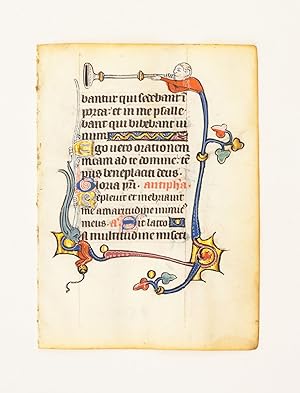
FROM A SMALL PSALTER-HOURS IN LATIN, WITH IMMENSELY CHARMING MARGINALIA
ILLUMINATED VELLUM MANUSCRIPT LEAVES, OFFERED INDIVIDUALLY
Edité par first half of 14th century, France
Ancien(s) ou d'occasion
Vendeur
Phillip J. Pirages Rare Books (ABAA), McMinnville, OR, Etats-Unis
Évaluation du vendeur 3 sur 5 étoiles

Honoris Librarius
Membre AbeBooks depuis 1996
Nous sommes désolés, cet exemplaire spécifique n'est plus disponible. Voici nos correspondances les plus proches pour FROM A SMALL PSALTER-HOURS IN LATIN, WITH IMMENSELY CHARMING MARGINALIA de ILLUMINATED VELLUM MANUSCRIPT LEAVES, OFFERED INDIVIDUALLY.
A propos de cet article
Description :
110 x 82 mm. (4 3/8 x 3 1/4"). Single column, 12 lines in a gothic book hand. One of these leaves beautifully framed. Rubrics in red, line enders in pink and blue with gold accents, each leaf with one or more one-line initials in blue with red penwork or gold with blue penwork, some leaves with one two-line initial painted pink, blue, and/or orange and INHABITED BY HUMAN FACE, all on a gold ground, one side of each leaf with A FULL BORDER composed of pink and blue tendrils accompanied by spikey gold decoration and gold accents, often terminating in ivy leaves, and incorporating EXTRAORDINARILY CHARMING EXAMPLES OF MARGINALIA, INCLUDING BEASTS AND HUMAN-BEAST HYBRIDS. ?One framed leaf with a one to two inch closed tear just touching one of the marginalia (but well masked in its frame), one leaf with a little slight staining in one margin, very light rubbing or smudging in a couple of places, but still excellent specimens, THE MARGINALIA BEAUTIFULLY PRESERVED. Though diminutive in size, these leaves contain enormously appealing marginal decoration in the form of humans, animals, and hybrid creatures inventively incorporated into the lively borders in manners that range from adorable to bizarre. Especially popular in Flanders, Northern France, and England during the 13th and 14th centuries, marginalia such as these comprise some of the most memorable and entertaining images to be found in any Medieval manuscripts. Despite being found largely in religious books such as Psalters and Books of Hours, the images are often strange, humorous, or even outrageous, and they provide us with consistent delight. Being by definition outside of the central text or miniature, the margins seem to have been a place where illuminators felt more at ease to experiment, resulting in highly imaginative and unique artistic expressions. The present specimens come from a fragmentary manuscript, with many leaves either missing or rendered defective where portions of the vellum were cut away. Fortunately, this group of leaves is intact and retains much marvelous imagery, including small animals, hybrid creatures with human heads and the bodies of beasts, a woman with a particularly stunning headdress composed of gold and painted wings, her mouth open as if to sing, a fantastic creature with long ears and a tail, and a trumpeter emerging from a tendril and blowing into a particularly long instrument measuring the width of the text. Marginalia of this caliber and in the kind of condition seen here is becoming increasingly rare on the market, making these examples particularly desirable. For additional leaves from this same manuscript at different price points, please check our website. N° de réf. du vendeur ST16985R
Détails bibliographiques
Titre : FROM A SMALL PSALTER-HOURS IN LATIN, WITH ...
Éditeur : first half of 14th century, France
Meilleurs résultats de recherche sur AbeBooks

Image fournie par le vendeur
FROM A SMALL PSALTER-HOURS IN LATIN, WITH IMMENSELY CHARMING MARGINALIA
Edité par
first half of 14th century, France
Ancien ou d'occasion
Vendeur : Phillip J. Pirages Rare Books (ABAA), McMinnville, OR, Etats-Unis
Évaluation du vendeur 3 sur 5 étoiles
110 x 82 mm. (4 3/8 x 3 1/4"). Single column, 12 lines in a gothic book hand. Rubrics in red, line enders in pink and blue with gold accents, each leaf with one or more one-line initials in blue with red penwork or gold with blue penwork, some leaves with one two-line initial painted blue, filled with either decorative shapes or INHABITED BY A HUMAN HEAD, all on a gold ground, one side of each leaf WITH A FULL BORDER composed of pink and blue tendrils accompanied by spikey gold decoration and gold accents, often terminating in ivy leaves, and incorporating EXTRAORDINARILY CHARMING EXAMPLES OF MARGINALIA, INCLUDING ANIMALS, HUMANS, AND HYBRIDS. âVellum slightly soiled and with a few minor imperfections, one leaf with a little offsetting in one corner, each leaf with a small area excised by a former owner (affecting marginalia and a few words of text), but each leaf with at least two fully intact examples of marginalia, and on the whole the leaves quite clean, the colors very bright, and the gold sparkling. Though diminutive in size, these leaves contain enormously appealing marginal decoration in the form of humans, animals, and hybrid creatures inventively incorporated into the lively borders in manners that range from adorable to bizarre. Especially popular in Flanders, Northern France, and England during the 13th and 14th centuries, marginalia such as these comprise some of the most memorable and entertaining images to be found in any Medieval manuscripts. Despite being found largely in religious books such as Psalters and Books of Hours, the images are often strange, humorous, or even outrageous, and they provide us with consistent delight. Being by definition outside of the central text or miniature, the margins seem to have been a place where illuminators felt more at ease to experiment, resulting in highly imaginative and unique artistic expressions. The present specimens come from a fragmentary manuscript, with many leaves either missing or rendered defective where portions of the vellum were cut away, as here. Fortunately, these leaves each retain at least two excellent examples of marginalia, including a very alert hare, hybrids with the heads of humans and the bodies of two-legged beasts, humans emerging from the border tendrils to help hold up initials, a human head with a wizened beard and a stylized hat incorporated into the border, and a trumpeter blowing into a long instrument accented with gold. Though fragmentary in appearance, these leaves present an excellent opportunity to acquire fine examples of marginalia at an affordable price. For additional leaves from this same manuscript at different price points, please check our website. N° de réf. du vendeur ST16985G
Acheter D'occasion
EUR 936,58
Expédition à EUR 8,74
Expédition nationale : Etats-Unis
Expédition nationale : Etats-Unis
Quantité disponible : 1 disponible(s)
FROM A SMALL PSALTER-HOURS IN LATIN, WITH IMMENSELY CHARMING MARGINALIA
Edité par
first half of 14th century, France
Ancien ou d'occasion
Vendeur : Phillip J. Pirages Rare Books (ABAA), McMinnville, OR, Etats-Unis
Évaluation du vendeur 3 sur 5 étoiles
110 x 82 mm. (4 3/8 x 3 1/4"). Single column, 12 lines in a gothic book hand. Line enders in pink and blue with gold accents, each leaf with one or more one-line initials in blue with red penwork or gold with blue penwork, each leaf with one two line initial painted pink or blue, filled with painted floral motifs, and on a gold or blue ground, one side of each leaf with A NEAR-FULL BORDER composed of pink and blue tendrils accompanied by spikey gold decoration and gold accents, often terminating in ivy leaves, and incorporating EXTRAORDINARILY CHARMING EXAMPLES OF MARGINALIA, INCLUDING ANIMALS, HUMANS, AND HYBRIDS. ?Vellum a little soiled and lightly stained and wrinkled in places, some of the gold a bit rubbed, one leaf with some noticeable smudging affecting some of the text and decoration (including the head of one of the hybrids), but the other examples of marginalia quite well preserved and still retaining much of their original charm. Though diminutive in size, these leaves contain enormously appealing marginal decoration in the form of humans, animals, and hybrid creatures inventively incorporated into the lively borders in manners that range from adorable to bizarre. Especially popular in Flanders, Northern France, and England during the 13th and 14th centuries, marginalia such as these comprise some of the most memorable and entertaining images to be found in any Medieval manuscripts. Despite being found largely in religious books such as Psalters and Books of Hours, the images are often strange, humorous, or even outrageous, and they provide us with consistent delight. Being by definition outside of the central text or miniature, the margins seem to have been a place where illuminators felt more at ease to experiment, resulting in highly imaginative and unique artistic expressions. The present specimens come from a fragmentary manuscript, with many leaves either missing or rendered defective where portions of the vellum were cut away. Fortunately, this group of leaves is intact and retains much marvelous imagery, including a particularly annoyed-looking bird, two human-beast hybrids with long necks and bushy tails, and a trumpeter emerging from the border decoration, blowing into a long instrument decorated with gold accents. For additional leaves from this same manuscript at different price points, please check our website. N° de réf. du vendeur ST16985L
Acheter D'occasion
EUR 2 341,44
Expédition à EUR 8,74
Expédition nationale : Etats-Unis
Expédition nationale : Etats-Unis
Quantité disponible : 1 disponible(s)
FROM A SMALL PSALTER-HOURS IN LATIN, WITH IMMENSELY CHARMING MARGINALIA
Edité par
First half of 14th century, France
Ancien ou d'occasion
Vendeur : Phillip J. Pirages Rare Books (ABAA), McMinnville, OR, Etats-Unis
Évaluation du vendeur 3 sur 5 étoiles
110 x 82 mm. (4 3/8 x 3 1/4"). Single column, 12 lines in a gothic book hand. Line enders in pink and blue with gold accents, each leaf with one or more one-line initials in blue with red penwork or gold with blue penwork, each leaf with one two line initial painted pink or blue, filled with painted floral motifs, and on a gold ground, one side of each leaf with A NEAR-FULL BORDER composed of pink and blue tendrils accompanied by spikey gold decoration and gold accents, often terminating in ivy leaves, and incorporating EXTRAORDINARILY CHARMING EXAMPLES OF MARGINALIA, INCLUDING HUMAN-BEAST HYBRIDS. ?Vellum a little soiled and with a few small stains, one leaf with more noticeable smudging affecting some of the text and decoration, another leaf with one of the heads a little rubbed, but all other examples of marginalia very well preserved. Though diminutive in size, these leaves contain enormously appealing marginal decoration in the form of humans, animals, and hybrid creatures inventively incorporated into the lively borders in manners that range from adorable to bizarre. Especially popular in Flanders, Northern France, and England during the 13th and 14th centuries, marginalia such as these comprise some of the most memorable and entertaining images to be found in any Medieval manuscripts. Despite being found largely in religious books such as Psalters and Books of Hours, the images are often strange, humorous, or even outrageous, and they provide us with consistent delight. Being by definition outside of the central text or miniature, the margins seem to have been a place where illuminators felt more at ease to experiment, resulting in highly imaginative and unique artistic expressions. The present specimens come from a fragmentary manuscript, with many leaves either missing or rendered defective where portions of the vellum were cut away. Fortunately, this group of leaves is intact and retains much marvelous imagery, including a beast with an exaggeratedly long body and horns, and long-necked beasts with human heads--one who appears to be blowing smoke into the air, one with a bearded face as its bottom, and another with the body of a stork, sporting a hat with a long, pointy tendril. For additional leaves from this same manuscript at different price points, please check our website. N° de réf. du vendeur ST16985M
Acheter D'occasion
EUR 2 809,73
Expédition à EUR 8,74
Expédition nationale : Etats-Unis
Expédition nationale : Etats-Unis
Quantité disponible : 1 disponible(s)
FROM A SMALL PSALTER-HOURS IN LATIN, WITH IMMENSELY CHARMING MARGINALIA
Edité par
first half of 14th century, France
Ancien ou d'occasion
Vendeur : Phillip J. Pirages Rare Books (ABAA), McMinnville, OR, Etats-Unis
Évaluation du vendeur 3 sur 5 étoiles
110 x 82 mm. (4 3/8 x 3 1/4"). Single column, 12 lines in a gothic book hand. Line enders in pink and blue with gold accents, each leaf with one or more one-line initials in blue with red penwork or gold with blue penwork, each leaf with one two line initial painted pink or blue, filled with painted floral motifs, and TWO INHABITED BY HUMAN FACES, and on a gold ground, one side of each leaf with A FULL BORDER composed of pink and blue tendrils accompanied by spikey gold decoration and gold accents, often terminating in ivy leaves, and incorporating EXTRAORDINARILY CHARMING EXAMPLES OF MARGINALIA, INCLUDING ANIMALS, HUMAN HEADS, AND HUMAN-BEAST HYBRIDS. âVellum a little soiled and with a few small stains (one leaf with more obvious soiling), varying degrees of smudging (two leaves with more noticeable smudging affecting some of the text and decoration), another leaf with two of the human heads slightly rubbed, but all other examples of marginalia very well preserved, and paint quite fresh and the gold sparkling. Though diminutive in size, these leaves contain enormously appealing marginal decoration in the form of humans, animals, and hybrid creatures inventively incorporated into the lively borders in manners that range from adorable to bizarre. Especially popular in Flanders, Northern France, and England during the 13th and 14th centuries, marginalia such as these comprise some of the most memorable and entertaining images to be found in any Medieval manuscripts. Despite being found largely in religious books such as Psalters and Books of Hours, the images are often strange, humorous, or even outrageous, and they provide us with consistent delight. Being by definition outside of the central text or miniature, the margins seem to have been a place where illuminators felt more at ease to experiment, resulting in highly imaginative and unique artistic expressions. The present specimens come from a fragmentary manuscript, with many leaves either missing or rendered defective where portions of the vellum were cut away. Fortunately, this group of leaves is intact and retains much marvelous imagery, including several animals (a dog, a bird, a squirrel, and a large hare), human and bestial heads capping the ends of border tendrils (many with a memorable detail such as a bushy beard, a massive gold horn, or wearing a tall, pointy hat) including the torso of a person holding a long, antler-like club, and colorful human-beast hybrids. A couple of these leaves also have initials inhabited by charming little human faces. For additional leaves from this same manuscript at different price points, please check our website. N° de réf. du vendeur ST16985N
Acheter D'occasion
EUR 3 278,02
Expédition à EUR 8,74
Expédition nationale : Etats-Unis
Expédition nationale : Etats-Unis
Quantité disponible : 3 disponible(s)
Image fournie par le vendeur
FROM A SMALL PSALTER-HOURS IN LATIN, WITH IMMENSELY CHARMING MARGINALIA
Edité par
first half of 14th century, France
Ancien ou d'occasion
Vendeur : Phillip J. Pirages Rare Books (ABAA), McMinnville, OR, Etats-Unis
Évaluation du vendeur 3 sur 5 étoiles
110 x 82 mm. (4 3/8 x 3 1/4"). Single column, 12 lines in a gothic book hand. Line enders in pink and blue with gold accents, each leaf with one or more one-line initials in blue with red penwork or gold with blue penwork, each leaf with one two line initial painted pink or blue--filled with painted floral motifs or a gold cross, and ONE INHABITED BY HUMAN FACE--all on a gold ground, one side of each leaf with A FULL BORDER composed of pink and blue tendrils accompanied by spikey gold decoration and gold accents, often terminating in ivy leaves, and incorporating EXTRAORDINARILY CHARMING EXAMPLES OF MARGINALIA, INCLUDING ANIMALS, HUMAN HEADS, AND HUMAN-BEAST HYBRIDS. âOccasional minor smudging, vellum a little soiled and with a few small stains, (one leaf with noticeable staining affecting some of the text and decoration, but with extremely appealing imagery making up for it), another leaf with some marginal offsetting and the inhabited initial slightly rubbed, but all other examples of marginalia VERY WELL PRESERVED. Though diminutive in size, these leaves contain enormously appealing marginal decoration in the form of humans, animals, and hybrid creatures inventively incorporated into the lively borders in manners that range from adorable to bizarre. Especially popular in Flanders, Northern France, and England during the 13th and 14th centuries, marginalia such as these comprise some of the most memorable and entertaining images to be found in any Medieval manuscripts. Despite being found largely in religious books such as Psalters and Books of Hours, the images are often strange, humorous, or even outrageous, and they provide us with consistent delight. Being by definition outside of the central text or miniature, the margins seem to have been a place where illuminators felt more at ease to experiment, resulting in highly imaginative and unique artistic expressions. The present specimens come from a fragmentary manuscript, with many leaves either missing or rendered defective where portions of the vellum were cut away. Fortunately, this group of leaves is intact and retains much marvelous imagery, including two very alert hares, an owl, and a wonderful stork with a long beak, grabbing the equally long beard emanating from a human-beast hybrid in the upper margin, and the heads of humans (some in the guise of a fool) and storks with long beaks (each holding a gold bezant) incorporated into the border tendrils. One leaf shows more damage than the others here, but contains some very desirable marginalia: a human-beast hybrid, with an orange, speckled body and a long tail, in a stand-off with a snail in the upper margin, and the torso of a trumpeter emerging from one of the border tendrils, blowing into an extremely long, gold instrument held vertically in the fore margin. For additional leaves from this same manuscript at different price points, please check our website. N° de réf. du vendeur ST16985P
Acheter D'occasion
EUR 3 746,31
Expédition à EUR 8,74
Expédition nationale : Etats-Unis
Expédition nationale : Etats-Unis
Quantité disponible : 1 disponible(s)
FROM A SMALL PSALTER-HOURS IN LATIN, WITH IMMENSELY CHARMING MARGINALIA
Edité par
first half of 14th century, France
Ancien ou d'occasion
Vendeur : Phillip J. Pirages Rare Books (ABAA), McMinnville, OR, Etats-Unis
Évaluation du vendeur 3 sur 5 étoiles
110 x 82 mm. (4 3/8 x 3 1/4"). Single column, 12 lines in a gothic book hand. Line enders in pink and blue with gold accents, each leaf with one or more one-line initials in blue with red penwork or gold with blue penwork, each leaf with one two line initial painted pink or blue, ONE INHABITED BY HUMAN FACE, others filled with painted floral motifs, all on a gold ground, one side of each leaf with A FULL BORDER composed of pink and blue tendrils accompanied by spikey gold decoration and gold accents, often terminating in ivy leaves, and incorporating EXTRAORDINARILY CHARMING EXAMPLES OF MARGINALIA, INCLUDING ANIMALS, HUMAN HEADS, AND HUMAN-BEAST HYBRIDS. ?Vellum with a little soiling and a few small stains (slightly more noticeable on one leaf where it is touching the text, though not obscuring meaning), a few instances of rubbing to gold and decoration (including one bird with its detailing rubbed away), other minor imperfections, but none of these flaws egregious, and the most desirable imagery here still very well preserved. Though diminutive in size, these leaves contain enormously appealing marginal decoration in the form of humans, animals, and hybrid creatures inventively incorporated into the lively borders in manners that range from adorable to bizarre. Especially popular in Flanders, Northern France, and England during the 13th and 14th centuries, marginalia such as these comprise some of the most memorable and entertaining images to be found in any Medieval manuscripts. Despite being found largely in religious books such as Psalters and Books of Hours, the images are often strange, humorous, or even outrageous, and they provide us with consistent delight. Being by definition outside of the central text or miniature, the margins seem to have been a place where illuminators felt more at ease to experiment, resulting in highly imaginative and unique artistic expressions. The present specimens come from a fragmentary manuscript, with many leaves either missing or rendered defective where portions of the vellum were cut away. Fortunately, this group of leaves is intact and retains much marvelous imagery, including an owl and two other birds (one apparently holding a worm in its mouth), human heads and torsos capping off the ends of border tendrils (including a trumpeter blowing into a particularly long instrument, and a man reaching both arms straight into the air as if trying to grab the head attached to the tendril above him), and a hybrid with the head of a human in a gold hood and the body of a hare, perched gingerly on an ivy branch. For additional leaves from this same manuscript at different price points, please check our website. N° de réf. du vendeur ST16985Q
Acheter D'occasion
EUR 4 214,60
Expédition à EUR 8,74
Expédition nationale : Etats-Unis
Expédition nationale : Etats-Unis
Quantité disponible : 1 disponible(s)