A propos de cet article
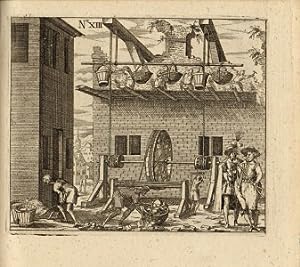
Leipzigk et Altenburg, Grossen ? Liegern ? Meuschken ? Jansonium, 1614-29. Soit 6 parties reliées en 2 volumes in-8 oblong de : I/ (32) ff. y compris le titre frontispice, 159 pp., (1) f. ; (4) ff., 76 pp., (2) ff. ; (4) ff., 91 pp., (2) pp., (1) f.bl. ; (8) ff., 85 pp., (2) pp. ; (6) ff., 102 pp., (1) f. ; (4) ff., 175 pp., (1) f. ; II/ 152 planches numérotées dont 21 dépliantes. Pt. trou de vers dans le titre du premier texte, pte. galerie de vers dans les 10 derniers ff. du volume de texte et dans les 3 dernières planches du volume d'illustrations. Plein vélin ivoire, dos lisses, traces de liens, tranches bleues. Reliure de l'époque. Dimensions du volume de texte : 156 x 185 mm. Dimensions du volume de planches : 146 x 168 mm. --- Très rare seconde édition du premier théâtre de machines allemand. Wolf, A history of Science, Technology. in the 16th and 17th centuries, p.541; Holstein (B.), pp. 154-156. L'auteur, étudiant en architecture, confia à son ami, Henning Grosse le Jeune, libraire à Leipzig, le soin de publier cette seconde édition, l'originale étant parue en 1607. Il s'assura les services de Hieronymus Megiser pour les traductions et ceux de Johann Meuschken, Georg Liegern et Justum Jansonium pour l'impression. Le texte s'articule autour de six parties, chacune annoncée par un bel encadrement de titre baroque, deux d'entre eux étant signés, soit du nom soit des initiales d'Andreas Bretschneider. L'illustration, inspirée de celle de Ramelli, se compose de 152 gravures sur cuivre, représentant des pompes aspirantes et refoulantes, des fontaines, des treuils, des leviers, des ponts mobiles, des grues, des machines hydrauliques, des écluses, . La plupart présentent un aspect plus animé et détaillé que celles des autres théâtres de machines de Ramelli, Zonca, Branca et Boeckler. Bien que la moitié d'entre elles ne soient pas signées, certaines planches portent les mentions HZ f. HG exc. ou AB f. HC exc. Il faut ce /// Leipzigk et Altenburg, Grossen ? Liegern ? Meuschken ? Jansonium, 1614-29. --- A total of 6 parts bound in 2 oblong 8vo volumes of: I/ (32) ll. including the frontispiece title, 159 pp., (1) l.; (4) ll., 76 pp., (2) ll.; (4) ll., 91 pp., (2) pp., (1) bl.l.; (8) ll., 85 pp., (2) pp.; (6) ll., 102 pp., (1) l.; (4) ll., 175 pp., (1) l.; II/ 152 numbered plates including 21 folding ones. Small wormhole in the title of the first text, small wormtrack in the 10 last ll. of the text volume and in the 3 last plates of the illustration volume. Full ivory vellum, flat spines, remains of ties, blue edges. Contemporary binding. Dimensions of the text volume: 156 x 185 mm. Dimensions of the plates volume: 146 x 168 mm. Very rare second edition of the first German theater of machines. Wolf, A history of Science, Technology. in the 16th and 17th centuries, p.541; Holstein (B.), pp. 154-156. The author, a student in architecture, entrusted his friend, Henning Grosse the Younger, librarian in Leipzig, with the publication of this second edition, the first one published in 1607. He got Hieronymus Megiser?s help for the translations and Johann Meuschken, Georg Liegern and Justum Jansonium's help for the impression. The text is articulated around six parts, each being announced by a beautiful Baroque frame, two of them being signed, either with the name or with the initials of Andreas Bretschneider. The illustration, inspired by Ramelli's one, is composed of 152 copper-engraved plates, representing suction and force pumps, fountains, winches, levers, movable bridges, cranes, hydraulic machines, locks ? Most of them seem more animated and more detailed than those in the other theaters of machines by Ramelli, Zonca, Branca and Boeckler. Though half of them aren't signed, some plates bear the mentions HZ f. HG exc. or AB f. HC exc. These initials certainly stand for Henning Grosse, Heinrich Zeising and Andreas Bretschneider. We know that the latter settled in Leipzig i.
N° de réf. du vendeur LCS-16737
Contacter le vendeur
Signaler cet article