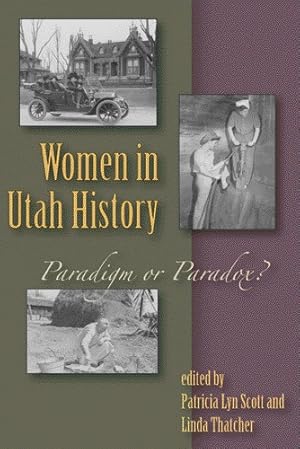
A project of the Utah Women’s History Association and cosponsored by the Utah State Historical Society, Paradigm or Paradox provides the first thorough survey of the complicated history of all Utah women. Some of the finest historians studying Utah examine the spectrum of significant social and cultural topics in the state’s history that particularly have involved or affected women.
Women in Utah History
Paradigm or Paradox?Utah State University Press
Copyright © 2005 Utah State University Press
All right reserved.ISBN: 978-0-87421-625-7Contents
Introduction..................................................................................................................................................ix1. Polygamous and Monogamous Mormon Women: A Comparison Jessie L. Embry and Lois Kelley.....................................................................12. Innovation and Accommodation: The Legal Status of Women in Territorial Utah, 1850-1896 Lisa Madsen Pearson and Carol Cornwall Madsen.....................363. Conflict and Contributions: Women in Churches, 1847-1920 John Sillito....................................................................................824. Ethnic Women, 1900-1940 Helen Z. Papanikolas.............................................................................................................1295. The Professionalization of Farm Women, 1890-1940 Cynthia Sturgis.........................................................................................1546. Gainfully Employed Women, 1896-1950 Miriam B. Murphy.....................................................................................................1837. From Schoolmarm to State Superintendent: The Changing Role of Women in Education, 1847-2004 Mary R. Clark and Patricia Lyn Scott.........................2238. Scholarship, Service, and Sisterhood: Women's Clubs and Associations, 1877-1977 Jill Mulvay Derr.........................................................2499. Women of Letters: A Unique Literary Tradition Gary Topping...............................................................................................29510. Women in the Arts: Evolving Roles and Diverse Expressions Martha Sonntag Bradley-Evans...................................................................32411. Women in Politics: Power in the Public Sphere Kathryn L. MacKay..........................................................................................36012. Women's Life Cycles, 1850-1940 Jessie L. Embry...........................................................................................................394Suggested Readings............................................................................................................................................416Contributors..................................................................................................................................................419Index.........................................................................................................................................................424
Chapter One
Polygamous and Monogamous Mormon Women A Comparison
Jessie L. Embry and Lois Kelley
For many people throughout the world, the words Utah and Mormons automatically bring associations of polygamy even though members of the Church of Jesus Christ of Latter-day Saints have not officially practiced plural marriage for at least a century. I realized this when I knocked on a door as a Mormon missionary in Fredericton, New Brunswick, in 1974. The man who answered the door asked, "Isn't that the Church where you can have more than one wife? Would both of you be available?" Utah historian Thomas G. Alexander frequently reminds me that I should not be surprised by such comments, explaining that for many the interesting aspects of history are sex and violence. For many, the most interesting part of polygamy is: "How did the women respond?"
Views of Mormon plural wives have changed over the years. Nineteenth-century contemporaries like author Harriet Beecher Stowe described Mormon polygamy as "a slavery which debases and degrades womanhood, motherhood, and family," reflecting the nineteenth-century view that "polygamy destroyed the family and women's unique place in it and made women unfit for their moral and social responsibilities."
While Stowe had a negative view of polygamy, recent scholars who have studied elite Mormon polygamous wives declare them the forerunners of modern feminists-especially in finances. According to one study, "Polygamy developed independent women who bore much of the financial responsibility for their families because husbands were often away on missions and even when they were home the wives were often left to manage their homes alone."
Based on the conclusions of nineteenth-century contemporaries and some twentieth-century studies, Mormon plural wives were unique. Yet a study of Mormon polygamous and monogamous wives in Utah during the late nineteenth and early twentieth centuries shows little difference in their lifestyles. As historian Julie Roy Jeffrey explained, "With its peculiar tensions and freedoms, polygamy did, of course, shape the Mormon female life on the frontier.... Yet Mormon women ... shared with other pioneer women common frontier experiences and even ideas about woman's place in the world. To be a Mormon woman on the Utah frontier was therefore, to be both the same as, and different from, pioneer women elsewhere." This chapter examines the experiences of Utah women who lived in polygamous households and those who lived in monogamous families.
Sample
Our study is based on our examination of interviews, autobiographies, and diaries. Sociology professor Kimball Young and two graduate research assistants, James Hulett and Fay Ollerton, conducted the first set of interviews in the late 1930s. Hulett used them to write his dissertation, "The Sociological and Social Psychological Aspects of the Mormon Polygamous Family," and Young used them extensively in his book Isn't One Wife Enough? The Kimball Young Collection is in the L. Tom Perry Special Collections and Manuscripts, Harold B. Lee Library, Brigham Young University. It contains Hulett's and Ollerton's notes from interviews with thirteen husbands, fifty wives, five husbands and wives, and eighty-three children of polygamous families. A second data source is the Charles Redd Center for Western Studies's LDS Polygamy Oral History Project (1976-82), also housed in Perry Special Collections. Included are the transcriptions of interviews with more than 250 men and women who were children in plural marriages contracted before the Second Manifesto of 1904. In 1982 the Redd Center project added interviews with 150 men and women who were children in monogamous families from the same period, thus forming a comparison group.
Other interviews, diaries, and autobiographies are housed in both Archives of the Family and Church History Department, Church of Jesus Christ of Latter-day Saints, Salt Lake City (hereafter LDS Church Archives) and in the L. Tom Perry Special Collections, Harold B. Lee Library, Brigham Young University. Altogether, this essay looks at the experiences of approximately 400 plural wives and 150 monogamous women.
Informants' observations in oral histories are the most severely limited in scope. Most children, especially in the nineteenth century, never asked their parents why they married in polygamy, how they divided money and goods, and how often they had sexual relations. Elsie Chamberlain Carroll, a daughter of Thomas Chamberlain and Eleanor Hoyt Chamberlain, who grew up in Kane County, added another reason: "I guess it is just natural to remember the pleasant things and forget the unpleasant." However, often, their memories are the only sources available, and they provide valuable data that cannot be found elsewhere.
A Historical Overview of Mormon Polygamy
Religious values underlie any discussion of Mormon polygamy. Latter-day Saints believe that the church Joseph Smith Jr. founded in 1830 restored truths lost from Christianity during a "great apostasy," which followed the death of Christ's apostles. As part of this restoration, he revised the Bible to correct errors in translation and recorded many revelations, often in answer to his questions. These revelations were canonized in the Doctrine and Covenants. As part of the restoration of all things, he received a revelation recorded as:
Prepare thy heart to receive and obey the instructions which I am about to give unto you; for all those who have this law revealed unto them must obey the same.... If any man espouse a virgin, and desires to espouse another, and if the first give her consent, and if he espouse the second, and they are virgins, and have vowed to no other man, then is he justified; he cannot commit adultery for they are given unto him; for he cannot commit adultery with that that belongeth to him and to no one else.
Smith had already been "sealed" to several plural wives before he recorded this revelation in July 1843, apparently at the request of his brother, Hyrum, who hoped to reduce the opposition of Joseph's wife, Emma Hale Smith. He reportedly received this revelation as much as a decade earlier and, although the evidence is circumstantial, married his first plural wife, Fanny Alger, in 1835. However, he was never able to persuade Emma, except for two brief periods in 1843, to accept this practice.
Before Joseph and Hyrum Smith's assassinations in June 1844, only a few of the people in Nauvoo's elite circle knew of or entered into the practice of polygamy. They used code words in an attempt to conceal the practice from the enemies of the church and from most church members and issued public statements denying that they were practicing polygamy. However, the rumors surfaced repeatedly. After the disaffection of John Cook Bennett, one-time mayor of Nauvoo, in the summer of 1842, he published a detailed expos. Even more significant were the defections of William Law, a member of the First Presidency (consisting of the church president and two counselors), and his brother Wilson. With other dissidents, they organized a separate church and published the Nauvoo Expositor whose primary theme was opposition to polygamy. After the first number appeared in June 1844, Joseph Smith as mayor and the Nauvoo City Council ordered the press destroyed, an act that led to Smith's arrest and death in Carthage, Illinois, later that month.
In 1846, the Mormons evacuated Nauvoo. By July 1847, they had reached the Great Basin and founded Salt Lake City. Brigham Young had energetically pursued Joseph Smith's doctrine of polygamy, and its practice was an open secret in Utah. Brigham Young decided to publicly announce the practice of plural marriage. In August 1852, Orson Pratt, an apostle who had left the church for a short time when Joseph Smith proposed marriage to Pratt's wife, made the announcement at a church conference and made a systematic defense of the practice as a religious principle with social benefits.
Hosea Stout, an early Mormon who was involved in church and civic affairs, recorded in his diary: "Orson Pratt preached today on the subject of polygamy or plurality of wives as believed and practiced by the Latter day Saints. In the after noon the Revelation on the subject given to Joseph Smith ... was publicly read for the first time to the great joy of the saints who have looked forward ... for the time to come when we could publickly declare the ... greatest principles of our holy religion."
While Stout appreciated the public announcement, Americans in the larger society were shocked. Two years later in 1854, the Republican Party termed polygamy and slavery the "twin relics of barbarism." Opponents petitioned Congress to pass laws; and in 1862, Representative Justin S. Morrill of Vermont, introduced a bill that prohibited plural marriage in the territories, disincorporated the church, and restricted the church's ownership of property to $50,000. Although Abraham Lincoln signed the bill, the nation was in the midst of the Civil War and he reportedly said, "You tell Brigham Young if he will leave me alone, I'll leave him alone."
The Utah Territorial Legislature asked Congress to repeal the Morrill Act in 1867. Some federal officers saw this petition as an attempt to legalize polygamy, and the House Judiciary Committee asked why the law was not being enforced. Illinois Representative Shelby M. Cullom introduced a bill in late 1870 that called for greater federal control in Utah Territory. Women in Utah could vote; and three thousand Mormon women immediately signed a petition protesting the bill as unjust and asserting that they were not oppressed, as non-Mormons commonly believed. The Cullom Bill passed in the House of Representatives but failed in the Senate. Congress introduced several bills against polygamy during the 1870s; but only the Poland Act (1874), introduced by Vermont's Lake P. Poland, passed. It gave district courts all civil and criminal jurisdiction and limited the Mormon-controlled probate courts to estate settlement, guardianship, and divorce.
Mormons continued to perform polygamous marriages and to live as plural families because they believed it was a religious practice protected by the freedom of religion clause in the First Amendment. To test the constitutionality of the laws, George Reynolds, Brigham Young's private secretary, agreed to become the test case in 1875. After a series of appeals, in January 1879 the U.S. Supreme Court upheld the Morrill Act's constitutionality. According to the court's opinion, "Laws are made for the government of actions, and while they cannot interfere with mere religious belief and opinion, they may with practices." John Taylor, who had become church president after Brigham Young's death in 1877, responded to the Reynolds ruling: "We are between the hands of God and the hands of the Government of the United States. God has ... commanded us to enter into these covenants with each other.... I know they are true, ... and all the edicts and laws of Congress and legislators and decisions of courts could not change my opinion."
Three U.S. presidents-Rutherford B. Hayes in 1880 and James A. Garfield and Chester A. Arthur in 1881-spoke against the "barbarous system" of polygamy. Petitions against the practice flooded Congress during 1881 and 1882. In response, Congress passed the Edmunds Act in 1882, introduced by Senator George F. Edmunds, a Vermont Republican. A series of amendments to the Morrill Act, it restated that polygamy was a felony punishable by five years of imprisonment and a $500 fine.
Because of the difficulty in establishing that a marriage ceremony had occurred (plural marriages were not registered in public records), the act made a misdemeanor of "unlawful cohabitation," which merely required that the couple lived in the same dwelling. It was punishable by six months' imprisonment and a $300 fine. The law disenfranchised polygamous men and prohibited them from holding political offices. Those who practiced polygamy could not be on a jury, and those who professed a belief in the practice could not serve in a polygamy case. A board of five commissioners replaced the registration and election officers. Male voters had to take an oath that they did "not live or cohabit with more than one woman in the marriage relation." In 1885 the U.S. Supreme Court upheld the disenfranchisement of polygamists but voided the test oath. The commission replaced the oath by a new one that left out the terms "marriage relation."
The Edmunds Act did not succeed in suppressing polygamy, and after three years of debate, in 1887 it passed what one historian called the "hodgepodge Edmunds-Tucker Bill." It required plural wives to testify against their husbands, dissolved the Perpetual Emigrating Fund (a revolving loan system institution to help Mormons immigrate to Utah from Europe), abolished the Nauvoo Legion (Utah militia), and provided a mechanism for acquiring the church property already disincorporated by the Morrill Act. Congress debated the Cullom-Struble Bill with even stricter measures in 1889; but it was seen as unnecessary after Wilford Woodruff, John Taylor's successor as church president, issued the Manifesto in September 1890 withdrawing official support for new plural marriages.
In the fifty years between the 1840s and the 1890s, all of these pressures affected the church, though they did not compel the Latter-day Saints to abolish polygamy. Each church president, including John Taylor and Wilford Woodruff, publicly affirmed the continual practice of polygamy. Even after the Manifesto, the church abandoned the practice but did not repudiate the religious doctrine of polygamy. During the late 1870s and especially during the 1880s when federal marshals and deputies flooded Utah Territory, raiding each community to arrest polygamous men, both husbands and wives went into hiding, on the "underground" to avoid arrest or to prevent testifying. John Taylor, who had argued he was not violating the law because he had not married a plural wife since before the Morrill Act, operated the church from hiding. Some polygamous groups who still practice plural marriage ("fundamentalists") claim that Taylor, while he was in hiding, received a revelation that the practice of polygamy should continue and ordained several men to continue it outside official sanction. Acting on his new understanding, Taylor married an eighth wife, Josephine Roueche, in 1886. He died the next year.
As might be imagined, the transition away from authorized plural marriage was a time of enormous tensions, especially given the immense efforts and sacrifices of church leaders and members to continue living the "higher law" as federal pressures intensified. Wilford Woodruff initially supported the continued practice of polygamy; but the confiscation of the church's economic resources and especially the threat of seizing the church's four temples (the forty-year project of building the Salt Lake Temple came to fruition during his presidency in 1893), faced him with intolerable alternatives. In 1889, he told Salt Lake reporters that he had refused to authorize any new plural marriages since becoming church president.
A year later on September 15, 1890, he recorded in his journal: "I have arrived at a point in the history of the Church of Jesus Christ of Latter-day Saints where I am under the necessity of acting for the temporal salvation of the Church." The next day, after consultation with some but not all of the apostles, he issued a press release, the Manifesto: "I publicly declare that my advice to the Latter-day Saints is to refrain from contracting any marriages forbidden by the law of the land." Federal officials would not accept the declaration as binding without a sustaining vote by the church membership. They did so a week later at the general conference on October 6, 1890.
(Continues...)
Excerpted from Women in Utah History Copyright © 2005 by Utah State University Press. Excerpted by permission.
All rights reserved. No part of this excerpt may be reproduced or reprinted without permission in writing from the publisher.
Excerpts are provided by Dial-A-Book Inc. solely for the personal use of visitors to this web site.