Vendeur
Peter Harrington. ABA/ ILAB., London, Royaume-Uni
Évaluation du vendeur 5 sur 5 étoiles
Honoris Librarius
Membre AbeBooks depuis 1996
A complete set of the official accounts of Cook's three Pacific voyages, the second voyage in the first edition, the first and third voyages in the often-preferred second editions. "Captain Cook's three great voyages form the basis for any collection of Pacific books. In three voyages Cook did more to clarify the geographical knowledge of the southern hemisphere than all his predecessors had done together. He was the first really scientific navigator and his voyages made great contributions to many fields of knowledge" (Hill). His contributions to the advancement of knowledge were widely recognized in his own time. Cook's many discoveries resulted in British claims in Alaska, British Columbia, Oregon, Australia, New Zealand, and Hawaii, the last of which he regarded as his most valuable discovery but where he met his death. "Cook earned his place in history by opening up the pacific to western civilization and by the foundation of British Australia. The world was given for the first time an essentially complete knowledge of the Pacific Ocean and Australia, and Cook proved once and for all that there was no great southern continent, as had always been believed. He also suggested the existence of antarctic land in the southern ice ring, a fact which was not proved until the explorations of the nineteenth century" (PMM). This set includes some noteworthy and interesting additions: proofs before letters of "A Man of Van Diemen's Land" and "A Woman of Van Diemen's Land", in strong dark impressions, beautifully inked, both in the first volume of the third voyage, with the captioned plates also present in the atlas volume. Bound as a frontispiece in the first volume of the third voyage is the stipple engraved portrait of Cook by Francesco Bartolozzi after John Webber, published separately in June 1784. - First voyage: HAWKESWORTH, John. An Account of the Voyages Undertaken by the Order of His Present Majesty for Making Discoveries in the Southern Hemisphere, and Successively Performed by Commodore Byron, Captain Wallis, Captain Carteret and Captain Cook. London: W. Strahan and T. Cadell, 1773. Second edition. The primary purpose of Cook's first voyage in Endeavour was the observation of the transit of Venus from Tahiti, and then to continue the enterprise of geographical investigation begun by Commodore Byron. This was to result in the discovery of the Society Islands, the circumnavigation of New Zealand, and the charting of the eastern coast of Australia. "Hawkesworth, an eminent London author, was chosen by Lord Sandwich and commissioned by the Admiralty to prepare these narratives for publication. [He] was expected to add polish to the rough narratives of sea men, and to present the accounts in a style befitting the status of the voyages as official government expeditions, intended to embellish England's prestige as a maritime power" (ODNB). He was paid £6,000 for his labours. The second edition, following the first of the same year, includes a new preface by Hawkesworth in reply to a letter from Alexander Dalrymple and is sometimes preferred for that reason; in addition, the second and third volumes are separately paginated - in the first edition pagination was continuous across those volumes. - Second voyage: COOK, James, 1728-1779. A Voyage towards the South Pole, and Round the World. Performed in His Majesty's Ships the Resolution and Adventure, In the years 1772, 1773, 1774, and 1775. London: Printed for W. Strahan; and T. Cadell, 1777. First edition. The fame Cook had achieved by his first voyage allowed him to write the account of the second himself. It is the only one of the three voyages written directly by Cook, as the first was authored by Hawkesworth, and the third was published after Cook's death and derived from his journals. Historically, the second voyage is his most important expedition, conducted in search of the great "Terra Australis", a great southern landmass. In the course of the voyage he visited Easter Isl. N° de réf. du vendeur 138403
Titre : Complete set of the three voyages.
Éditeur : London: W. Strahan and T. Cadell [and others], 1773-85
Edition : Edition originale
Vendeur : Peter Harrington. ABA/ ILAB., London, Royaume-Uni
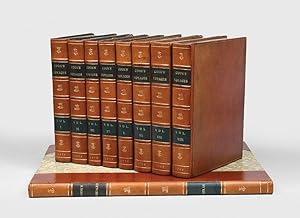
A complete set of the official accounts of Cook's three Pacific voyages, all second editions; attractively presented in a uniform binding. "Captain Cook's three great voyages form the basis for any collection of Pacific books. In three voyages Cook did more to clarify the geographical knowledge of the southern hemisphere than all his predecessors had done together. He was the first really scientific navigator and his voyages made great contributions to many fields of knowledge" (Hill). His contributions to the advancement of knowledge were widely recognized in his own time. Cook's many discoveries resulted in British claims in Alaska, British Columbia, Oregon, Australia, New Zealand, and Hawaii, the last of which he regarded as his most valuable discovery but where he met his death. "Cook earned his place in history by opening up the pacific to western civilization and by the foundation of British Australia. The world was given for the first time an essentially complete knowledge of the Pacific Ocean and Australia, and Cook proved once and for all that there was no great southern continent, as had always been believed. He also suggested the existence of antarctic land in the southern ice ring, a fact which was not proved until the explorations of the nineteenth century" (PMM). - First voyage: HAWKESWORTH, John. An Account of the Voyages Undertaken by the Order of His Present Majesty for Making Discoveries in the Southern Hemisphere, and Successively Performed by Commodore Byron, Captain Wallis, Captain Carteret and Captain Cook. London: W. Strahan and T. Cadell, 1773. Second edition. The primary purpose of Cook's first voyage in Endeavour was the observation of the transit of Venus from Tahiti, and then to continue the enterprise of geographical investigation begun by Commodore Byron. This was to result in the discovery of the Society Islands, the circumnavigation of New Zealand, and the charting of the eastern coast of Australia. "Hawkesworth, an eminent London author, was chosen by Lord Sandwich and commissioned by the Admiralty to prepare these narratives for publication. [He] was expected to add polish to the rough narratives of sea men, and to present the accounts in a style befitting the status of the voyages as official government expeditions, intended to embellish England's prestige as a maritime power" (ODNB). Hawkesworth "secured from Strahan and Cadell the huge sum of £6,000 for the rights of publication, more than was paid for any other literary work of the century. This staggering figure soon became common knowledge, and indignation and resentment that Hawkesworth should get so much for fashioning the work of other people were a main ingredient in the hostile reception of the work" (Edwards, p. 85) The second edition, following the first of the same year, includes a new preface by Hawkesworth in reply to a letter from Alexander Dalrymple and is sometimes preferred for that reason; in addition, the second and third volumes are separately paginated - in the first edition pagination was continuous across those volumes. - Second voyage: COOK, James, 1728-1779. A Voyage towards the South Pole, and Round the World. Performed in His Majesty's Ships the Resolution and Adventure, In the years 1772, 1773, 1774, and 1775. London: Printed for W. Strahan; and T. Cadell, 1777. Second edition. The fame Cook had achieved by his first voyage allowed him to write the account of the second himself. It is the only one of the three voyages written directly by Cook, as the first was authored by Hawkesworth, and the third was published after Cook's death and derived from his journals. Historically, the second voyage is his most important expedition, conducted in search of the great "Terra Australis", a great southern landmass. In the course of the voyage he visited Easter Island, the Marquesas, Tahiti, the Society Islands, Niue, the Tonga Islands, the New Hebrides, New Caledonia, Norfolk Island, Palmerston Island, South Sandwich Islands, and South Georgia, many of which he named in the process. Cook proved the "Terra Australis" to be a myth, and predicted Antarctic land beyond the ice barrier. In addition to the geographical, botanical and other cultural discoveries of the voyage, Cook also deals with the organizational problems of an expedition on such a large scale: he was "probably the first sea captain to realize the importance of preserving the health and well-being of his crew" (PMM). Cook's account is also noted for its illustrations, "of very high artistic quality" (Rosove), mostly after drawings and paintings by young artist William Hodges (1744-1797). - Third voyage: COOK, James, & James King. A Voyage to the Pacific Ocean Undertaken by the Command of His Majesty, for Making Discoveries in the Northern Hemisphere. London: Printed by H. Hughs, for G. Nicol and T. Cadell, 1785. Second edition, published a year after the first, of Cook's fatal third voyage, an attempt to find a north-west passage, which led to a first and finally lethal encounter with the Hawaiian Islands. The third voyage was distinguished for the extent and importance of its discoveries. Alongside the discovery of Hawaii and several smaller islands, Cook charted the Pacific coast from northern California to the Bering Strait, much of which was formerly unknown. The voyage thereby "depicted accurately for the first time the north-west coast of America, leaving no major discoveries for his successors. In addition the scientific discoveries in the fields of natural history and ethnology were considerable and the drawings made by the artists were of great significance" (ODNB). The text was edited by Dr John Douglas from Cook's journals, and continued after his death from the journals of Captain King. The second edition has long been considered the best; the title pages are enhanced by the addition of vignettes of Cook's Royal Society medal and a portrait medal of Captain King, and the text was entirely reset. Forbes points ou. N° de réf. du vendeur 157169
Quantité disponible : 1 disponible(s)
Vendeur : HALEWOOD : ABA:ILAB : Booksellers :1867, PRESTON, Royaume-Uni
Hardcover. Etat : Very Good. A Complete and Rare FIRST EDITION Set of the Official Accounts of Cook's Three Pacific Voyages. Published 1773 - 1784. Contemporary Calf, Atlas rebacked. (1)* An Account of the Voyages undertaken by the order of his Present Majesty for Making Discoveries in the Southern Hemisphere. Three Volumes, complete.* (2)* Voyage Towards the South Pole, Two Volumes, complete. (3)* A Voyage to the Pacific Ocean undertaken, by the Command of his Majesty, for making discoveries in the Northern Hemisphere. Three Volumes, complete.* Cook's 1st voyage was designed to observe the transit of Venus across the sun from the Southern Hemisphere, determine the distance between the sun and the earth and continue Byron's exploration. On completion of those tasks, Cook charted for the first time the Society Islands, New Zealand & the east coast of Australia (naming New South Wales). The other narratives include Byron's voyage to the Gilbert & Tuamotu Islands, Wallis's discovery of Tahiti & Moorea and Carteret's discovery of Pitcairn Island after his separation in a storm from Capt. Wallis. SECOND VOYAGE. Cook, James. Voyage Towards the South Pole, and Round the World performed in H.M.S. the Resolution and Adventure in the years 1772, 73, 74 & 1775. written by James Cook, Commander of the Resolution. In which is included Captain Furneaux's narrative of his proceedings in the Adventure during the separation of the ships.The main objective of the 2nd voyage was to circumnavigate the world as far south as possible in search of the Great Southern Land. In doing so, the Resolution & Adventure became the first ships to cross the Antarctic circle, in Jan. 1773. Cook crossed the Antarctic circle twice more and achieved the 71 S, a record that was to last for 50 years. On this voyage Cook pioneered the use of sauerkraut as a dietary supplement to prevent scurvy, he succeeded, losing only four of his 112 man crew and none from scurvy. This was regarded as a great maritime feat on its own. During this voyage, Cook played his part in furthering the great longitude debate. An accurate way to determine longitude had long been a goal of all seafaring nations. English clockmaker John Harrison was a mechanical genius who invented a clock that would carry the true time from the home port, thereby enabling the calculation of the ships' longitude. Cook carried four watches with him, the principal one named "K-1," which he frequently complimented in the log of the Resolution, calling it "our trusty friend the Watch," and "our never failing guide, the Watch." With its help, he made the first, and highly accurate, charts of many newly discovered South Pacific islands. This is also the only account of any of his voyages that Cook himself wrote. THIRD VOYAGE. Cook, James & King, James. Voyage to the Pacific Ocean undertaken, by the Command of his Majesty, for making discoveries in the Northern Hemisphere to determine the Position and Extent of the West Side of North America; In his Majesty's Ships the Resolution and Discovery. In the Years 1776, 1777, 1778, 1779, and 1780.(4)* Folio Atlas with the 61 copper-engraved plates & the two large folding maps. "Captain Cook's three great voyages form the basis for any collection of Pacific books. In three voyages Cook did more to clarify the geographical knowledge of the southern hemisphere than all his predecessors had done together. He was the first really scientific navigator and his voyages made great contributions to many fields of knowledge" (Hill). The cornerstone of any Pacific voyage collection. These official accounts are the full accounts of the three voyages and are illustrated with impressive engravings based on the works of the official artists, which include Sydney Parkinson, Wm. Hodges and John Webber. At the time of publishing, they were very expensive and the 1st editions were sold out within a few days of publication. Together Nine Volumes. EXCELLENT. N° de réf. du vendeur 1835
Quantité disponible : 1 disponible(s)
Vendeur : James Cummins Bookseller, ABAA, New York, NY, Etats-Unis
First editions. First editions. Collations as below. 10 vols. 4to text and folio atlases. [FIRST VOYAGE] HAWKESWORTH, John. An Account of the Voyages Undertaken by the Order of His Present Majesty for Making Discoveries in the Southern Hemisphere, and Successively Performed by Commodore Byron, Captain Wallis, Captain Carteret, and Captain Cook, in the Dolphin, the Swallow, and the Endeavour. 51 engraved maps and plates, many folding. 3 volumes. 4to. London: W. Strahan and T. Cadell, 1773. First edition, early issue without the Straits of Magellan map. Contemporary speckled calf, sympathetically rebacked. Provenance: F. Norcliffe (armorial bookplate). Beddie 648; Hill 782; Holmes 6; Sabin 30934. [SECOND VOYAGE] COOK, James. A Voyage towards the South Pole, and Round the World. Performed in His Majesty's Ships the Resolution and Adventure, In the Years 1772, 1773, 1774, and 1775. 64 engraved maps and plates. 3 volumes. 4to text and oblong folio atlas. London: W. Strahan and T. Cadell, 1777. First edition, rare issue with the maps and plates bound in an atlas. Contemporary speckled calf (text) and contemporary marbled paper boards (atlas), the atlas rebacked and retipped. Provenance: F. Norcliffe (armorial bookplate in the text vols); Richard Clarke (bookplate in the atlas). Beddie 1216; Hill 358; Holmes 24; Printing and the Mind of Man 223; Rosove 77.A1; Sabin 16245. [THIRD VOYAGE] COOK, James; and James KING. A Voyage to the Pacific Ocean. Undertaken, by the command of His Majesty, for Making Discoveries in the Northern Hemisphere. 24 engraved maps and plates in the text, 63 engraved maps and plates in the atlas. 4 volumes. 4to text and folio atlas. London: W. Strahan and T. Cadell, 1784. First edition. Contemporary speckled calf (text) and contemporary half calf and marbled paper boards (atlas). Provenance: F. Norcliffe (armorial bookplate in the text vols); Richard Henry Tidswell (circular armorial bookplate in the atlas). Beddie 1543; Forbes 85; Hill 361; Holmes 47; Howes C729a; Lada-Mocarski 37; Sabin 16250. A fine complete set of all three of Cook's great voyages of discovery: "the basis for any collection of Pacific books" (Hill). Cook's first voyage included visits to Tahiti and New Zealand, and the tracing of the east coast of Australia was one of the most perilous feats of navigation in the whole recorded history of exploration. The second voyage pushed further south than any previous navigators in search of a southern continent, as well as visiting numerous Pacific islands. The third voyage returned to islands previously visited, discovered Hawaii, and explored the northwest coast of America from Alaska to Oregon. The text of these official reports form an invaluable record of the voyages, but they are enhanced enormously by the Plates, maps, charts and views. "In three great voyages Cook did more to clarify the geographical knowledge of the southern hemisphere than all his predecessors had done together. He was really the first scientific navigator and his voyages made great contributions to many fields of knowledge" (Hill). Besides being first edition of each, this set highly desirable as it includes the very rare separate atlas to the second voyage; almost all copies of the second voyage had the engraved plates trimmed and folded into the text volumes. We have seen only a couple of examples of this format, which represented a distinct and special issue of the book. The text has demonstrably never had engravings bound within it and the superb impressions can be seen to their best advantage in this folio format where they are unfolded and untrimmed. Collations as below. 10 vols. 4to text and folio atlases. N° de réf. du vendeur 367088
Quantité disponible : 1 disponible(s)
Vendeur : Daniel Crouch Rare Books Ltd, London, Royaume-Uni
Set of Cook's three voyages, with the plates and maps bound separately in three atlas volumes Second, third, and second editions. 8 quarto volumes, of text (first and second voyages: 290 by 230mm), (third voyage: 235 by 300mm), 3 folio atlases, (1st voyage: 455 by 280mm), (second voyage: 480 by 310mm), (third voyage: 545 by 400mm); 180 charts and plates, including Bartolozzi and Byrne's 'The Death of Captain Cook' (1785); uniformly (not identically) bound in full eighteenth century tree calf, spines elaborately gilt, with double red and green lettering-pieces. An excellent set of Cook's three voyages with three separate atlases. Cook (1728-1779) was promoted to the rank of Lieutenant and despatched by the Admiralty at the insistence of the Royal Society to observe the 1769 transit of Venus across the face of the sun and to seek out the much discussed southern continent. Accompanying Cook were Joseph Banks (from the Royal Society), the Swedish naturalist Dr. Daniel Carl Solander and the artist Sydney Parkinson. Sailing via Madeira and Tierra del Fuego Tahiti was reached in April 1769 where the transit was successfully recorded in June of that year. From Tahiti Cook sailed to the South Pacific in search of the new continent, first striking the Society Islands, before reaching New Zealand, whose coast he surveyed. From thence Cook proceeded to New Holland surveying the whole East Coast, before returning home via Batavia, proving once and for all the New Guinea was not a part of Australia, a fact first shown by Torres in 1607. He finally reached England in 1771, anchoring off the Downs on 12th June, having lost one third of his crew. In July of the following year Cook, now promoted to the rank of Commander, set out once more for the southern Pacific in the Resolution with the Adventure. This voyage was particularly important since Cook made the first crossing of the Antarctic Circle and finally determined once and for all that the Southern Continent did not exist. In addition Cook secured the medal of the Royal Society by successfully irradicating scurvy through diet and better hygiene. Only three shipboard deaths (all resulting from accidents) were recorded on this voyage - a dramatic reduction from the one third who died on his first voyage. Cook's third voyage began in July 1776 and concentrated on the North Pacific, resulting in the discovery of Hawaii, which Cook considered to be his greatest feat. In addition the theory of a Northern passage connecting the Pacific to the Atlantic was also disproved. With him travelled George Vancouver who later charted the North West Coast of America and also the artist John Webber who provided Europe with many images of the Pacific. Cook however was killed on 14th February, 1779 in a shoreline skirmish. The tragic event is illustrated in Bartolozzi and Byrne's iconic separately published engraving, 'The Death of Captain Cook' (1785), included here, after the original painting by Webber. Captain King subsequently took over command of the expedition, which returned to England in 1780. Provenance: With the engraved armorial bookplates of Alexander Speirs of Eldersley. Literature: Beddie, 'Bibliography of Captain James Cook', 650, 1216, 1552; Hill, 'The Hill Collection of Pacific Voyages', 783, 358, 361. N° de réf. du vendeur 23213
Quantité disponible : 1 disponible(s)