Synopsis
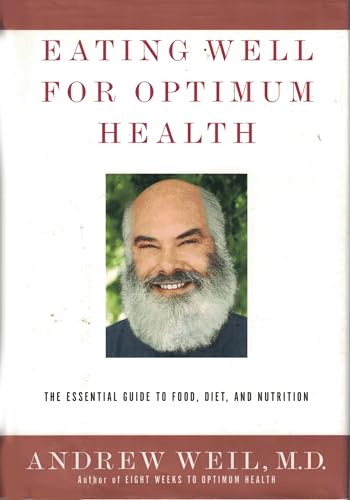
Book by Weil Md Andrew
Extrait
CHAPTER ONE
The Principles of Eating Well
When I use the words eating well, I mean using food not only to influence health and well-being but to satisfy the senses, providing pleasure and comfort. In addition to supplying the basic needs of the body for calories and nutrients, an optimum diet should also reduce risks of disease and fortify the body's defenses and intrinsic mechanisms of healing. I believe that how we eat is an important determinant of how we feel and how we age. I also believe that food can function as medicine to influence a variety of common ailments.
The American Council on Science and Health, a New York-based nonprofit organization dedicated to "helping distinguish between real and hypothetical health risks," recently suggested ten resolutions for a healthy new year. The council included obvious ones, such as don't smoke, wear seat belts, and install smoke detectors, but addressed diet in only one paragraph:
Eat a balanced and varied diet. Avoid obesity and fad diets. There are no magical guidelines for good nutrition. Patients should resolve to plan their diet around the watchwords "variety, moderation, and balance." Remember: There are no "good" or "bad" foods. The primary danger from food is overindulgence.
I find this advice to be remarkably unhelpful. Eat a balanced diet What is that? I meet people who think that adding a salad with creamy dressing to a cheeseburger and French fries balances the meal. Avoid obesity? Sure, that sounds like a good idea, but how do you do it? There are no "good" or "bad" foods? What about soybeans? They contain healthy fiber, a fat that may help lower cholesterol, and unusual compounds called isoflavones that may offer significant protection against common forms of cancer. Soybeans seem like a good food to me. What about margarine? For years I've been telling my patients to avoid it because it contains trans-fatty acids (TFAs), unnatural fats that promote inflammation, heart disease, and cancer. Sounds like a bad food to me -- I won't eat it, even in moderation or in the pursuit of variety.
The primary danger from food is overindulgence? I'm sure my distant ancestors had no problem in that area, but what am I supposed to do when everywhere I look I see tempting offerings of food in ever more novel preparations, when many restaurants score points for the size of portions they serve, when I get more for my money buying giant sizes of food and drink, and when people who love me or want my attention give me food and more food as expressions of their affection or interest?
The poor advice about diet and health that people get far too often when they ask physicians, nurses, registered dietitians, and other representatives of the health-care establishment for help reflects the dearth of good nutritional education in our professional schools. If you look to other sources -- alternative practitioners, bookstores, health food stores, the Internet, for example -- there is no shortage of information about nutritional influences on health. In fact, there is much too much of it out there, most of it contradictory, unscientific, and intended to promote particular foods, diets, or dietary supplements.
While scanning nutrition-related sites on the Internet, for example, I came across glowing recommendations for products made from "super blue-green algae," microorganisms from a lake in Oregon. I was told that:
Super Blue Green Algae gives us nutrients and energy at almost no cost to the body's reserves. This algae is 97% assimilable, and many of the nutrients are in forms that are directly usable. For example, the algae's 60% protein content is of a type called glycoproteins, as opposed to the lipoproteins found in vegetables and meat. As a result, the body doesn't have to spend its valuable resources converting lipoproteins into glycoproteins as it does with other foods. Super Blue Green Algae contains almost every vitamin and mineral needed by the body . . . [and] is one of the richest sources of chlorophyll -- a cell regenerator and blood purifier.
Should I rush to order this costly "superfood"? Can it be that all my life my body has been wasting its valuable resources converting lipoproteins to glycoproteins when it could have been getting just what it wanted from pond scum? As for chlorophyll, while it performs a vital function in the life of green plants, it has no role that I know of in human nutrition.
At one extreme are authorities telling us that we are what we eat, that health, good and bad, is entirely or mostly a creation of what we put in our mouths. There is a kernel of attractive logic in that formulation that resonates with common sense. We have to eat to live, because food is fuel for the metabolic engine. The quality of fuel you burn must influence your body, just as the grade of fuel you put into an internal combustion engine influences its performance for better or worse, not only in the short run -- a smooth purr versus a ragged knock, for example -- but also in the long run, retarding or accelerating the accumulation of deposits that reduce the longevity of valves, rings, and ultimately the entire engine. But it is a long way from this simple observation to the conclusion that diet is everything.
At the other extreme are voices telling us it doesn't matter. "Eat healthy, exercise, die anyway." "Just eat a balanced diet." "My uncle Jake ate big helpings of bacon, eggs, steak, and butter every day of his life and lived to be ninety-nine." "There are no good and bad foods." "People who say you can affect your health and treat disease by changing your diet are food faddists." "It's all in your genes, anyway."
I know of no subject more confused, emotionally charged, and important in our lives than food and nutrition and their influence on our well-being. When I give public talks on health and medicine, the questions I get reveal both the interest and confusion. Here are some examples:
How can I lose weight? I've tried everything.
It seems as if I gain weight just by looking at food. Why?
I've had cancer. What foods should I avoid?
I have no energy. Could my diet be the problem?
I thought we were supposed to avoid dietary fat. Now I'm hearing that fat is okay and carbohydrates are bad. What are the answers?
Is it okay to eat soybeans if I had breast cancer?
If I change my diet, can I get off all the drugs I'm taking for my arthritis?
My five-year-old has asthma. Are there foods he shouldn't be eating? My doctor doesn't seem to know.
A holistic doctor told me I'm allergic to wheat. What does that mean? I love bread and pasta.
If I'm eating pretty well, do I need to take vitamins?
If I'm supposed to be eating more fruits and vegetables, do I have to worry about pesticides on them?
I don't have time to cook. How can I eat a healthy diet?
My children like only macaroni and cheese. How can I get them to develop better eating habits?
I love chocolate. Is it bad for me?
The cafeteria food at my school is wretched. How can I persuade the school to improve it?
Is it all right to eat eggs if heart disease runs in your family?
Is sugar bad for you?
Are microwave ovens safe?
Is it dangerous to cook in aluminum pots?
I read that dairy products could be causing my sinus problems. Isn't milk supposed to be the perfect food?
Are artificial sweeteners safe?
Is it okay to drink water with your meals?
What's the best way to eat if I want to live to be a hundred?
I could extend this list to fill dozens and dozens of pages. It shows the keen interest people have in this subject, their inability to get answers, and their concern about opinions that are contradictory and confusing. People sense the possibility of improving health by making informed choices regarding food, and they sense danger in making uninformed ones, but they do not know where to get information they can trust.
Physicians are at almost the same disadvantage as the rest of us. My medical partner, Dr. Brian Becker, tells me that he was completely turned off the subject of nutrition at the age of ten, when he was forced to listen to a dietitian talk to his fifth-grade class about healthy eating and the four basic food groups then in fashion. "She was overweight, slovenly, smoked at the break, and was in no way anyone I wanted to identify with," he recalls. "Furthermore, the information she gave us was later proved wrong. That one experience stayed with me for years and has made it impossible for me to read or hear anything about nutrition without feeling bored and resentful."
My purpose in writing this book is to explore the issues and controversies surrounding food and nutrition in order to bring clarity to the subject and establish for readers a sense of what eating well means. First I want to state seven basic propositions that underlie my philosophy of food and nutrition and how they both influence health.
We Have to Eat to Live.
The body requires energy for all of its functions, from the beating of the heart and the elimination of wastes to the transmission of electrical and chemical signals in the nervous system. It gets its energy from food, by taking it in, digesting it, and metabolizing its components. Food is fuel that contains energy from the sun, originally captured and stored by green plants, then passed along to fruits, seeds, and animals. Humans eat these foods, and burn the fuel they contain -- that is, combine it with oxygen in a controlled fashion to release and capture the stored solar energy. As long as we live, we have to eat and eat often.
Or do we? Throughout history there have been unsubstantiated reports of persons who survive without eating. Their ability to do so is usually ascribed to sainthood or to mastery of esoteric mental powers. I can understand that some people are fascinated by the possibility of surviving witho...
Les informations fournies dans la section « A propos du livre » peuvent faire référence à une autre édition de ce titre.