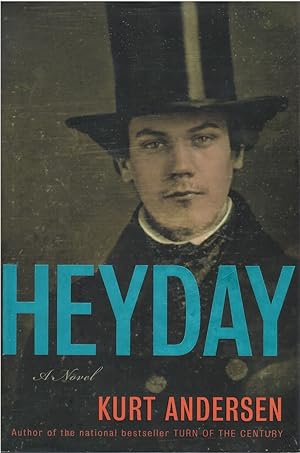
Synopsis
Book by Andersen Kurt
Extrait
1
April 27, 1848
· · ·
New York C i t y
Benjamin Knowles wobbled into the New World. He hadn’t stood on solid ground for nearly two weeks, and as he stepped from the gangway onto the Cunard pier he felt shaky. The adventure continued! Albeit for the moment in a place called New Jersey. Until an hour before, he had never heard of New Jersey.
But after a few moments he found his feet and spoke to his first American on American soil, the ship’s assistant bursar, a man with a swollen red nose standing at a portable blue cabinet. He took one of Ben’s £5 coins and counted out American money in exchange–a ten-dollar gold piece, two five-dollar gold pieces, and a silver dollar.
“Trade you four good Lady Libertys for just one of your girl,” the man said as he clicked and rubbed his dirty thumbnail across Victoria’s face, winked, then placed the four coins one at a time in Ben’s palm.
Ben stared at his new money. Each of the coins carried a portrait of Liberty, and all were extremely shiny.
“Plus your three cents for the ferry and another besides.” As the man dribbled the pennies onto the gold, he glanced behind Ben at some commotion near the gangway. “That foreign fella seems to be wanting you pretty bad, sir . . .”
What?
Ben spun around, suddenly in a freak, his heart in his throat, imagining the worst–
But it was only Mr. Memmo, his fellow passenger, held up by an immigration agent skeptical of his true nationality.
“Mr. Knowles,” Memmo shouted, “because I am delayed here, I must say the fondest farewell to you just now–so off to our Gotham on your own, eh?”
Ben took a deep breath and waved goodbye. “Gotham”! It was a word he had read only in books.
The day seemed sunnier than any in London ever, and the river smelled sweet in comparison with the Thames. As his ferry, the Davy Crockett, chugged from New Jersey toward Manhattan, it passed through a flotilla of market boats sailing in every direction, dozens of sloops and schooners piled with sturgeon and lettuce and peaches and husked corn, the Coxsackie packed to the decks with snow-white lime and the Doctor Faustus with tengallon cans of milk, the Favorite full of dead ducks and the Revenge carrying live spring lambs. The river was so wide that each of the smaller craft–other ferries, a longboat here, a flat-bottomed launch there, cutters and yawls and even a few little punts–was apparently free to plot its own course at any angle it wished, channels and charts be damned. One big sidewheel steamer called the Novelty was pulling away from a pier straight ahead as another, the Intelligence, steamed in for a landing from the north, its puffy tails of black smoke and white steam extending almost the whole width of the river like some heavenly bridge.
The Davy Crockett’s engine slowed. Ben was at the bow, bags in hand. At the next pier over, cotton was being unloaded from a Charleston steamer. He wondered if these very bales might now be shipped across the Atlantic to his father’s mills in Lancashire. The year Ben had worked there, the arriving American cotton bales had always reminded him of coffins–coffins in a dream, white and soft and impossibly heavy. This morning they looked only like cotton.
Ben stepped off and wandered into the confusion.
He looked and listened and smelled more acutely than he ever had before. His preconceptions were already sloughing away as the actual America, bit by vivid bit, began to replace accreted years of wishful speculation. His last look at the Old World had been Liverpool’s orderly stone wharves; this first glimpse of the New World was all rotting wood and ramshackle sheds, a jumble of painted signs and paper billboards and chalked words and prices on blackboards. Everything and everyone seemed to shout and hawk.
A few yards away a respectable-looking older woman was addressing a pair of respectable-looking younger men, one of whom was not just laughing aloud but guffawing in the street so madly that he seemed about to tumble over. The bustle of people and carts and animals seemed greater than in London, wilder and even slightly desperate, but also somehow happier. And strangers looked at him as intently as he looked at each of them–looked him straight in the eye, as no Londoner who wasn’t a whore or a lunatic would think of doing.
In this place of which he had only read and dreamed, he had the odd sense of arriving home. A “cosmopolite,” the friendly American newspaperman he met on the ship this morning had called him. Ben savored the phrase, hoped that it might become true. It was a word that his brother Philip used as a polite disparagement for artists and feckless Europeans and Jews.
In the footpath on the far side of the street he spotted two Negroes, a man and a boy, maybe father and son, starting to sing at the tops of their lungs and clap in time to their tune. “He got the whole danged world, he got the whole world in his hands.” Ben’s mouth dropped open at the sight. He had stepped off the boat only a minute ago, and here was minstrelsy, no cocoa butter and burnt cork on white men, no West End stage parody, but the real thing, in the American street. Their associate, a white boy, held a tin bowl he shook for coins from onlookers. Ben handed over his remaining penny and lifted his bags to go. He’s got the whole world in his hands.
As he walked toward a cluster of hackney cabs, he happened to glance at the smallest sign among the scores that surrounded him. He was walking down a street called Liberty.
His cabdriver was friendly and talkative in just the brassy way Americans were reputed to be. In their first minute together, he had asked Ben his age (twenty-six) and if he was planning to stay in New York for a while (yes).
“That there is the superb Trinity Church,” the driver said as he turned north, pointing like a hired guide at a brand-new fake-Gothic spire.
“Anglican?” Ben asked.
“Aristocratic,” the driver said without a smile, “and the tallest doggone thing on the continent.”
“And that fine place,” Ben asked of a building across Broadway, “is an army headquarters?” Two black men in regimental uniforms stood guard at either side of the main entrance.
“Because of the darkies at the door? Ha! You are a comical one, if I can say so, sir.” It was the Lafayette Bazaar, an arcade of shops, reading rooms, and photographers’ studios. The two men in blue costumes, the driver explained, “are just, well, hired showmen, I expect you could say.”
Ben’s first impressions of his hotel were disheartening. White and new and fine, the Astor House was the very picture of ten-shilling-a-night respectability. Except for its great size, it was in no way vulgar or strange, and Ben had come to America craving vulgarity and strangeness. His room, on the sixth floor, was outfitted with a feather bed, a steam radiator, water from a tap, even a water closet with plumbing. He did not feel that he was at the center of a rough new democratic dynamo. Indeed, he might as well have been in the most luxurious hotel in Rome or Paris or Berlin. With its marble and mahogany and miles of drapery, and a score of liveried men and footboys carrying parcels and platters and answering bells, this establishment would suit his father, or–good God–his brother Philip.
Yes, Ben said to himself, and what else should one expect of the Astor House, a hotel built by the famous millionaire himself? He had taken his father’s suggestion and used the firm’s travel clerk to arrange lodgings, and now he wondered if the Astor House was part of an Archie Knowles stratagem to pamper and disillusion him from the moment he arrived, to persuade Ben that he was indeed (as his father had said) “an overromantic carpet knight” who had sailed three thousand miles only to encounter the familiar. Ben vowed to find a permanent place to live in a more suitably . . . American way. Whatever that meant.
But as he walked downstairs for dinner, wondering why the public rooms of such a hotel featured so many large and empty brass flowerpots, the man walking just in front of him turned his head and, hardly pausing at all, spat a large bolus of syrupy tobacco juice several feet into the nearest pot. Aha: spittoons. Ben smiled. He was pleased. No such thing had ever happened in Berkeley Square.
The two young New Yorkers were seated in a corner of the largest of the dining saloons at the Astor House. Duff Lucking wore a brown serge frock coat, his first new one since before he left for Mexico. Polly Lucking wore her favorite dress, a brocaded yellow silk with a lace bodice, and her highheeled kid boots. Until they’d arrived, their destination had been a secret to her. For this week’s dinner Duff had announced he would “fête her royally” to celebrate the happy, happy news.
Duff had never tasted champagne, let alone Heidsieck at two dollars a glass. “A toast . . .”
Polly smiled as if embarrassed, but the show of humility was rote. She was as pleased as she had ever been. She had learned the day before that she was cast to play the young heroine Florence Dombey in the stage production based on Charles Dickens’s new novel. It would be the most significant role so far in her somewhat whiffling theatrical career.
“Now come on, Polly–raise your glass!”
She smiled and lifted her ginger fizz an inch or two off the table.
“To New York’s–no, to the nation’s̵...
Les informations fournies dans la section « A propos du livre » peuvent faire référence à une autre édition de ce titre.