

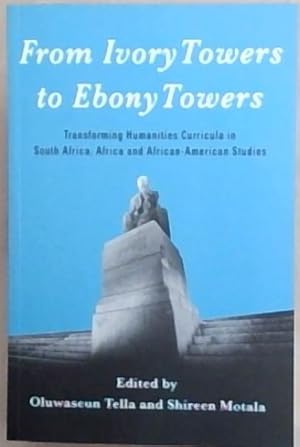
FROM IVORY TOWERS TO EBONY TOWERS : transforming Humanities Curricula in South Africa, Africa and African - American Studies
Tella, Oluwaseun ; Motala, Shireen [Ed.]
ISBN 10: 1928232906 ISBN 13: 9781928232902
Edité par Fanele, 2020
Ancien(s) ou d'occasion
Paperback
Vendeur
Chapter 1, Johannesburg, GAU, Afrique du sud
Évaluation du vendeur 5 sur 5 étoiles

Vendeur AbeBooks depuis 29 mars 2004
Cet article spécifique n'est plus disponible.
A propos de cet article
Description :
a clean and presentable copy. minor usage markings. soundly bound. [SK]. Our orders are shipped using tracked courier delivery services. N° de réf. du vendeur 49zp
Synopsis :
“This edited volume is a significant academic achievement. The book offers a comparatively enriched account of debates in higher education transformation across South African, African, and African-American epistemic contexts. The text offers perspectives on how the humanities could be reformed in the quest to decolonise curriculum and free the higher education from Eurocentrism.” Aslam Fataar, Distinguished Professor, Stellenbosch University, South Africa “The book’s strength came from its diversity of countries, theories, and histories. I came away from the book feeling not only inspired but also guided and prodded. While it is a much-needed text for all of us in higher education, I think it will find a quick and large audience of readers. I do not know of another competing book at this scale.” Wayne Hugo, Associate Professor of Education, University of KwaZulu-Natal, South Africa Despite two-and-a-half decades of black majority rule after 1994, much of South African higher education in the area of humanities continues to embrace European models and paradigms. This is despite concepts such as Africanisation, indigenisation and decolonisation of the curriculum having become buzzwords, especially after the #MustFall campaigns, student-led protests from 2015. This book argues that, beyond the use of internally constructed strategies to foster curriculum transformation in South Africa, it is important to draw lessons from the curriculum transformation efforts of other African countries and African-American studies in the United States (US). The end of colonialism in Africa from the 1950s marked the most important era in curriculum transformation efforts in African higher education, evident in the rise of leading decolonial schools: the Ibadan School of History, the Dar es Salaam School of Political Economy and the Dakar School of Culture. These centres used rigorous research methods such as nationalist historiography and oral sources to challenge Eurocentric epistemologies. African-American studies emerged in the US from the 1920s to debunk notions of white superiority and challenge racist ideas and structures in international relations. The two important schools of this scholarship were the Atlanta School of Sociology and the Howard School of International Affairs.
À propos de l'auteur: Shireen Motala is Senior Director of the Postgraduate School: Research and Innovation Division, and Professor in the Faculty of Education at the University of Johannesburg. She has worked extensively in research and research management, and provided leadership for regional and international partnerships. Professor Motala served on the South African Council of Higher Education (CHE), the Ministerial Task Team to review the national Senior Certificate examination, and South Africa’s United Nations Educational, Scientific, and Cultural Organisation (UNESCO) Commission. Her research interests and expertise are in Education Financing; Internationalisation; Post-graduate Pedagogies; Decolonisation; and Globalisation. Oluwaseun Tella is a Senior Researcher at the Institute for Pan-African Thought and Conversation at the University of Johannesburg in South Africa. He holds a Doctorate in Political Science from the University of KwaZulu- Natal in South Africa. Dr Tella has edited a book entitled Nigeria–South Africa Relations and Regional Hegemonic Competence; and published two book chapters, and over 20 mostly single-authored journal articles in Politikon, Journal of Asian and African Studies, Journal of Black Studies and elsewhere. His research interests include Foreign Policy; International Relations; Soft Power; Peace and Conflict Studies; African Politics; and South African Higher Education.
Les informations fournies dans la section « A propos du livre » peuvent faire référence à une autre édition de ce titre.
Détails bibliographiques
Titre : FROM IVORY TOWERS TO EBONY TOWERS : ...
Éditeur : Fanele
Date d'édition : 2020
Reliure : Paperback
Etat : Near Fine
Edition : First Edition.