Synopsis
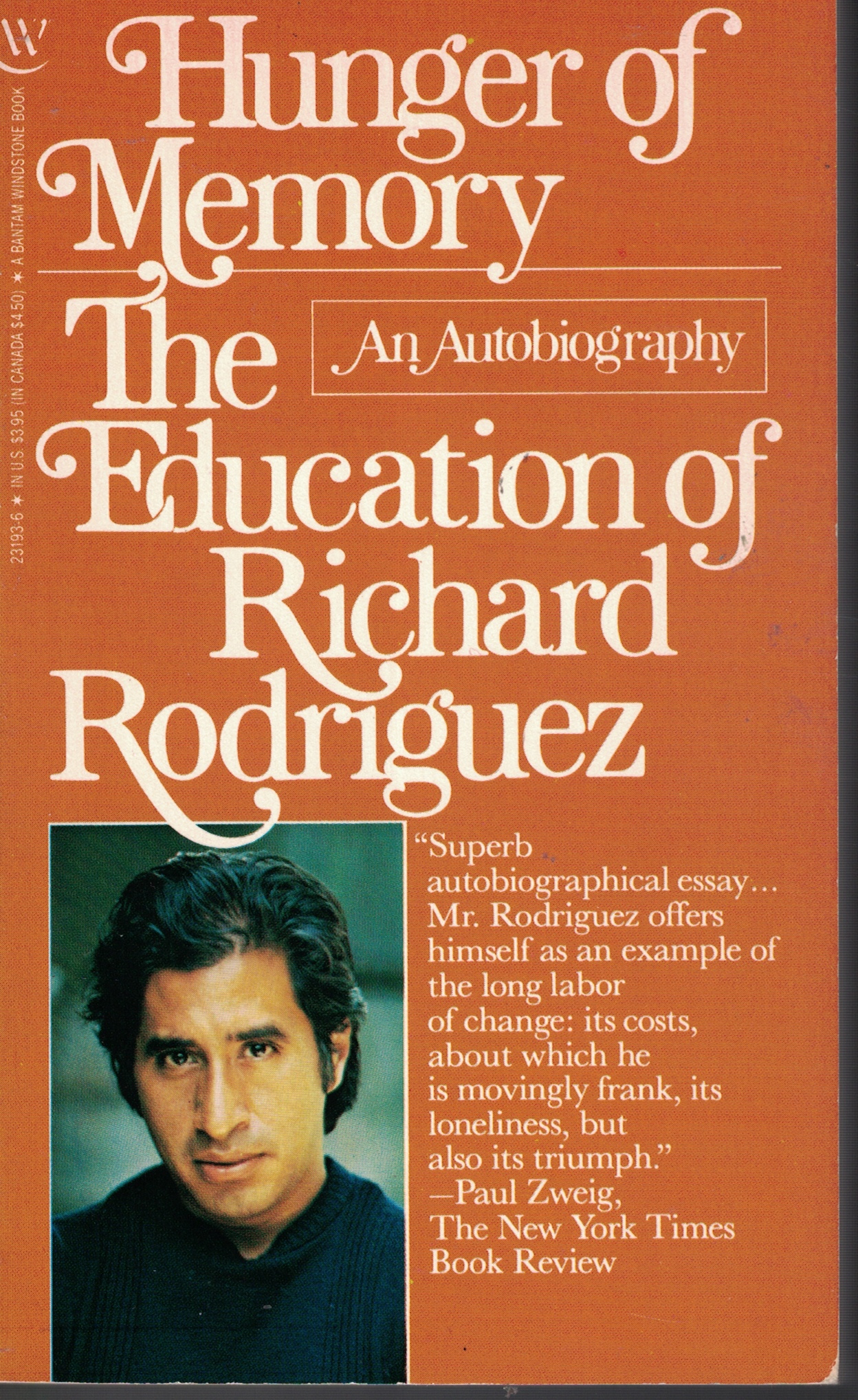
Book by Rodriguez Richard
Extrait
Chapter One
I remember to start with that day in Sacramento-a California now nearly thirty years past-when I first entered a classroom, able to understand some fifty stray English words.
The third of four children, I had been preceded to a neighborhood Roman Catholic school by an older brother and sister. But neither of them had revealed very much about their classroom experiences. Each afternoon they returned, as they left in the morning, always together, speaking in Spanish as they climbed the five steps of the porch. And their mysterious books, wrapped in shopping-bag paper, remained on the table next to the door, closed firmly behind them.
An accident of geography sent me to a school where all my classmates were white, many the children of doctors and lawyers and business executives. All my classmates certainly must have been uneasy on that first day of school-as most children are uneasy-to find themselves apart from their families in the first institution of their lives. But I was astonished.
The nun said, in a friendly but oddly impersonal voice, 'Boys and girls, this is Richard Rodriguez.' (I heard her sound out: Rich-heard Road-ree-guess.) It was the first time I had heard anyone name me in English. 'Richard,' the nun repeated more slowly, writing my name down in her black leather book. Quickly I turned to see my mother's face dissolve in a watery blur behind the pebbled glass door.
***
Many years later there is something called bilingual education-a scheme proposed in the late 1960s by Hispanic-American social activists, later endorsed by a congressional vote. It is a program that seeks to permit non-English-speaking children, many from lower-class homes, to use their family language as the language of school. (Such is the goal its supporters announce.) I hear them and am forced to say no: It is not possible for a child-any child-ever to use his family's language in school. Not to understand this is to misunderstand the public uses of schooling and to trivialize the nature of intimate life-a family's 'language.'
Memory teaches me what I know of these matters; the boy reminds the adult. I was a bilingual child, a certain kind-socially disadvantaged-the son of working-class parents, both Mexican immigrants.
In the early years of my boyhood, my parents coped very well in America. My father had steady work. My mother managed at home. They were nobody's victims. Optimism and ambition led them to a house (our home) many blocks from the Mexican south side of town. We lived among gringos and only a block from the biggest, whitest houses. It never occurred to my parents that they couldn't live wherever they chose. Nor was the Sacramento of the fifties bent on teaching them a contrary lesson. My mother and father were more annoyed than intimidated by those two or three neighbors who tried initially to make us unwelcome. ('Keep your brats away from my sidewalk!') But despite all they achieved, perhaps because they had so much to achieve, any deep feeling of ease, the confidence of 'belonging' in public was withheld from them both. They regarded the people at work, the faces in crowds, as very distant from us. They were the others, los gringos. That term was interchangeable in their speech with another, even more telling, los americanos.
I grew up in a house where the only regular guests were my relations. For one day, enormous families of relatives would visit and there would be so many people that the noise and the bodies would spill out to the backyard and front porch. Then, for weeks, no one came by. (It was usually a salesman who rang the doorbell.) Our house stood apart. A gaudy yellow in a row of white bungalows. We were the people with the noisy dog. The people who raised pigeons and chickens. We were the foreigners on the block. A few neighbors smiled and waved. We waved back. But no one in the family knew the names of the old couple who lived next door; until I was seven years old, I did not know the names of the kids who lived across the street.
In public, my father and mother spoke a hesitant, accented, not always grammatical English. And they would have to strain-their bodies tense-to catch the sense of what was rapidly said by los gringos. At home they spoke Spanish. The language of their Mexican past sounded in counterpoint to the English of public society. The words would come quickly, with ease. Conveyed through those sounds was the pleasing, soothing, consoling reminder of being at home.
During those years when I was first conscious of hearing, my mother and father addressed me only in Spanish; in Spanish I learned to reply. By contrast, English (ingles), rarely heard in the house, was the language I came to associate with gringos. I learned my first words of English overhearing my parents speak to strangers. At five years of age, I knew just enough English for my mother to trust me on errands to stores one block away. No more.
I was a listening child, careful to hear the very different sounds of Spanish and English. Wide-eyed with hearing, I'd listen to sounds more than words. First, there were English (gringo) sounds. So many words were still unknown that when the butcher or the lady at the drugstore said something to me, exotic polysyllabic sounds would bloom in the midst of their sentences. Often, the speech of people in public seemed to me very loud, booming with confidence. The man behind the counter would literally ask, 'What can I do for you?' But by being so firm and so clear, the sound of his voice said that he was a gringo; he belonged in public society.
I would also hear then the high nasal notes of middle-class American speech. The air stirred with sound. Sometimes, even now, when I have been traveling abroad for several weeks, I will hear what I heard as a boy. In hotel lobbies or airports, in Turkey or Brazil, some Americans will pass, and suddenly I will hear it again-the high sound of American voices. For a few seconds I will hear it with pleasure, for it is now the sound of my society-a reminder of home. But inevitably-already on the flight headed for home-the sound fades with repetition. I will be unable to hear it anymore.
When I was a boy, things were different. The accent of los gringos was never pleasing nor was it hard to hear. Crowds at Safeway or at bus stops would be noisy with sound. And I would be forced to edge away from the chirping chatter above me.
I was unable to hear my own sounds, but I knew very well that I spoke English poorly. My words could not stretch far enough to form complete thoughts. And the words I did speak I didn't know well enough to make into distinct sounds. (Listeners would usually lower their heads, better to hear what I was trying to say.) But it was one thing for me to speak English with difficulty. It was more troubling for me to hear my parents speak in public: their high-whining vowels and guttural consonants; their sentences that got stuck with 'eh' and 'ah' sounds; the confused syntax; the hesitant rhythm of sounds so different from the way gringos spoke. I'd notice, moreover, that my parents' voices were softer than those of gringos we'd meet.
I am tempted now to say that none of this mattered. In adulthood I am embarrassed by childhood fears. And, in a way, it didn't matter very much that my parents could not speak English with ease. Their linguistic difficulties had no serious consequences. My mother and father made themselves understood at the county hospital clinic and at government offices. And yet, in another way, it mattered very much-it was unsettling to hear my parents struggle with English. Hearing them, I'd grow nervous, my clutching trust in their protection and power weakened.
There were many times like the night at a brightly lit gasoline station (a blaring white memory) when I stood uneasily, hearing my father. He was talking to a teenaged attendant. I do not recall what they were saying, but I cannot forget the sounds my father made as he spoke. At one point his words slid together to form one word-sounds as confused as the threads of blue and green oil in the puddle next to my shoes. His voice rushed through what he had left to say. And, toward the end, reached falsetto notes, appealing to his listener's understanding. I looked away to the lights of passing automobiles. I tried not to hear anymore. But I heard only too well the calm, easy tones in the attendant's reply. Shortly afterward, walking toward home with my father, I shivered when he put his hand on my shoulder. The very first chance that I got, I evaded his grasp and ran on ahead into the dark, skipping with feigned boyish exuberance.
But then there was Spanish. Espa–ol: my family's language. Espa–ol: the language that seemed to me a private language. I'd hear strangers on the radio and in the Mexican Catholic church across town speaking in Spanish, but I couldn't really believe that Spanish was a public language, like English. Spanish speakers, rather, seemed related to me, for I sensed that we shared-through our language-the experience of feeling apart from los gringos. It was thus a ghetto Spanish that I heard and I spoke. Like those whose lives are bound by a barrio, I was reminded by Spanish of my separateness from los otros, los gringos in power. But more intensely than for most barrio children-because I did not live in a barrio-Spanish seemed to me the language of home. (Most days it was only at home that I'd hear it.) It became the language of joyful return.
A family member would say something to me and I would feel myself specially recognized. My parents would say something to me and I would feel embraced by the sounds of their words. Those sounds said: I am speaking with ease in Spanish. I am addressing you in words I never use with los gringos. I recognize you as someone special, close, like no one outside. You belong with us. In the family.
(Ricardo.)
At the age of five, six, well past the time when most other children no longer easily notice the difference between sounds uttered at home and words spoken in public, I had a different experience. I lived in a world magically compounded of sounds. I remained a child longer than most; I lingered too long, poised at the edge of language-often frightened by the sounds of los gringos, delighted by the sounds of Spanish at home. I shared with my family a language that was startlingly different from that used in the great city around us.
For me there were none of the gradations between public and private society so normal to a maturing child. Outside the house was public society; inside the house was private. Just opening or closing the screen door behind me was an important experience. I'd rarely leave home all alone or without reluctance. Walking down the sidewalk, under the canopy of tall trees, I'd warily notice the-suddenly-silent neighborhood kids who stood warily watching me. Nervously, I'd arrive at the grocery store to hear there the sounds of the gringo-foreign to me-reminding me that in this world so big, I was a foreigner. But then I'd return. Walking back toward our house, climbing the steps from the sidewalk, when the front door was open in summer, I'd hear voices beyond the screen door talking in Spanish. For a second or two, I'd stay, linger there, listening. Smiling, I'd hear my mother call out, saying in Spanish (words): 'Is that you, Richard?' All the while her sounds would assure me: You are home now; come closer; inside. With us.
'S’,' I'd reply.
Once more inside the house I would resume (assume) my place in the family. The sounds would dim, grow harder to hear. Once more at home, I would grow less aware of that fact. It required, however, no more than the blurt of the doorbell to alert me to listen to sounds all over again. The house would turn instantly still while my mother went to the door. I'd hear her hard English sounds. I'd wait to hear her voice return to soft-sounding Spanish, which assured me, as surely as did the clicking tongue of the lock on the door, that the stranger was gone.
Plainly, it is not healthy to hear such sounds so often. It is not healthy to distinguish public words from private sounds so easily. I remained cloistered by sounds, timid and shy in public, too dependent on voices at home. And yet it needs to be emphasized: I was an extremely happy child at home. I remember many nights when my father would come back from work, and I'd hear him call out to my mother in Spanish, sounding relieved. In Spanish, he'd sound light and free notes he never could manage in English. Some nights I'd jump up just at hearing his voice. With mis hermanos I would come running into the room where he was with my mother. Our laughing (so deep was the pleasure!) became screaming. Like others who know the pain of public alienation, we transformed the knowledge of our public separateness and made it consoling-the reminder of intimacy. Excited, we joined our voices in a celebration of sounds. We are speaking now the way we never speak out in public. We are alone-together, voices sounded, surrounded to tell me. Some nights, no one seemed willing to loosen the hold sounds had on us. At dinner, we invented new words. (Ours sounded Spanish, but made sense only to us.) We pieced together new words by taking, say, an English verb and giving it Spanish endings. My mother's instructions at bedtime would be lacquered with mock-urgent tones. Or a word like s’ would become, in several notes, able to convey added measures of feeling. Tongues explored the edges of words, especially the fat vowels. And we happily sounded that military drum roll, the twirling roar of the Spanish r. Family language: my family's sounds. The voices of my parents and sisters and brother. Their voices insisting: You belong here. We are family members. Related. Special to one another. Listen! Voices singing and sighing, rising, straining, then surging, teeming with pleasure that burst syllables into fragments of laughter. At times it seemed there was steady quiet only when, from another room, the rustling whispers of my parents faded and I moved closer to sleep.
Chapter Two
Supporters of bilingual education today imply that students like me miss a great deal by not being taught in their family's language. What they seem not to recognize is that, as a socially disadvantaged child, I considered Spanish to be a private language. What I needed to learn in school was that I had the right-and the obligation-to speak the public language of los gringos. The odd truth is that my first-grade classmates could have become bilingual, in the conventional sense of that word, more easily than I. Had they been taught (as upper-middle-class children are often taught early) a second language like Spanish or French, they could have regarded it simply as that: another public language. In my case such bilingualism could not have been so quickly achieved. What I did not believe was that I could speak a single public language.
Les informations fournies dans la section « A propos du livre » peuvent faire référence à une autre édition de ce titre.