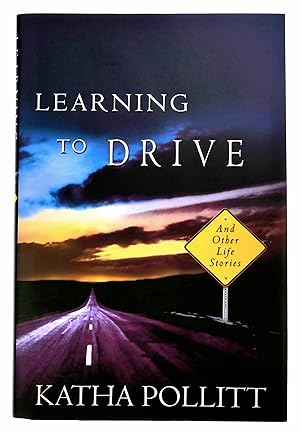
Synopsis
Unusual book
Extrait
OVER THERE, THE RED JEEP. PARK!” BEN, MY gentle Filipino driving instructor, has suddenly become severe, abrupt, commanding. A slight man, he now looms bulkily in his seat; his usually soft voice has acquired a threatening edge. In a scenario that we have repeated dozens of times, and that has kinky overtones I don’t even want to think about, he is pretending to be the test examiner, barking out orders as we tool along the streets above Columbia University in the early morning. I am impersonating the would-be licensee, obediently carrying out instructions. “Pull out when you are ready!” “Right turn!” “Left turn at the intersection!” “Straight!” “All right, Ms. Pollitt, pull over.” He doesn’t even need to say the words. From the rueful look on his once again kindly face I know that I have failed.
What did I do wrong this time? Did I run a red light, miss a stop sign, fail to notice one of the many bicyclists who sneak into my blind spot whenever I go into reverse? Each of these mistakes means automatic failure. Or did I fail on points? Five for parallel-parking more than fourteen inches from the curb and not successfully fixing it, ten for rolling when I paused for the woman with the stroller (but at least I saw her! I saw her!), fifteen for hesitating in the intersection, so that a driver in a car with New Jersey plates honked and gave me the finger? This time it was points, Ben tells me: in our five-minute practice test I racked up sixty. New York State allows you thirty.
“Observation, Kahta, observation! This is your weakness.” This truth hangs in the air like mystical advice from an Asian sage in a martial-arts movie. “That, and lining up too far away when you go to park.”
The clock on the dashboard reads 7:47. We will role-play the test repeatedly during my two-hour lesson. I will fail every time.
Observation is my weakness. I did not realize that my mother was a secret drinker. I did not realize that the man I lived with, my soul mate, made for me in Marxist heaven, was a dedicated philanderer, that the drab colleague he insinuated into our social life was his long-standing secret girlfriend, or that the young art critic he mocked as silly and second-rate was being groomed as my replacement. I noticed that our apartment was becoming a grunge palace, with books and papers collecting dust on every surface and kitty litter crunching underfoot. I observed—very good, Kahta!—that I was spending many hours in my study, engaged in arcane e-mail debates with strangers, that I had gained twenty-five pounds in our seven years together and could not fit into many of my clothes. I realized it was not likely that the unfamiliar pink-and-black-striped bikini panties in the clean-clothes basket were the result, as he claimed, of a simple laundry room mix-up. But all this awareness was like the impending danger in one of those slow-motion dreams of paralysis, information that could not be processed. It was like seeing the man with the suitcase step off the curb and driving forward anyway.
I am a fifty-two-year-old woman who has yet to get a driver’s license. I’m not the only older woman who can’t legally drive—Ben recently had a sixty-five-year-old student who took the test four times before she passed—but perhaps I am the only fifty-two-year-old feminist writer in this situation. How did this happen to me? For decades, all around me, women were laying claim to forbidden manly skills—how to fix the furnace, perform brain surgery, hunt seals, have sex without love. Only I, it seems, stood still, growing, if anything, more helpless as the machines in my life increased in both number and complexity. When I was younger, not driving had overtones of New York hipness—growing up in the city, I didn’t learn to drive because I went to an old-fashioned private girls’ school that taught Latin and how to make a linzer torte instead of dorky suburban boy subjects like driver’s ed. There was something beatnik, intellectual, European about being disconnected from the car culture: the rest of America might deliquesce into one big strip mall, but New York City would remain a little outpost of humane civilization, an enclave of ancient modes of transportation—the subway, the bus, the taxi, the bicycle, the foot. Having a car in New York was not liberation but enslavement to the alternate-side-of-the-street parking ritual, to constant risk of theft. Still, my family always had a car—a Buick, a Rambler, some big, lumbering masculine make. My father would sit in it and smoke and listen to the ball game in the soft summer evening, when he and my mother had had a fight.
I am trying so hard to help you, Kahta,” Ben says. “I was thinking about you after yesterday’s lesson—I feel perhaps I am failing you as your teacher.” In a lifetime in and out of academia, I have never before heard a teacher suggest that his student’s difficulties might have something to do with him. The truth is, Ben is a natural pedagogue—organized, patient, engaged with his subject, and always looking for new ways to explain some tricky point. Sometimes he illustrates what I should have done by using a pair of toy cars, and I can see the little boy he once was—intent, happy, lost in play. Sometimes he makes up analogies:
“Kahta, how do you know if you’ve put in enough salt and pepper when you are making beef stew?”
“Um, you taste it?”
“Riiight, you taste it. So: what do you do if you’ve lost track of which way the car is pointing when you parallel-park?”
“I dunno, Ben. You taste it?”
“You just let the car move back a tiny bit and see which way it goes! You taste the direction! Then you—”
“Correct the seasonings?”
“Riiight...you adjust!”
Because it takes me a while every morning to focus on the task at hand, Ben and I have fallen into the habit of long lessons—we drive for two hours, sometimes even three. We go up to Washington Heights and drive around the winding, hilly roads of Fort Tryon Park, around the narrow crooked Tudoresque streets near Castle Village. What a beautiful neighborhood! we exclaim. Look at that Art Deco subway station entrance! Look at those Catholic schoolgirls in front of Mother Cabrini High, in those incredibly cute, sexy plaid uniforms! I am careful to stop for the old rabbi; I pause and make eye contact with the mother herding her two little boys. It’s like another, secret New York up here, preserved from the 1940s, in which jogging yuppies in electric-blue spandex look like time travelers from the future among the staid elderly burghers walking their dogs along the leafy sidewalks overlooking the Hudson. In that New York, the one without road-raging New Jersey drivers or sneaky cyclists, in which life is lived at twenty miles per hour, I feel sure I could have gotten my license with no trouble. I could have been living here all along, commuting to a desk job in midtown and coming out of the Art Deco entrance at dusk, feeling like I was in the country, with sweet-smelling creamy pink magnolias all around me.
I spend more time with Ben than any other man just now. There are days when, except for an exchange of smiles and hellos with Mohammed at the newsstand and my suppertime phone call with a man I am seeing who lives in London, Ben is the only man I talk to. In a way he’s perfect—his use of the double brake is protective without being infantilizing, his corrections are firm but never condescending or judgmental, he spares my feelings but tells the truth if asked. (“Let’s say I took the test tomorrow, Ben. What are my chances?” “I’d say maybe fifty-fifty.” I must be pretty desperate—those don’t seem like such bad odds to me.) He’s a big improvement on my former boyfriend, who told a mutual friend that he was leaving me because I didn’t have a driver’s license, spent too much time on e-mail, and had failed in seven years to read Anton Pannekoek’s Workers’ Councils and other classics of the ultra-Left. Ben would never leave me because I don’t have a driver’s license. Quite the reverse. Sometimes I feel sad to think that these lessons must one day come to an end—will I ever see those little streets again, or drive around Fort Tryon Park in the spring? “Will you still be my teacher, Ben, after I get my license, so I can learn how to drive on the highway?” Ben promises that he will always be there for me, and I believe him.
In at least one way, I am like the other older women learning to drive: I am here because I have lost my man. Most women in my condition are widows or divorcees who spent their lives under Old World rules, in which driving was a male prerogative and being ferried about a female privilege. My boyfriend’s mother lived in the wilds of Vermont for years with her Marxist-intellectual husband. With the puritanical zeal for which German Jews are famous, she kept the house spotless, grew all their fruits and vegetables, and raised her son to be a world-class womanizer—while earning a Ph.D. that would enable her to support her husband’s life of reading and writing and, of course, driving. She didn’t learn to drive until after his death, when she was over sixty. To hear her tell it now, the whole process took five minutes. When she asked if I’d got my license yet—which she did every time we spoke—she adopted a tone of intense and invasive concern. It was as if she were asking me if the Thorazine had started to work.
Les informations fournies dans la section « A propos du livre » peuvent faire référence à une autre édition de ce titre.