
Articles liés à The Right to Justification: Elements of a Constructivist...
The Right to Justification: Elements of a Constructivist Theory of Justice - Couverture rigide
Livre 13 sur 59: New Directions in Critical Theory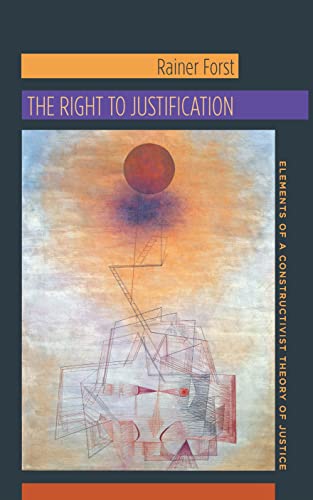
Synopsis
Contemporary philosophical pluralism recognizes the inevitability and legitimacy of multiple ethical perspectives and values, making it difficult to isolate the higher-order principles on which to base a theory of justice. Rising up to meet this challenge, Rainer Forst, a leading member of the Frankfurt School's newest generation of philosophers, conceives of an "autonomous" construction of justice founded on what he calls the basic moral right to justification.
Forst begins by identifying this right from the perspective of moral philosophy. Then, through an innovative, detailed critical analysis, he ties together the central components of social and political justice--freedom, democracy, equality, and toleration--and joins them to the right to justification. The resulting theory treats "justificatory power" as the central question of justice, and by adopting this approach, Forst argues, we can discursively work out, or "construct," principles of justice, especially with respect to transnational justice and human rights issues. As he builds his theory, Forst engages with the work of Anglo-American philosophers such as John Rawls, Ronald Dworkin, and Amartya Sen, and critical theorists such as Jürgen Habermas, Nancy Fraser, and Axel Honneth. Straddling multiple subjects, from politics and law to social protest and philosophical conceptions of practical reason, Forst brilliantly gathers contesting claims around a single, elastic theory of justice.Les informations fournies dans la section « Synopsis » peuvent faire référence à une autre édition de ce titre.
À propos de l'auteur
Rainer Forst is professor of political theory and philosophy at Goethe University in Frankfurt am Main, Germany, and director of the research cluster on the "Formation of Normative Orders." He is the author of Contexts of Justice: Political Philosophy Beyond Liberalism and Communitarianism; Toleration in Conflict: Past and Present; Justification and Critique: Towards a Critical Theory of Politics, and coauthor, with Wendy Brown, of The Power of Tolerance: A Debate. In 2012 he received the Gottfried Wilhelm Leibniz Prize, the highest honor awarded to German researchers.
Jeffrey Flynn is assistant professor of philosophy at Fordham University.Les informations fournies dans la section « A propos du livre » peuvent faire référence à une autre édition de ce titre.
Résultats de recherche pour The Right to Justification: Elements of a Constructivist...

Image d'archives
The Right to Justification: Elements of a Constructivist Theory of Justice (New Directions in Critical Theory)
Edité par
Columbia University Press, 2011
ISBN 10 : 0231147082
ISBN 13 : 9780231147088
Ancien ou d'occasion
Couverture rigide
Vendeur : Midtown Scholar Bookstore, Harrisburg, PA, Etats-Unis
Évaluation du vendeur 5 sur 5 étoiles

Hardcover. Etat : Good. Good - Bumped and creased book with tears to the extremities, but not affecting the text block, may have remainder mark or previous owner's name - GOOD Standard-sized. N° de réf. du vendeur M0231147082Z3
Acheter D'occasion
EUR 33,25
Expédition à EUR 5,33
Expédition nationale : Etats-Unis
Expédition nationale : Etats-Unis
Quantité disponible : 2 disponible(s)
Image d'archives
The Right to Justification: Elements of a Constructivist Theory of Justice (New Directions in Critical Theory)
Edité par
Columbia University Press, 2011
ISBN 10 : 0231147082
ISBN 13 : 9780231147088
Ancien ou d'occasion
Couverture rigide
Vendeur : Midtown Scholar Bookstore, Harrisburg, PA, Etats-Unis
Évaluation du vendeur 5 sur 5 étoiles
Hardcover. Etat : Very Good. Very Good - Crisp, clean, unread book with some shelfwear/edgewear, may have a remainder mark - NICE Standard-sized. N° de réf. du vendeur M0231147082Z2
Acheter D'occasion
EUR 33,76
Expédition à EUR 5,33
Expédition nationale : Etats-Unis
Expédition nationale : Etats-Unis
Quantité disponible : Plus de 20 disponibles
Image d'archives
The Right to Justification: Elements of a Constructivist Theory of Justice (New Directions in Critical Theory)
Edité par
Columbia University Press, 2011
ISBN 10 : 0231147082
ISBN 13 : 9780231147088
Neuf
Couverture rigide
Vendeur : Basi6 International, Irving, TX, Etats-Unis
Évaluation du vendeur 5 sur 5 étoiles
Etat : Brand New. New. US edition. Expediting shipping for all USA and Europe orders excluding PO Box. Excellent Customer Service. N° de réf. du vendeur ABEOCT25-399013
Acheter neuf
EUR 41,60
Livraison gratuite
Expédition nationale : Etats-Unis
Expédition nationale : Etats-Unis
Quantité disponible : 1 disponible(s)
Image d'archives
The Right to Justification: Elements of a Constructivist Theory of Justice
Edité par
Columbia University Press, New York, 2012
ISBN 10 : 0231147082
ISBN 13 : 9780231147088
Ancien ou d'occasion
Couverture rigide
Vendeur : Green Ink Booksellers, Hay-on-Wye, POWYS, Royaume-Uni
Évaluation du vendeur 5 sur 5 étoiles
Etat : Near Fine. Etat de la jaquette : Near Fine. Minor shelfwear otherwise clean bright tight book. N° de réf. du vendeur 640857
Acheter D'occasion
EUR 78,93
Expédition à EUR 14,15
Expédition depuis Royaume-Uni vers Etats-Unis
Expédition depuis Royaume-Uni vers Etats-Unis
Quantité disponible : 1 disponible(s)
Image d'archives
The Right to Justification: Elements of a Constructivist Theory of Justice (New Directions in Critical Theory, 46)
Edité par
Columbia University Press, New york, 2011
ISBN 10 : 0231147082
ISBN 13 : 9780231147088
Ancien ou d'occasion
Couverture rigide
Vendeur : Edmonton Book Store, Edmonton, AB, Canada
Évaluation du vendeur 4 sur 5 étoiles

Etat : very good. Etat de la jaquette : very good. 8vo pp.351. book. N° de réf. du vendeur 304187
Acheter D'occasion
EUR 68,65
Expédition à EUR 50,65
Expédition depuis Canada vers Etats-Unis
Expédition depuis Canada vers Etats-Unis
Quantité disponible : 1 disponible(s)
Image fournie par le vendeur
The Right to Justification
Edité par
Columbia University Press, US, 2011
ISBN 10 : 0231147082
ISBN 13 : 9780231147088
Neuf
Couverture rigide
Vendeur : Rarewaves USA, HEBRON, KY, Etats-Unis
Évaluation du vendeur 5 sur 5 étoiles
Hardback. Etat : New. Contemporary philosophical pluralism recognizes the inevitability and legitimacy of multiple ethical perspectives and values, making it difficult to isolate the higher-order principles on which to base a theory of justice. Rising up to meet this challenge, Rainer Forst, a leading member of the Frankfurt School's newest generation of philosophers, conceives of an "autonomous" construction of justice founded on what he calls the basic moral right to justification. Forst begins by identifying this right from the perspective of moral philosophy. Then, through an innovative, detailed critical analysis, he ties together the central components of social and political justice--freedom, democracy, equality, and toleration--and joins them to the right to justification. The resulting theory treats "justificatory power" as the central question of justice, and by adopting this approach, Forst argues, we can discursively work out, or "construct," principles of justice, especially with respect to transnational justice and human rights issues.As he builds his theory, Forst engages with the work of Anglo-American philosophers such as John Rawls, Ronald Dworkin, and Amartya Sen, and critical theorists such as Jurgen Habermas, Nancy Fraser, and Axel Honneth. Straddling multiple subjects, from politics and law to social protest and philosophical conceptions of practical reason, Forst brilliantly gathers contesting claims around a single, elastic theory of justice. N° de réf. du vendeur LU-9780231147088
Acheter neuf
EUR 149,56
Livraison gratuite
Expédition nationale : Etats-Unis
Expédition nationale : Etats-Unis
Quantité disponible : Plus de 20 disponibles
Image fournie par le vendeur
Right to Justification : Elements of a Constructivist Theory of Justice
Edité par
Columbia University Press, 2011
ISBN 10 : 0231147082
ISBN 13 : 9780231147088
Neuf
Couverture rigide
Vendeur : GreatBookPricesUK, Woodford Green, Royaume-Uni
Évaluation du vendeur 5 sur 5 étoiles
Etat : New. N° de réf. du vendeur 12519512-n
Acheter neuf
EUR 155,55
Expédition à EUR 17,68
Expédition depuis Royaume-Uni vers Etats-Unis
Expédition depuis Royaume-Uni vers Etats-Unis
Quantité disponible : Plus de 20 disponibles
Image fournie par le vendeur
Right to Justification : Elements of a Constructivist Theory of Justice
Edité par
Columbia University Press, 2011
ISBN 10 : 0231147082
ISBN 13 : 9780231147088
Ancien ou d'occasion
Couverture rigide
Vendeur : GreatBookPrices, Columbia, MD, Etats-Unis
Évaluation du vendeur 5 sur 5 étoiles
Etat : As New. Unread book in perfect condition. N° de réf. du vendeur 12519512
Acheter D'occasion
EUR 177,27
Expédition à EUR 2,35
Expédition nationale : Etats-Unis
Expédition nationale : Etats-Unis
Quantité disponible : Plus de 20 disponibles
Image fournie par le vendeur
The Right to Justification
Edité par
Columbia University Press, US, 2011
ISBN 10 : 0231147082
ISBN 13 : 9780231147088
Neuf
Couverture rigide
Vendeur : Rarewaves USA United, HEBRON, KY, Etats-Unis
Évaluation du vendeur 5 sur 5 étoiles
Hardback. Etat : New. Contemporary philosophical pluralism recognizes the inevitability and legitimacy of multiple ethical perspectives and values, making it difficult to isolate the higher-order principles on which to base a theory of justice. Rising up to meet this challenge, Rainer Forst, a leading member of the Frankfurt School's newest generation of philosophers, conceives of an "autonomous" construction of justice founded on what he calls the basic moral right to justification. Forst begins by identifying this right from the perspective of moral philosophy. Then, through an innovative, detailed critical analysis, he ties together the central components of social and political justice--freedom, democracy, equality, and toleration--and joins them to the right to justification. The resulting theory treats "justificatory power" as the central question of justice, and by adopting this approach, Forst argues, we can discursively work out, or "construct," principles of justice, especially with respect to transnational justice and human rights issues.As he builds his theory, Forst engages with the work of Anglo-American philosophers such as John Rawls, Ronald Dworkin, and Amartya Sen, and critical theorists such as Jurgen Habermas, Nancy Fraser, and Axel Honneth. Straddling multiple subjects, from politics and law to social protest and philosophical conceptions of practical reason, Forst brilliantly gathers contesting claims around a single, elastic theory of justice. N° de réf. du vendeur LU-9780231147088
Acheter neuf
EUR 155,56
Expédition à EUR 44,43
Expédition nationale : Etats-Unis
Expédition nationale : Etats-Unis
Quantité disponible : Plus de 20 disponibles
Image fournie par le vendeur
Right to Justification : Elements of a Constructivist Theory of Justice
Edité par
Columbia University Press, 2011
ISBN 10 : 0231147082
ISBN 13 : 9780231147088
Ancien ou d'occasion
Couverture rigide
Vendeur : GreatBookPricesUK, Woodford Green, Royaume-Uni
Évaluation du vendeur 5 sur 5 étoiles
Etat : As New. Unread book in perfect condition. N° de réf. du vendeur 12519512
Acheter D'occasion
EUR 184,07
Expédition à EUR 17,68
Expédition depuis Royaume-Uni vers Etats-Unis
Expédition depuis Royaume-Uni vers Etats-Unis
Quantité disponible : Plus de 20 disponibles