
Articles liés à Testament
Synopsis
"My starting point was that this character was not divine."
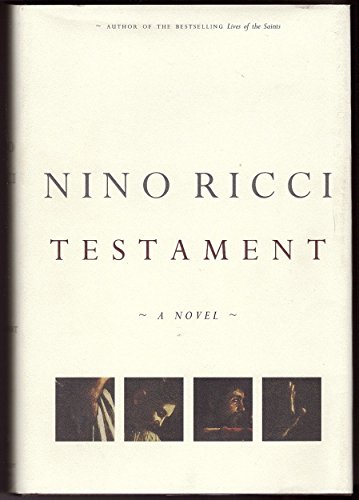
From Governor General’s Award-winner Nino Ricci, one of Canada’s most highly acclaimed literary voices, Testament is a bold work of historical fiction. Set in a remote corner of the Roman Empire at a moment of political unrest and spiritual uncertainty, it re-tells the life of a holy man of enormous charisma who alters the course of human history. Grounded in extensive research, and written with the poetic sensibility that has earned Ricci an international reputation, Testament vividly recreates first-century Palestine in elegant but accessible prose to explore the story of the man we know as Jesus.
Testament at once distances us from the familiar accounts by using Hebrew and Aramaic names. Moreover, he offers the story of Yeshua (Jesus) through the eyes and testimony of four fictional followers, reminiscent of yet utterly different from the Gospels, giving fresh perspective and a captivating narrative to an age-old story.
- Yihuda of Qiryat (Judas Iscariot) is a rebel freedom fighter working for Rome’s overthrow, who sees Yeshua come in from the desert. He is drawn to him; and yet he is full of doubt, always an outsider, too intellectual to simply accept and be accepted. “Tell me your secret,” he thinks, “make me new.”
- Miryam of Migdal (Mary Magdalene), whose family make a living curing fish, is captivated by the way Jesus includes her among his followers, who he encourages to ask questions and challenge him. For this woman, kept back by society from intellectual stimulation, he “reached inside me with his words to touch the inmost part of me.”
- Yeshua’s mother Miryam tells us plainly that he was the result of a rape by a Roman legate; she was forced to marry an old man named Yehoceph, and give birth in his rough lodgings. Her eldest son quickly set himself apart from his siblings. She shows how he learned from different teachers, always quick to challenge received knowledge.
- Finally, we read the account of Simon of Gergesa, a Greek shepherd who sees Jesus with hundreds of followers on a hill across the lake, and comes to the shore to hear him. « This was strange enough, for a Jew, to come out in search of us Syrians and Greeks. » Simon, who finds great sense in Jesus’ teachings, relates to us the last days of the Jewish preacher.
Nino Ricci says: “From the outset I assumed that Jesus was somebody who, in whatever way, was greater than I was, someone I wasn’t going to get to the bottom of.” So he used the technique of circling around the subject, giving different facets, trying to show by suggestion something that cannot be simply explained. “You can’t describe the light and you can’t portray the light, but you know the light is there because it is casting shadows.” In these overlapping narratives with varying interpretations, each narrator seeing the holy man according to his or her needs, we also see how the story may have been transformed through countless retellings.
“I don’t think he saw himself as the Son of God. I think that was a later overlay.” Ricci is not the first novelist to approach this central figure of Western civilization : notable others include D.H. Lawrence, Nikos Kazantzakis (who aroused much anger with his Last Temptation of Christ), Anthony Burgess, Jose Saramago, Norman Mailer, recently Jim Crace. However, Ricci ignored the divine element, using naturalistic explanations for the Bible’s miraculous events. “I find it much more interesting to think of him as having been a real person…who tries to change things in a human way with only human powers. To me that makes him a great man -- and a model.”
For research, Ricci travelled to Israel and Jordan to visit the Biblical sites; for an understanding of ancient Mediterranean peoples, he drew on knowledge of Italian folk culture and his experience with tribal peoples in Africa. He also read widely and deeply, from the Roman historian Josephus to contemporary academic works by a group of American scholars called the Jesus Seminar, especially John Dominic Crossan’s The Historical Jesus. Though controversial elements of the story drew some accusations of blasphemy, even the portrait of the virgin birth as a rape is grounded in research. Ricci did not expect true believers to be his readers, given the premise that Jesus was not divine.
“Canadians tend to be tolerant of other points of view,” however, says Ricci, and he finds controversy refreshing as long as it sparks analysis and discussion. The Jesus of Testament is a revolutionary teacher who continually challenges people and forces them to think for themselves. “Most writers feel it’s their job to stir up the pot a bit. If you’re not doing that, why bother?” The book has captivated many readers and provides much scope for debate with its bold depiction of Jesus. “Do I believe that it somehow represents the truth of who Jesus was? No. But I believe that it gives a way of understanding his character that sheds light on who he may have been.”
Les informations fournies dans la section « Synopsis » peuvent faire référence à une autre édition de ce titre.
À propos de l'auteur
Nino Ricci was born fourth of six children in an Italian farming family in Leamington, Ontario. His older siblings did well in school and got him interested in reading. He earned a B.A. from Toronto’s York University, and a M.A. from Montreal’s Concordia, and studied in Florence, Italy. He spent two years teaching in Nigeria with CUSO, and after settling in Toronto, served as a director and then President in the mid-nineties of PEN Canada, the human rights organization that works for freedom of expression.
The Lives of the Saints, his first novel, started out as his master’s thesis. It was originally to be a ‘satiric romp’ with a delusional character who believed he was the second coming of Christ; his professor helped to weed out the ‘over-the-top stuff’ of the early manuscripts by asking probing questions, and Ricci decided to divide what was an enormous project into three books. “I had no idea whether the book would ever be published; it was hard to write it for that reason because every day you’re thinking it might be just a waste of time. At the same time there is a kind of freedom in your early efforts.”
The novel, about a young Italian boy from an Appenine village whose mother becomes the subject of a scandal, spent a stunning seventy-five weeks on the Globe and Mail’s bestseller list, and was acclaimed in more than a dozen countries, winning prizes in Canada, England and France. The New York Times Book Review called it "an extraordinary story - brooding and ironic, suffused with yearning, tender and lucid and gritty." Ricci feels that readers identified with the characters, and were especially attracted to the child, as children have “such a fresh way of looking at the world.”
The trilogy continued with In a Glass House, in which Vittorio struggles to adapt to a new world. The Times of London summed up many reactions when they called it ‘beautifully written and tireless in its pursuit of emotional truth’. Readers were fascinated by the exploration of the Italian background and the immigrant experience. In the third novel, Where She Has Gone, Vittorio returns to his native village with hopes of rediscovering his roots. But it was not Ricci’s intention simply to write about ethnicity: “My original idea was to explore an intense relationship between a brother and a sister.” The novel builds slowly, exploding in a shocking scene of incest. The Boston Globe called Vittorio’s journey ‘a brilliant study of the way shame is passed down through generations’.
Not one to shy from difficult material, for his highly anticipated fourth novel Ricci took on the life of Jesus, knowing he was tackling a very taboo subject. It was also one close to his heart. Jesus was ‘a kind of ideal hero figure’ to him as a boy going to Catholic school; at the age of eight he dreamed of being a priest. In his teens he began to feel his commitment to Christianity was too tepid, and joined an evangelical group to see if it would feel ‘more real’, but the sense of failure was ineluctable. At university, he went through a strong intellectual rejection of the religion, but continued to search for a middle ground that could acknowledge the cultural importance of Christianity as well as the strength of the figure of Jesus himself.
With the historical novel Testament, Ricci wanted to get close to the source and find a Jesus who made sense outside the confines of church dogma, not only for people like him with an ambivalent relationship to their own religious upbringing, but to encourage readers in general to think about the moral and religious issues that inform our culture. He wanted to explore what might have been the real person behind the stories and the myths, a charismatic Jewish leader with single-minded vision and some revolutionary teachings, and a special kind of energy. While other writers have given us their contemporary take on Jesus, Ricci also took away the divine element and approached him from a strictly human angle. He succeeded in creating a believable, moving and compelling portrait of Jesus. Still, he agrees it was an ambitious idea: “As a writer, you spend a lot of time alone in a room and you think you can do anything. Four years later you come out in public and you realize what you’ve done.”
Extrait. © Reproduit sur autorisation. Tous droits réservés.
Book I
Yihuda of Qiryat
I first saw him in the winter of that year at En Melakh, a town of a few hundred just north of the Salt Sea. He had come in out of the desert, people said -- from the look of him, his blistered face and the way his skin hung from his bones, he’d passed a good while there. He had set himself up now just off the square, squatting in the shade of an old fig tree; I had a good view of him from the porch of the tavern I’d put up in across the way. Some of the townspeople, no doubt taking him for a holy man, dropped bits of food in front of him from time to time, which he accepted with a nod of his head but more often than not couldn’t seem to bring himself to stomach, letting them sit there in the dirt for the flies to collect on or the dogs to snatch away.
Though the town lay on the Roman side of the frontier, the soldiers of Herod Antipas often passed that way when they travelled up from his southern territories. At the time, I was awaiting an informant we had among Herod’s men on his way back to the court from the Macherus fortress. The holy man had appeared perhaps the third day of my wait, simply there beneath the fig tree when I awoke; from the joyless look of him I thought he might have been cast out from one of the desert cults, the way they did sometimes if some bit of food should touch your hand before you’d washed it or if you missed some pause or half-word in your prayers. His hair and beard were scraggly and short as if recently shaved for a vow -- they gave him a boyish appearance but couldn’t however quite take the dignity from him, which seemed to sit on him like some mantle someone had laid over him.
He wasn’t wearing any sandals or cloak. I thought surely he’d had some cave out there to hole up in, and some brush for fire, or he would have frozen to death in the cold. Even here in the valley the nights had been bitter, the little heat the sun built up over the day through the winter haze vanishing the instant dusk fell. I waited to see if he planned to weather the night in the open or repair to some cranny when darkness set in. But the sun dropped and he didn’t move. My tavern-keeper, a mangy sort with an open sore on one of his knuckles, brought a lamp out to the porch and a bit of the gruel he passed off as food.
“He’s a quiet one, that one,” he said, with his low, vulgar laugh, trying to ingratiate himself. “Nearly dead, from the look of it.”
Not ten strides from the man some of the boys of the town, coming out after their suppers, began to get up a bit of a fire, spitting and holding their hands up to the flames and keeping their talk low lest the holy man overhear them. The orange haze their fire threw out just reached the man where he was, making him seem like someone at a threshold, someone turned away from the room of light the fire formed. Get up and warm yourself, I wanted to say to him, feeling I was out there with him in the cold, with the wind at my ankles and just a few bits of bread in my belly. But still he sat. It occurred to me that he was perhaps simply too enfeebled to rise, that his hapless look was his own hunger-dimmed wonder that he could sit there as his life ebbed away and not be able to lift a finger to save himself.
I had half-resolved to go out and offer him my cloak when I was headed off by a woman who was apparently the mother of one of the boys in the square, and who came out chastising the lot of them.
“Animals! Didn’t one of you think to give him a bit of fire?”
And she proceeded to purloin some of the precious faggots of wood the boys had no doubt scrounged for all afternoon in the brush and to build a little fire in front of the man. When she’d got a blaze going she took off her own shawl and draped it over his shoulders, then took her son by the ear and dragged him off home. Within minutes the rest of the boys, thus humiliated, had begun to disperse as well, the last two or three lingering defiantly a bit before finally quenching their own fire and shamefacedly dropping their remaining handfuls of wood into that of the holy man.
The holy man, for his part, had seemed oblivious to all of this. But when the boys had gone I detected a bit of movement in him, a slight drawing in towards the fire as if towards some secret it might whisper to him. I thought I ought to assure myself that he at least had his wits about him, and so, with the excuse of further stoking his fire, I took a few twigs from the small bundle that the tavern-keeper kept near his gate and walked out to him. It was only when I got close to him that I saw what his body had been giving in to: he had fallen asleep. I wavered a moment over tending to him -- it was always my instinct then in situations of that kind to err on the side of indifference, as the way of drawing the least attention to myself. But seeing him helpless like that in his sleep, and even more hopelessly frail than he had seemed from a distance, I shored up his fire a bit and then for good measure draped my cloak over his shawl, knowing that I could beg an extra blanket off the tavern-keeper for my own lice-infested bed. What struck me as I draped the cloak over him was how peculiar this act of charity felt, how alien to my nature, as if I had now truly become a man whom I’d thought I merely feigned to be.
Les informations fournies dans la section « A propos du livre » peuvent faire référence à une autre édition de ce titre.
Résultats de recherche pour Testament

Image d'archives
Testament
Edité par
Doubleday Canada, 2002
ISBN 10 : 0385658540
ISBN 13 : 9780385658546
Ancien ou d'occasion
Couverture rigide
Vendeur : More Than Words, Waltham, MA, Etats-Unis
Évaluation du vendeur 5 sur 5 étoiles

Etat : Good. A sound copy with only light wear. Overall a solid copy at a great price! N° de réf. du vendeur BOS-E-11a-01709
Acheter D'occasion
EUR 1,53
Expédition à EUR 3,57
Expédition nationale : Etats-Unis
Expédition nationale : Etats-Unis
Quantité disponible : 1 disponible(s)
Image d'archives
Testament
Edité par
Doubleday Canada, 2002
ISBN 10 : 0385658540
ISBN 13 : 9780385658546
Ancien ou d'occasion
Couverture rigide
Edition originale
Vendeur : Better World Books, Mishawaka, IN, Etats-Unis
Évaluation du vendeur 5 sur 5 étoiles
Etat : Good. 1St Edition. Former library copy. Pages intact with minimal writing/highlighting. The binding may be loose and creased. Dust jackets/supplements are not included. Includes library markings. Stock photo provided. Product includes identifying sticker. Better World Books: Buy Books. Do Good. N° de réf. du vendeur GRP88604559
Acheter D'occasion
EUR 10,27
Livraison gratuite
Expédition nationale : Etats-Unis
Expédition nationale : Etats-Unis
Quantité disponible : 1 disponible(s)
Image d'archives
Testament
Edité par
Doubleday Canada, 2002
ISBN 10 : 0385658540
ISBN 13 : 9780385658546
Ancien ou d'occasion
Couverture rigide
Vendeur : SustainableBooks.com, Amherst, NY, Etats-Unis
Évaluation du vendeur 5 sur 5 étoiles
Etat : Very Good. Book is in Used-VeryGood condition. Pages and cover are clean and intact. Used items may not include supplementary materials such as CDs or access codes. May show signs of minor shelf wear and contain very limited notes and highlighting. N° de réf. du vendeur 0385658540-2-3
Acheter D'occasion
EUR 13,81
Livraison gratuite
Expédition nationale : Etats-Unis
Expédition nationale : Etats-Unis
Quantité disponible : 1 disponible(s)
Image d'archives
Testament: A Novel
Edité par
Doubleday Canada, Toronto, Ontario, 2002
ISBN 10 : 0385658540
ISBN 13 : 9780385658546
Ancien ou d'occasion
Couverture rigide
Vendeur : Hourglass Books, Vancouver, BC, Canada
Évaluation du vendeur 5 sur 5 étoiles
Hardcover. Etat : Very Good. Etat de la jaquette : Very Good, Not Price Clipped. Canadian First. Complete number line from 1 to 10; some edge wear to boards and dust jacket; otherwise a solid, clean copy with no marking or underlining; collectible condition. Book. N° de réf. du vendeur 013354
Acheter D'occasion
EUR 13,83
Livraison gratuite
Expédition depuis Canada vers Etats-Unis
Expédition depuis Canada vers Etats-Unis
Quantité disponible : 1 disponible(s)
Image d'archives
Testament: A Novel
Edité par
Doubleday Canada, Toronto, Ontario, 2002
ISBN 10 : 0385658540
ISBN 13 : 9780385658546
Ancien ou d'occasion
Couverture rigide
Signé
Vendeur : Hourglass Books, Vancouver, BC, Canada
Évaluation du vendeur 5 sur 5 étoiles
Hardcover. Etat : Near Fine. Etat de la jaquette : Near Fine, Not Price Clipped. Canadian First. Complete number line from 1 to 10; signed by Nino Ricci on the title page with no inscription; minor wear; otherwise a solid, clean copy with no marking or underlining; collectible condition. Signed by Author(s). Book. N° de réf. du vendeur 020549
Acheter D'occasion
EUR 18,44
Livraison gratuite
Expédition depuis Canada vers Etats-Unis
Expédition depuis Canada vers Etats-Unis
Quantité disponible : 1 disponible(s)
Image d'archives
Testament
Edité par
Doubleday Canada Ltd., 2002
ISBN 10 : 0385658540
ISBN 13 : 9780385658546
Ancien ou d'occasion
Couverture rigide
Edition originale
Signé
Vendeur : Heroes Bookshop, Paris, ON, Canada
Évaluation du vendeur 4 sur 5 étoiles

Hardcover. Etat : Very Good. Etat de la jaquette : Acceptable. First Edition. flat signed by Nino Ricci on the title page.previous owners name on the FFEP.this copy has a solid tight binding with clean unmarked pages.the dust jacket has chipping and small tears to it's edges.mylar protected. Signed by Author. N° de réf. du vendeur js767
Acheter D'occasion
EUR 11,98
Expédition à EUR 8,95
Expédition depuis Canada vers Etats-Unis
Expédition depuis Canada vers Etats-Unis
Quantité disponible : 1 disponible(s)
Image d'archives
Testament
Edité par
Doubleday, Toronto, 2002
ISBN 10 : 0385658540
ISBN 13 : 9780385658546
Ancien ou d'occasion
Couverture rigide
Edition originale
Vendeur : B-Line Books, Amherst, NS, Canada
Évaluation du vendeur 5 sur 5 étoiles
Hardcover. Etat : Fine. Etat de la jaquette : Near Fine. First Edition; First Printing. 457 pages; "My starting point was that this character was not divine."From Governor General?s Award-winner Nino Ricci, one of Canada?s most highly acclaimed literary voices, Testament is a bold work of historical fiction. Set in a remote corner of the Roman Empire at a moment of political unrest and spiritual uncertainty, it re-tells the life of a holy man of enormous charisma who alters the course of human history. Grounded in extensive research, and written with the poetic sensibility that has earned Ricci an international reputation, Testament vividly recreates first-century Palestine in elegant but accessible prose to explore the story of the man we know as Jesus.Testament at once distances us from the familiar accounts by using Hebrew and Aramaic names. Moreover, he offers the story of Yeshua (Jesus) through the eyes and testimony of four fictional followers, reminiscent of yet utterly different from the Gospels, giving fresh perspective and a captivating narrative to an age-old story.- Yihuda of Qiryat (Judas Iscariot) is a rebel freedom fighter working for Rome?s overthrow, who sees Yeshua come in from the desert. He is drawn to him; and yet he is full of doubt, always an outsider, too intellectual to simply accept and be accepted. ?Tell me your secret,? he thinks, ?make me new.?- Miryam of Migdal (Mary Magdalene), whose family make a living curing fish, is captivated by the way Jesus includes her among his followers, who he encourages to ask questions and challenge him. For this woman, kept back by society from intellectual stimulation, he ?reached inside me with his words to touch the inmost part of me.?- Yeshua?s mother Miryam tells us plainly that he was the result of a rape by a Roman legate; she was forced to marry an old man named Yehoceph, and give birth in his rough lodgings. Her eldest son quickly set himself apart from his siblings. She shows how he learned from different teachers, always quick to challenge received knowledge.- Finally, we read the account of Simon of Gergesa, a Greek shepherd who sees Jesus with hundreds of followers on a hill across the lake, and comes to the shore to hear him. ëà This was strange enough, for a Jew, to come out in search of us Syrians and Greeks.à û Simon, who finds great sense in Jesus? teachings, relates to us the last days of the Jewish preacher.Nino Riccià says: ?From the outset I assumed that Jesus was somebody who, in whatever way, was greater than I was, someone I wasn?t going to get to the bottom of.? So he used the technique of circling around the subject, giving different facets, trying to show by suggestion something that cannot be simply explained. ?You can?t describe the light and you can?t portray the light, but you know the light is there because it is casting shadows.? In these overlapping narratives with varying interpretations, each narrator seeing the holy man according to his or her needs, we also see how the story may have been transformed through countless retellings.?I don?t think he saw himself as the Son of God. I think that was a later overlay.? Ricci is not the first novelist to approach this central figure of Western civilizationà : notable others include D.H. Lawrence, Nikos Kazantzakis (who aroused much anger with his Last Temptation of Christ), Anthony Burgess, Jose Saramago, Norman Mailer, recently Jim Crace. However, Ricci ignored the divine element, using naturalistic explanations for the Bible?s miraculous events. ?I find it much more interesting to think of him as having been a real person?who tries to change things in a human way with only human powers.à To me that makes him a great man -- and a model.? For research, Ricci travelled to Israel and Jordanà to visit the Biblical sites; for an understanding of ancient Mediterranean peoples, he drew on knowledge of Italian folk culture and his experience with tribal peoples in Africa. He also read widely and deeply, from the Roman historian Josephus to contemporary academic works by a group of American scholars called the Jesus Seminar, especially John Dominic Crossan?s The Historical Jesus. Though controversial elements of the story drew some accusations of blasphemy, even the portrait of the virgin birth as a rape is grounded in research. Ricci did not expect true believers to be his readers, given the premise that Jesus was not divine.?Canadians tend to be tolerant of other points of view,? however, says Ricci, and he finds controversy refreshingà as long as it sparks analysis and discussion. The Jesus of Testament is a revolutionary teacher who continually challenges people and forces them to think for themselves. ?Most writers feel it?s their job to stir up the pot a bit. If you?re not doing that, why bother?? The book has captivated many readers and provides much scope for debate with its bold depiction of Jesus. ?Do I believe that it somehow represents the truth of who Jesus was? No. But I believe that it gives a way of understanding his character that sheds light on who he may have been.? N° de réf. du vendeur 22881
Acheter D'occasion
EUR 12,91
Expédition à EUR 11,19
Expédition depuis Canada vers Etats-Unis
Expédition depuis Canada vers Etats-Unis
Quantité disponible : 1 disponible(s)
Image d'archives
Testament
Edité par
Doubleday Canada, Toronto, 2002
ISBN 10 : 0385658540
ISBN 13 : 9780385658546
Ancien ou d'occasion
Couverture rigide
Vendeur : BISON BOOKS - ABAC/ILAB, Winnipeg, MB, Canada
Évaluation du vendeur 5 sur 5 étoiles
Hardcover. Etat de la jaquette : dj. pp. 457. 8vo. Brown binding with gilt lettering to spine. Light shelfwear; very good+ in very good+ dustjacket. N° de réf. du vendeur 084018
Acheter D'occasion
EUR 12,50
Expédition à EUR 11,62
Expédition depuis Canada vers Etats-Unis
Expédition depuis Canada vers Etats-Unis
Quantité disponible : 1 disponible(s)
Image d'archives
Testament
Edité par
Doubleday Canada, 2002
ISBN 10 : 0385658540
ISBN 13 : 9780385658546
Ancien ou d'occasion
Couverture rigide
Vendeur : Booked Experiences Bookstore, Burlington, ON, Canada
Évaluation du vendeur 4 sur 5 étoiles
Hardcover. Etat : Fine. Etat de la jaquette : Fine. pp.456 clean tight copy with former owner's initials on frontpiece Size: 8vo - over 7¾" - 9¾" tall. N° de réf. du vendeur 014061
Acheter D'occasion
EUR 11,94
Expédition à EUR 12,53
Expédition depuis Canada vers Etats-Unis
Expédition depuis Canada vers Etats-Unis
Quantité disponible : 1 disponible(s)
Image d'archives
Testament, a Novel (Signed copy)
Edité par
Doubleday Canada Ltd., Toronto, 2002
ISBN 10 : 0385658540
ISBN 13 : 9780385658546
Ancien ou d'occasion
Couverture rigide
Edition originale
Signé
Vendeur : J. W. Mah, Burnaby, BC, Canada
Évaluation du vendeur 5 sur 5 étoiles
Hardcover. Etat : Fine. Etat de la jaquette : Fine. 1st. (CAD) 1st printing. SIGNED BY AUTHOR in characteristic squiggle to title page, no other markings, Fine n Fine dust jacket. Boards, 457pp. This novel is about a holy man and political fighter set in a remote corner of the Roman Empire. (2.3 JM LVR 200/4 Size: 8vo - over 7¾" - 9¾". Signed by Author. N° de réf. du vendeur 04170
Acheter D'occasion
EUR 18,39
Expédition à EUR 8,05
Expédition depuis Canada vers Etats-Unis
Expédition depuis Canada vers Etats-Unis
Quantité disponible : 1 disponible(s)