
Articles liés à Testament
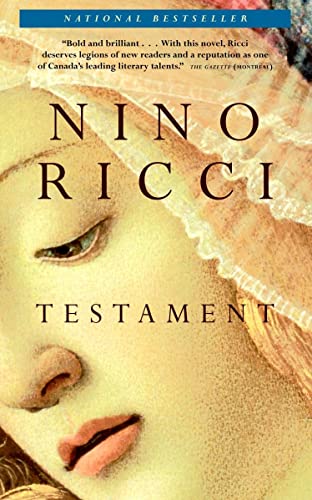
Synopsis
Provocative, ambitious and rich in the sights and smells of the ancient world, Testament brings a new perspective to the greatest story ever told.
From Governor General’ s Award-winner Nino Ricci, one of Canada’s most highly acclaimed literary voices, Testament is a bold work of historical fiction. Set in a remote corner of the Roman Empire at a moment of political unrest and spiritual uncertainty, it re-tells the life of a holy man of enormous charisma who alters the course of human history. Grounded in extensive research, and written with the poetic sensibility that has earned Ricci an international reputation, Testament vividly recreates first-century Palestine in elegant but accessible prose to explore the story of the man we know as Jesus.
Les informations fournies dans la section « Synopsis » peuvent faire référence à une autre édition de ce titre.
À propos de l'auteur
NINO RICCI's first novel, Lives of the Saints, won the Governor General's Literary Award for Fiction, the SmithBooks/Books in Canada First Novel Award, and the F.G. Bressani Prize and was made into a motion picture starring Sophia Loren. The novel was also a long-time national bestseller, and was followed by the highly acclaimed In a Glass House and Where She Has Gone, which was shortlisted for the Scotiabank Giller Prize. His bestselling novel Testament won the Trillium Book Award. The Origin of Species received the Governor General's Literary Award for Fiction and the Canadian Authors Association Award for Fiction. Nino Ricci has also won the Betty Trask Award for Fiction (UK), The Winnifred Holtby Prize (UK) and the 1992 Prise Contrepoint Madrineaux (France). He lives in Toronto.
Extrait. © Reproduit sur autorisation. Tous droits réservés.
Book I
Yihuda of Qiryat
I first saw him in the winter of that year at En Melakh, a town of a few hundred just north of the Salt Sea. He had come in out of the desert, people said -- from the look of him, his blistered face and the way his skin hung from his bones, he’d passed a good while there. He had set himself up now just off the square, squatting in the shade of an old fig tree; I had a good view of him from the porch of the tavern I’d put up in across the way. Some of the townspeople, no doubt taking him for a holy man, dropped bits of food in front of him from time to time, which he accepted with a nod of his head but more often than not couldn’t seem to bring himself to stomach, letting them sit there in the dirt for the flies to collect on or the dogs to snatch away.
Though the town lay on the Roman side of the frontier, the soldiers of Herod Antipas often passed that way when they travelled up from his southern territories. At the time, I was awaiting an informant we had among Herod’s men on his way back to the court from the Macherus fortress. The holy man had appeared perhaps the third day of my wait, simply there beneath the fig tree when I awoke; from the joyless look of him I thought he might have been cast out from one of the desert cults, the way they did sometimes if some bit of food should touch your hand before you’d washed it or if you missed some pause or half-word in your prayers. His hair and beard were scraggly and short as if recently shaved for a vow -- they gave him a boyish appearance but couldn’t however quite take the dignity from him, which seemed to sit on him like some mantle someone had laid over him.
He wasn’t wearing any sandals or cloak. I thought surely he’d had some cave out there to hole up in, and some brush for fire, or he would have frozen to death in the cold. Even here in the valley the nights had been bitter, the little heat the sun built up over the day through the winter haze vanishing the instant dusk fell. I waited to see if he planned to weather the night in the open or repair to some cranny when darkness set in. But the sun dropped and he didn’t move. My tavern-keeper, a mangy sort with an open sore on one of his knuckles, brought a lamp out to the porch and a bit of the gruel he passed off as food.
“He’s a quiet one, that one,” he said, with his low, vulgar laugh, trying to ingratiate himself. “Nearly dead, from the look of it.”
Not ten strides from the man some of the boys of the town, coming out after their suppers, began to get up a bit of a fire, spitting and holding their hands up to the flames and keeping their talk low lest the holy man overhear them. The orange haze their fire threw out just reached the man where he was, making him seem like someone at a threshold, someone turned away from the room of light the fire formed. Get up and warm yourself, I wanted to say to him, feeling I was out there with him in the cold, with the wind at my ankles and just a few bits of bread in my belly. But still he sat. It occurred to me that he was perhaps simply too enfeebled to rise, that his hapless look was his own hunger-dimmed wonder that he could sit there as his life ebbed away and not be able to lift a finger to save himself.
I had half-resolved to go out and offer him my cloak when I was headed off by a woman who was apparently the mother of one of the boys in the square, and who came out chastising the lot of them.
“Animals! Didn’t one of you think to give him a bit of fire?”
And she proceeded to purloin some of the precious faggots of wood the boys had no doubt scrounged for all afternoon in the brush and to build a little fire in front of the man. When she’d got a blaze going she took off her own shawl and draped it over his shoulders, then took her son by the ear and dragged him off home. Within minutes the rest of the boys, thus humiliated, had begun to disperse as well, the last two or three lingering defiantly a bit before finally quenching their own fire and shamefacedly dropping their remaining handfuls of wood into that of the holy man.
The holy man, for his part, had seemed oblivious to all of this. But when the boys had gone I detected a bit of movement in him, a slight drawing in towards the fire as if towards some secret it might whisper to him. I thought I ought to assure myself that he at least had his wits about him, and so, with the excuse of further stoking his fire, I took a few twigs from the small bundle that the tavern-keeper kept near his gate and walked out to him. It was only when I got close to him that I saw what his body had been giving in to: he had fallen asleep. I wavered a moment over tending to him -- it was always my instinct then in situations of that kind to err on the side of indifference, as the way of drawing the least attention to myself. But seeing him helpless like that in his sleep, and even more hopelessly frail than he had seemed from a distance, I shored up his fire a bit and then for good measure draped my cloak over his shawl, knowing that I could beg an extra blanket off the tavern-keeper for my own lice-infested bed. What struck me as I draped the cloak over him was how peculiar this act of charity felt, how alien to my nature, as if I had now truly become a man whom I’d thought I merely feigned to be.
Les informations fournies dans la section « A propos du livre » peuvent faire référence à une autre édition de ce titre.
Résultats de recherche pour Testament

Image fournie par le vendeur
Testament
Edité par
Doubleday Canada, 2003
ISBN 10 : 0385658559
ISBN 13 : 9780385658553
Ancien ou d'occasion
paperback
Vendeur : WeBuyBooks, Rossendale, LANCS, Royaume-Uni
Évaluation du vendeur 5 sur 5 étoiles

paperback. Etat : Good. Most items will be dispatched the same or the next working day. A copy that has been read but remains in clean condition. All of the pages are intact and the cover is intact and the spine may show signs of wear. The book may have minor markings which are not specifically mentioned. N° de réf. du vendeur rev5322169599
Acheter D'occasion
EUR 2,42
Expédition à EUR 6,20
Expédition depuis Royaume-Uni vers Etats-Unis
Expédition depuis Royaume-Uni vers Etats-Unis
Quantité disponible : 1 disponible(s)
Image d'archives
Testament
Edité par
Anchor Canada, 2003
ISBN 10 : 0385658559
ISBN 13 : 9780385658553
Ancien ou d'occasion
Couverture souple
Vendeur : Better World Books, Mishawaka, IN, Etats-Unis
Évaluation du vendeur 5 sur 5 étoiles
Etat : Very Good. Pages intact with possible writing/highlighting. Binding strong with minor wear. Dust jackets/supplements may not be included. Stock photo provided. Product includes identifying sticker. Better World Books: Buy Books. Do Good. N° de réf. du vendeur 40301000-75
Acheter D'occasion
EUR 8,88
Livraison gratuite
Expédition nationale : Etats-Unis
Expédition nationale : Etats-Unis
Quantité disponible : 1 disponible(s)
Image d'archives
Testament
Edité par
Anchor Canada, 2003
ISBN 10 : 0385658559
ISBN 13 : 9780385658553
Ancien ou d'occasion
Couverture souple
Vendeur : Better World Books, Mishawaka, IN, Etats-Unis
Évaluation du vendeur 5 sur 5 étoiles
Etat : Good. Pages intact with minimal writing/highlighting. The binding may be loose and creased. Dust jackets/supplements are not included. Stock photo provided. Product includes identifying sticker. Better World Books: Buy Books. Do Good. N° de réf. du vendeur GRP99081168
Acheter D'occasion
EUR 8,88
Livraison gratuite
Expédition nationale : Etats-Unis
Expédition nationale : Etats-Unis
Quantité disponible : 1 disponible(s)
Image d'archives
Testament
Edité par
Doubleday Canada, 2003
ISBN 10 : 0385658559
ISBN 13 : 9780385658553
Ancien ou d'occasion
paperback
Vendeur : Reuseabook, Gloucester, GLOS, Royaume-Uni
Évaluation du vendeur 5 sur 5 étoiles
paperback. Etat : Used; Good. Dispatched, from the UK, within 48 hours of ordering. This book is in good condition but will show signs of previous ownership. Please expect some creasing to the spine and/or minor damage to the cover. Aged book. Tanned pages and age spots, however, this will not interfere with reading. Damaged cover. The cover of is slightly damaged for instance a torn or bent corner. N° de réf. du vendeur CHL10714405
Acheter D'occasion
EUR 4,75
Expédition à EUR 8,27
Expédition depuis Royaume-Uni vers Etats-Unis
Expédition depuis Royaume-Uni vers Etats-Unis
Quantité disponible : 1 disponible(s)
Image d'archives
Testament
Edité par
Anchor Canada February 2003, 2003
ISBN 10 : 0385658559
ISBN 13 : 9780385658553
Ancien ou d'occasion
Trade Paperback
Vendeur : Old Goat Books, Waterloo, ON, Canada
Évaluation du vendeur 3 sur 5 étoiles

Trade Paperback. Etat : Near Fine. Etat de la jaquette : Near Fine. Condition: 'NF' Notes: Novel. N° de réf. du vendeur 1139625
Acheter D'occasion
EUR 9,19
Expédition à EUR 14,28
Expédition depuis Canada vers Etats-Unis
Expédition depuis Canada vers Etats-Unis
Quantité disponible : 1 disponible(s)
Image d'archives
Testament
Edité par
Doubleday Canada, Limited, 2003
ISBN 10 : 0385658559
ISBN 13 : 9780385658553
Ancien ou d'occasion
Paperback
Vendeur : Russell Books, Victoria, BC, Canada
Évaluation du vendeur 5 sur 5 étoiles
Paperback. Etat : Good. 1st Printing. N° de réf. du vendeur FORT524192
Acheter D'occasion
EUR 9,18
Expédition à EUR 17,84
Expédition depuis Canada vers Etats-Unis
Expédition depuis Canada vers Etats-Unis
Quantité disponible : 1 disponible(s)
Image d'archives
Testament
Edité par
Doubleday Canada, Limited, 2003
ISBN 10 : 0385658559
ISBN 13 : 9780385658553
Ancien ou d'occasion
Paperback
Vendeur : Russell Books, Victoria, BC, Canada
Évaluation du vendeur 5 sur 5 étoiles
Paperback. Etat : Very Good. 1st Printing. N° de réf. du vendeur FORT469932
Acheter D'occasion
EUR 9,18
Expédition à EUR 17,84
Expédition depuis Canada vers Etats-Unis
Expédition depuis Canada vers Etats-Unis
Quantité disponible : 3 disponible(s)
Image fournie par le vendeur
Testament
Edité par
Anchor Canada, 2003
ISBN 10 : 0385658559
ISBN 13 : 9780385658553
Ancien ou d'occasion
Soft cover
Edition originale
Signé
Vendeur : Singing Pebble Books, Ottawa, ON, Canada
Évaluation du vendeur 5 sur 5 étoiles
Soft cover. Etat : Near Fine. 1st Edition. In Near Fine condition, all pages are clean with no markings. Slight scuffing on front and back cover. Inscribed by author. Inscribed by Author(s). N° de réf. du vendeur ABE-1746745974057
Acheter D'occasion
EUR 16,12
Expédition à EUR 26,78
Expédition depuis Canada vers Etats-Unis
Expédition depuis Canada vers Etats-Unis
Quantité disponible : 1 disponible(s)