
Articles liés à Representations: Images of the World in Ciceronian...
Synopsis
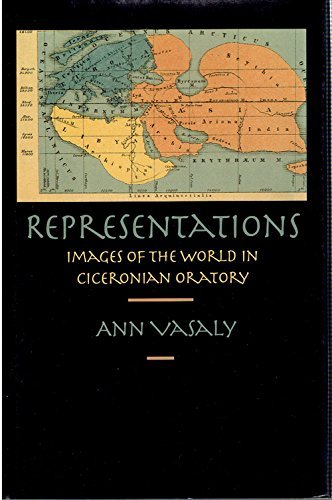
Ann Vasaly introduces representation theory into the study of Ciceronian persuasion and contends that an understanding of milieu—social, political, topographical—is crucial to understanding Ciceronian oratory. As a genre uniquely dependent on an immediate interaction between author and audience, ancient oratory becomes performance art.
Vasaly investigates the way Cicero represented the contemporary physical world—places, topography, and monuments, both those seen and those merely mentioned—to his listeners and demonstrates how he used these representations to persuade. Her exceptionally well-written study deftly recaptures the immediacy of Cicero's oratory and makes a trenchant contribution to an important new area of inquiry in Classical Studies.
Vasaly investigates the way Cicero represented the contemporary physical world—places, topography, and monuments, both those seen and those merely mentioned—to his listeners and demonstrates how he used these representations to persuade. Her exceptionally well-written study deftly recaptures the immediacy of Cicero's oratory and makes a trenchant contribution to an important new area of inquiry in Classical Studies.
Les informations fournies dans la section « Synopsis » peuvent faire référence à une autre édition de ce titre.
À propos de l'auteur
Ann Vasaly is Assistant Professor of Classical Studies at Boston University.
À propos de la quatrième de couverture
"This is the first book to undertake a study of how Cicero represented his raw material to the public. It does so in a very readable and attractive way, and none who take it up will find it easy to abandon."—Elaine Fantham, Princeton University
"The kind of study that enriches and enlivens our understanding. . . . There is nothing else like it in Ciceronian studies."—Eleanor Winsor Leach, Indiana University
"The kind of study that enriches and enlivens our understanding. . . . There is nothing else like it in Ciceronian studies."—Eleanor Winsor Leach, Indiana University
Extrait. © Reproduit sur autorisation. Tous droits réservés.
Representations: Images of the World in Ciceronian Oratory
By Ann VasalyUniversity of California Press
Copyright © 1993 Ann VasalyAll right reserved.
ISBN: 0520077555
Introduction: Theory and Practice
The first [thing to notice] is that the motorcycle, so described, is almost impossible to understand unless you already know how one works. . . . The second is that the observer is missing. . . . "You" aren't anywhere in the picture. Even the "operator" is a kind of personalityless robot whose performance of a function on the machine is completely mechanical. There are no real subjects in this description. Only objects exist that are independent of any observer.
Robert Persig, Zen and the Art of Motorcycle Maintenance
In the ancient Greek world the study of the art of persuasion sprang up at almost the same time as the democratic forms of government that made the ability to persuade large groups of one's fellow citizens, whether in the courtroom or in the agora, crucial to political success. The earliest handbooks of rhetoric are attributed to Corax and Tisias, rhetors of the early fifth century B.C. who became teachers of forensic oratory after the death of Hieron I had ushered in an era of democratic government in Syracuse and other cities in eastern Sicily. Teachers of oratory such as Gorgias of Leontini, who began arriving in Athens in the latter half of the fifth century B.C. , found the city filled with young men eager to pay for instruction in the techniques of persuasion. The kind of theoretical instruction offered by fifth- and fourth-century Sophists was mirrored in the handbooks of rhetoric written in the period, now imperfectly preserved through the extant fragments, through their incorporation in later works, and through the criticism leveled at them by contemporary writers, especially Plato and Aristotle.1
For a survey of the early history of Greek rhetoric, see Kennedy, Art of Persuasion, 26–124. For the rhetorical teaching of the Sophists and the handbooks attributed to them, see Guthrie, Greek Philosophy, 3:20, 44–54, 44–45 n. 4, 176–225. All translations in this and subsequent chapters are my own unless otherwise noted.
By the Hellenistic period rhetorical theory had grown increasingly elaborate, related only tangentially to the progress of practical oratory. While Aristotle had accurately seen that the itinerant Sophists and rhetors of his time—and the handbooks that reflected their teaching—did not offer a rational and systematic exposition of the means whereby persuasion might be achieved, it should be kept in mind that the teachers and works he maligned were closely wedded to the world of everyday oratorical practice. These men knew the sorts of arguments and strategies that were successful and could teach them to those who were willing to pay. Aristotle, through his clarification and classification of rhetorical elements and strategies, succeeded in rationalizing the modes of persuasion to an extent never before achieved. But at the same time his treatise on the art of rhetoric was part of the process whereby rhetorical theory became divorced from rhetorical practice. Every theoretical description of an art is, by definition, divorced from the art it attempts to describe; but in the case of the ars rhetorica the theoretical tradition early on acquired an astonishing vitality of its own, frequently independent of the practical art that had first brought it into existence. So separate was rhetorical theory that its development, whether by philosophers or rhetoricians themselves, was hardly weakened by the shrinking of the role of deliberative and forensic oratory in the fourth and third centuries B.C. that was brought about by the demise of democratic systems in the Greek world. In fact, rhetorical theory flourished in the Hellenistic period, building an ever more complex superstructure upon the inheritance of the past.2
Unlike the Greeks, Roman orators for a very long time after the birth of the Republic (traditionally dated, like the overthrow of the Pisistratid tyranny at Athens, to 510 B.C. ) seem not to have felt the need for formal instruction in the "art" of rhetoric. The old Roman system of education of the ruling class was based on a long period of apprenticeship in which a young man learned the arts of citizenship and governance by association with and observation of his father and his father's colleagues and
See Solmsen's survey of the development of ancient rhetorical theory, "The Aristotelian Tradition in Ancient Rhetoric." More recent discussions and bibliography dealing with Hellenistic rhetoric may be found in Kennedy, Art of Persuasion, 264–336, and Art of Rhetoric, 114–37; Wisse, Ethos and Pathos, 77–104.
friends as they went about the daily business of running the state. Although a Roman boy was under the control of his father for an extraordinarily long time—in theory until the latter's death—he was nevertheless expected to shoulder important public responsibilities while still in his teens, duties that often included service in the army as a junior officer and even the assumption of a major prosecution in the law courts.3 Only in the second century B.C. did Greek-speaking visitors introduce into Rome the, by then, well-developed system of rhetorical training. It is unsurprising, therefore, that the rhetorical treatises that have come down to us in Latin were, for the most part, heavily dependent on the elaborate system of description and prescription already created by Greek rhetoricians.4 If Roman practice was incorporated within the Greek theoretical system at all, it was only as an addition to a preexisting structure. Even when Cicero himself, the most experienced and successful of Roman orators, set out to create a new, more sophisticated description of rhetoric in the De oratore he ultimately failed to break free of the various organizations of the subject inherited from his Greek sources.
Their tendency to resort to excessive elaboration and subdivision, to assign only to one part of a speech techniques and strategies that in reality operate throughout, to assume implicitly that style can be separated from content, to ignore the question of how various techniques of persuasion function together as an ensemble, finally, their tendency to embalm rather than to enliven ancient oratory often make the rhetorical handbooks that have come down to us seem far removed from the stimulating world of ancient praxis. And yet this theoretical framework has been enormously influential and continues even today to determine to a great extent what we see when we look at an example of Roman oratory. The main outlines of the system found in the contemporary handbooks of Cicero's day, such as the Ad Herennium, can be summarized as follows. Three types of causes, listed here in descending order of importance within the rhetorical treatises, were identified—forensic (dealing with judicial decisions), deliberative (concerning public policy), and
See Clarke, Roman Mind, 1–7; Bonner, Education in Ancient Rome, 3–19.
The standard treatment of the development of persuasion in Rome is that of Kennedy, Art of Rhetoric . See also Clarke, Rhetoric at Rome; Leeman, Orationis Ratio . A good summary of the divisions of school rhetoric may be found in Leeman, 1:26–42.
epideictic (devoted to occasions on which individuals were praised or blamed). The duties or functions of the orator were summarized under the headings of Invention, Arrangement, Style, Memory, and Delivery. In theory the handbooks might have dealt with the application of the first three of these five categories to each of the three kinds of causes, but in practice the writers of the handbooks were chiefly interested in forensic oratory. The sections under Invention took up, among other subjects, the critical question of how the "status" of a case—that is, the basic issue involved and the overall strategy of defense (or prosecution)—was to be determined. Under the heading of Arrangement some treatises dealt with the divisions of a speech, although others subsumed this subject under Invention. Whether the subject appeared under Arrangement or Invention, its treatment included a great deal of material inherited from much earlier treatises in which the entire body of rhetorica had been organized under sections dealing with the chief parts of a forensic speech: the exordium, the narration, the proof, and the conclusion. To these four partes were sometimes added others, such as the division (following the narration) and the refutation (usually placed after the argument or proof). Discussions of style frequently included treatment of the three kinds of style (grand, middle, and plain), as well as a consideration of the "virtues" of an appropriate and well-wrought style. Briefer sections in the treatises dealt with the system of artificial memory used by the orator and the qualities of voice and movement that made for effective delivery.
One has only to look at a speech such as the Pro Milone to determine that it is possible to learn a good deal about Ciceronian oratory by analyzing it according to the system described above. Illustrated in the speech are many of the elements encountered in the Ad Herennium or Cicero's own De inventione, such as the clear and logical progression of the successive partes, the strategy found in the proem that is designed to remove the prejudice that existed against the unlikable defendant at the outset of the trial, and the defense against the accusation of murder, which makes twofold use of the status theory. In fact, reading the Pro Milone, or any other of Cicero's speeches, without the understanding of its formal framework that can be gleaned from the rhetorical handbooks may be compared to listening to the first movement of a symphony with no comprehension of sonata form. Or to being in the position of Cicero's audience for the Pro Caelio, to whom the orator remarks: "In [Caelius's speech] you saw not only his brilliance shine forth . . . but there was [in his speech], unless I am deceived by my good-
will towards him, a certain system, taught by liberal arts and refined by application and hard work" (45). Here Cicero assumes that any listener is able to recognize that a system or method (ratio ) is being used in Caelius's speech but that the subtleties of its application and manipulation would escape those not trained in rhetoric.
Two interconnected problems soon become apparent, however, when we rely exclusively upon this kind of analysis. First of all, the pleasure taken in discovering the congruence between the structure found in a speech and that described in the rhetorical handbooks can lead one to forget that the recognition of a formal framework is not an end but a beginning. Just as the understanding of the conventions of ancient oral poetry is a necessary preliminary to literary analysis of the Iliad and the Odyssey (poems that often draw on, often transcend, the tradition from which they spring), in the same way, knowledge of the rhetorical structures and techniques encountered in the handbooks is but a beginning—the prerequisite to analyzing a particular articulation, which at once draws on and at the same time adds to this "language."5 A second problem arises because this kind of formal analysis encourages one to see the speech as a static entity, a collection of parts, exacerbating a tendency already present in anyone who is reading a speech rather than witnessing its performance. It is as if the speech were an engine that we have become accustomed to describe not by considering it while functioning but by taking it apart, setting the pieces on the ground, and carefully examining each component, aided by the "parts manuals" furnished by antiquity.
These problems have not escaped notice. A number of leading scholars have taken pains to remind us that if we ever hope to understand ancient oratory, overall function must be considered as carefully as form. Thus an area of study that was at one time dominated by the desire to establish the application of theory to practice has turned increasingly to the "rhetoric of rhetoric"—that is, to the analysis of how the speeches would actually have convinced their audiences when given. The voices advocating this shift in emphasis are many. A. E. Douglas
Kennedy, Art of Persuasion, 5, compares early Greek oratory to oral poetry, stating how a speaker "used ancestors of the commonplaces of later oratory—the topics, the traditional examples, the maxims which he had heard and used before—in the same way that the oral poet used his devices." This was achieved, in this early period, "without conscious observance of rules." See the discussion of commonplaces below, pp. 252–54.
speaks disparagingly of unimaginative attempts "to see how far Cicero's speeches 'obey' the precepts of rhetorical theory rather than to see how far the theory is justified by the practice of the most successful exponents of practical oratory."6 A. D. Leeman, in an article on the Pro Murena, affirms that his analysis "will transcend the purely rhetorical point of view, which is in itself too formal and sterile, and consider the speech as a document of progressive manipulation."7 Wilfried Stroh compares the orator to an architect, stating that "as the architect creates an arrangement in space, so the orator does in time; and as the former arranges elements according to the requirements of a client, so the latter creates with regard to that which constitutes the goal of his speech: persuading the listener."8 And C. J. Classen reiterates the notion that studies of individual aspects of the orations must be complemented by those which analyze every part of the speech in terms of its contribution to the persuasive strategy of the whole.9
Despite the enlightening work produced by these and other scholars, even recent studies of ancient speeches as "documents of progressive manipulation" have continued to depend almost exclusively on the primary categories of persuasive techniques set forth in the rhetorical handbooks and to depend as well on readings that contemplate the received texts in isolation, extracted from the circumstances of performance. It is my intention in the pages that follow to force rhetorical analysis into new paths by posing certain questions which I consider fundamental to the understanding of Ciceronian oratorical strategy yet which have been dealt with by ancient and modern rhetoricians either
"Intellectual Background," 98–99; see also 99 n. 13.
"Technique of Persuasion," 199.
Taxis und Taktik, 8–9: "Denn wie der Architekt im Raume, so ordnet der Redner in der Zeit; und wie jener nach den Bedürfnissen eines Auftraggebers disponiert, so baut dieser mit Rücksicht auf das, was den Zweck seiner Rede ausmacht: die Überzeugung des Hörers."
Recht, Rhetorik, Politik, 11–12. See also Neumeister, Grundsätze der forensischen Rhetorik, esp. 7–12. Notice should also be taken of recent works that achieve an understanding of Cicero's overall persuasive strategies by examining the speeches in the light of the three sources of persuasion defined in Aristotle's Rhetoric: ethos, logos, and pathos . This Aristotelian division, adopted by Cicero in the De oratore, cuts across the artificial boundaries set up by most of the ancient rhetorical handbooks and allows an integrated analysis of all parts of the speech (see Solmsen, "Aristotle and Cicero on the Orator's Playing upon the Feelings"). For consideration of Ciceronian speeches based on these appeals, see, for instance, Craig, "Rational Argumentation"; May, Trials of Character .
peripherally or not at all: Can persuasion depend on the effect on an audience of the ambiance in which a speech takes place? If such an effect exists, how does the orator make use of it? What role might the representation of places and things play in oratory? Can the orator use references to monuments and places that the audience does not see in the same ways in which he manipulates their feelings about what is before their eyes? How does an orator respond to his audience's preconceptions of the physical world? How does his own representation of the physical world reorder, replace, or otherwise manipulate these preconceptions?10
I cannot claim that the sorts of passages that I will focus on in answering these questions have hitherto been ignored by scholars. In fact, they appear often in the work of historians, topographers, and art historians, usually as evidence supporting general statements about Roman attitudes. A danger exists, however, in the use of isolated extracts from the speeches as a source for "the Roman point of view." The practice of divorcing Ciceronian passages from their rhetorical context—while ignoring passages that may contradict those cited—has often resulted in the creation of a picture of Roman thought that is overly systematic and coherent at best. It is my belief that we must, first of all, read such passages as part of the rhetorical strategy of a particular speech and, second, analyze rather than ignore the inconcinnities that appear when passages from different speeches are compared. These inconcinnities are of great importance, for they alert us to the fact that the orator has adapted his representation of reality to suit his rhetorical goals. They are also a crucial part of any attempt to attain a more sophisticated understanding of a Roman weltanschauung, since the truth about the way the Romans saw their world is not a matter of "either/or" but is found by identifying a spectrum of beliefs, and it is only the contradictions between speeches that allow us to establish the boundaries of that spectrum.
My consideration of the questions posed above takes the following form. In chapter 1 I shall indicate what theoretical role was assigned by Latin rhetorical theory to the representation of places in general and to ambiance in particular. Here I hope to make clear that although the techniques and strategies in which I am interested are not central to the description of rhetoric in any of these works—even in Cicero's own—
For the limited amount of recent work exploring the role of ambiance in Ciceronian rhetoric, see below, p. 35.
nevertheless, a sensitive reading of both ancient works of rhetorical theory and Cicero's political and philosophical treatises suggests that Roman praxis had made at least some inroads into the Greek theoretical tradition. Chapter 2 will show how in the case of the first and third Catilinarians ambiance was actually incorporated into a strategy of persuasion. The third chapter takes up the complex question of how descriptions of and allusion to unseen places and things can create an imaginary world in an audience's mind which may then be made to perform the same symbolic functions as do those things that an audience can actually see. The second half of the book looks at the question of the rhetorical representation of reality through a somewhat wider lens, describing how Cicero manipulates his audience's generic and ethnic images of the Roman and non-Roman world. Chapter 4 provides a necessary entree to this enterprise by exploring the sorts of preconceptions and prejudices about places a mass audience of Cicero's day would have been likely to have. The fifth chapter focuses on the "generic" locales of city and country, tracing Cicero's manipulation of his audience's images of both places in several speeches, while the sixth chapter demonstrates how ethnicity can provide a key to the creation of a psychological topography that supports the rhetorical aims of the orator. The close of the book considers the conclusions that can be drawn both about Cicero himself, as man and orator, and about his audience from the exploration of these little-considered aspects of ancient rhetorical practice.
It should be apparent that the kind of study I propose depends upon a reconstruction of various aspects of the performance that the text represents as taking place. But what faith can we put in the text as a guide to this performance? There is surely no reason to feel undue confidence that the extant text of the speech reproduces the words that were actually spoken in antiquity. Even if we exclude for the moment the speeches that we know were never delivered, or not delivered in anything resembling the form in which we now have them (e.g., the Pro Milone, the Second Action of the Verrines ), we still have few reasons to trust the accuracy of the texts and several reasons to doubt it. Among the latter would be Cicero's desire to publish a more elegant and polished product than what was actually delivered, as well as the temptation he must have felt to make use of the hindsight he had acquired on political events when revising the speeches for publication. Scholars, especially German scholars, have labored long and hard in an attempt to separate the text of the original speeches from the form in which the speeches were pub-
lished.11 Much of this hard work, however, has in more recent years ground to a halt before one crucial realization: if Cicero—who published these speeches during his lifetime with the understanding that they would be read by individuals who were completely familiar with the circumstances that prevailed when they were given and even by many who were actually present when they were given—wrote the speeches in such a way as to maintain the illusion that they represented the text as delivered, how can we, who are separated from them by some two thousand years, presume to be able to distinguish—except in rare instances—what was added and what was elided, what was revised and what was left unchanged?
In spite of the fact that we cannot know the exact relationship of the written text to the speeches as delivered, nonetheless there exists a compelling reason for treating them as documents of persuasion: namely, there is evidence that perhaps the chief reason Cicero published the speeches was exactly this—that he wished them to serve as examples of practical rhetoric. They were intended to demonstrate to the student of oratory how Cicero had persuaded a particular audience at a particular time and place.12 Classen's comment concerning the Pro Milone, which
Key arguments were first stated by Laurand, Etudes, 1:1–23, who maintained that, in general, the texts accurately reflect the speeches as given; and, on the other side, by Humbert, Les plaidoyers écrits, who thought that many of the speeches were composed of passages delivered at different times during the course of a trial or public meeting and passages added in redaction. A more sophisticated understanding of Cicero's rhetorical strategies has, in the case of many orations, led to a reassessment of passages that had hitherto been considered suspect. See the remarks of Classen, "Ciceros Rede für Caelius," 85–87, who after a careful analysis of the speech, concludes: "Every part has its function, every sentence is essential; and there is no need for the hypothesis that the individual parts came into this speech from different phases of composition" (86). See discussion and further bibliography in Kennedy, Art of Rhetoric, 176–77, 276–77; Stroh, Taxis und Taktik, 31–54. Quintilian (12.10.51) wrote in the first century A.D. that the published speech was nothing other than monumentum actionis habitae . Other ancient texts bearing directly on the question may be found in Humbert, Les plaidoyers écrits, 1–8.
For the contention that the main reason for publication was pedagogical, see Leeman, "Technique of Persuasion," 198–99, who asserts: "The fact remains that the only aim of an orator in a given case was to win over his audience, and a main reason for publication was to enable his young readers to study his means in achieving it"; Stroh, Taxis und Taktik, 21, 52–54. Cf. Cic. Att. 2.1.3: "I shall, however, send you some little speeches—both the ones you are asking for and several others in addition, since the things that we have written when influenced by the enthusiasm of the young please you also"; Quint. 12.10.53.
we know to have been extensively revised after the failure of the original speech, puts the argument succinctly:
Cicero published all of his speeches as practical examples of how one could achieve success in a certain situation, and [therefore] he gave them an appropriate form. . . . The published form of the Miloniana was also written with this purpose: that is, here too Cicero is concerned with "winning the case" and not with writing a speech according to the simplest pattern of rhetorical theory; for the most significant challenge to theory is in tailoring a speech to an individual case, rather than to any rigid pattern.13
Therefore, even if we can never know for sure whether the words of a Ciceronian oration were identical with those that the orator actually spoke, we can nevertheless feel assured that the text is a plausible recreation of the sort of speech that he gave (or would have given) on a particular occasion.
Beginning with the words of the text, then, I have attempted to reconstruct the circumstances of an original—even if, in some cases, hypothetical—performance. Here, I have paid particular attention to certain factors, extrinsic to the text, that would have affected the Roman audience's reaction to this performance. Admittedly, there are important circumstances affecting the reception of a speech that can never be recovered: the intonation, expression, and gestures of the orator; the appearance of the participants in the trial; the noise and excitement generated by the crowd of onlookers; the exact look of the buildings and the tribunals; the smell in the air; the heat and glare of the Italian sun beating down on those gathered in the Forum. It is possible, however, in the case of most of the orations, to draw on a wealth of information gathered in recent years by historians, archaeologists, art historians,
"Ciceros Kunst der Überredung," 185–86: "Cicero hat alle Reden als vorbildartige Beispiele dafür veröffentlicht, wie man in einer bestimmten Situation zum Erfolg kommen kann, und ihnen eine entsprechende Form gegeben (abgesehen von den jeweiligen programmatischen politischen Aussagen). Auch die veröffentlichte Fassung der Miloniana ist in dieser Absicht geschrieben, d.h. auch hier geht es Cicero um ein "vincere la causa" und nicht darum, eine Rede nach dem einfachsten Schema der Theorie zu verfassen; denn die wichtigste Forderung der Theorie ist es, eine Rede dem einzelnen Fall anzupassen und nicht einem starren Schema." Cf. Quint. 2.4.32, cautioning the orator to reject any argument, no matter how eloquently put (quamlibet pulchra elocutio ), if it does not advance his cause (nisi ad victoriam tendit ).
and other scholars in order to determine, for instance, where the orator and the audience stood when a speech was delivered; what the audience could see and how they might have felt about what they saw; what they would have known of various places and monuments mentioned by Cicero, and the sort of thoughts, images, and emotions that allusions to them might have conjured up. Thus it is only against a background of discussion of contextual matters that I undertake a detailed analysis of Cicero's rhetorical strategies and the role played by the representations of places and monuments within those strategies.
Those familiar with current trends in scholarship will recognize connections between the enterprise I have described and recent work in various fields of scholarly interest. While I have not made use of the technical vocabulary of semiotics, I share with semioticians certain presumptions; chief among them is the idea that both verbal and nonverbal signs are ubiquitous and that the study of how meaning is conveyed takes in a far wider field of signification than previously considered. In rhetoric, then, the process of persuasion must be examined not simply through interpretation of the text but through consideration of the text as a component in something that extends beyond it: the rhetorical performance, which is an instance of communication that makes use of more than words to convey meaning. I share with semioticians as well a special interest in the interpreter of signs and the "cultural codes" that determine the range of meanings available to the interpreter. Here, the semioticians' notion of the process whereby certain meanings are "blown up" in an interpreter's mind and others are "narcotized" is a useful one.14 In the speeches we will find that from a wide range of meanings associated with the physical world Cicero carefully emphasizes some at the expense of others in order to support his overall rhetorical goals, and that this process often leads the orator to contradict in one speech the interpretations emphasized and deemphasized in other speeches, as well as leading him to create new interpretations of places and things that interact with those already available to his audience.15
Eco, Semiotics and the Philosophy of Language, 78–80.
An inquiry closely related to semiotic study of codes of interpretation is the Rezeptionsästhetik first introduced by Jauss. According to Jauss, the analysis of how a work conveyed meaning to any particular audience depends on the reference system of expectations of that audience. While I would disagree with Jauss as to the degree to which the "horizon of expectations" of Cicero's audience can be objectively formulated, nevertheless my own study takes for granted the need to analyze the audience's reception of Cicero's speeches within the historical and literary moment in which they occurred. See Jauss's "Literary History as a Challenge to Literary Theory."
I must note, however, that certain basic attitudes separate this work from most semiotic studies. The first involves the assumption by most exponents of semiotics that sign systems are not "controlled." In The Pursuit of Signs, Jonathan Culler remarks:
A whole tradition of thought treats man as essentially a thinking being, a conscious subject who endows objects around him with meaning. Indeed, we often think of the meaning of an expression as what the subject or speaker "has in mind." But as meaning is explained in terms of systems of signs—systems which the subject does not control—the subject is deprived of his role as source of meaning.16
My own work, by contrast, is in large part an effort to understand how Cicero attempts to draw on, add to, and, ultimately, to control a particular sign system (namely, the system of symbolic meanings that his audience associates with various places and monuments). Even in the case of locations that the audience perceived firsthand, I will show how an attempt was made by the orator—sometimes subtly, sometimes blatantly—to mediate the audience's interpretation of what they saw through the words of the speech. The order of presentation, the manner of description or allusion, the role played by places and things in various kinds of appeals, all are evidence of Cicero's attempt to manipulate the audience's images of the real world and their interpretation of those images. Essential to this study, then, is the idea of the orator as a conscious and controlling presence, whose rhetorical training and practical experience allow him (like the semiotician) to perceive consciously—and thus to exploit—the cultural codes that are unexamined by his audience.
It should also be kept in mind in assessing the relationship between this work and recent work in semiotics that a long-standing quarrel exists between rhetoric and semiotics regarding the very definition of the former. As competing philosophies of language, both attempt to describe the process of communication, although rhetoric tends to focus more steadily on the purposive generation of potentially meaningful signifiers, while semiotics is more concerned with the process by which a signifier becomes meaningful to an interpreter. As part of its attempt to supplant its more ancient rival, semiotics has rejected the definition of
Pursuit of Signs, 33–34.
rhetoric adopted by Aristotle, Cicero, Quintilian, and others, who saw in the ars rhetorica a study whose proper subject matter included all the means whereby a speaker might attempt to persuade an audience. While limiting rhetoric to only one of its five ancient divisions—namely, style—semiotics has gone on to claim for itself the task of analyzing signification in all its aspects.17 Although in the present work I take note of the fact that important elements of Latin oratorical praxis were inadequately assimilated into ancient rhetorical theory, nevertheless my discussion assumes the validity of that broad definition of the scope of rhetoric first formulated in antiquity.
I would hope that a particularly close kinship might be discerned between this study and recent works that explore the representation of reality to mass audiences during the early principate. The latter are best exemplified by two books, both of which were based on lectures delivered for the Thomas Spencer Jerome Lecture Series at the University of Michigan: Paul Zanker's The Power of Images in the Age of Augustus and Claude Nicolet's Space, Geography, and Politics in the Early Roman Empire (originally published as L'inventaire du monde: Géographie et politique aux origines de l'empire romain ). Surveying the wide range of images connected with the Augustan monarchy—including monuments, buildings, public rituals, and clothing—Zanker traces the development of a clear and consistent visual language that helped to create in the minds of Augustus's subjects a "new mythology of Rome."18 Nicolet's particular interest is in geography and the process by which both the Roman people and their rulers evolved a conception of geographical space that allowed them to make sense of and administer a world empire. While Zanker is concerned chiefly, although not exclusively, with buildings and works of art, Nicolet devotes most of his attention to the representation of space found in two monuments that depended for their effect on texts as well as nonverbal symbols: the bronze tablets of the Res gestae, which stood before the Mausoleum of Augustus, and the great map of the world exhibited by Marcus Agrippa in the Campus
For the relationship between semiotics and rhetoric, see, for instance, Culler, Pursuit of Signs, 188–92. Culler points out that because it sees rhetoric as primarily concerned with metaphor and because it sees metaphor, in turn, as crucial to the creation of linguistic signs, semiotic theory rescues rhetoric from irrelevance, for it "asserts the responsibility and authenticity of rhetoric" and "grounds it in the perception of resemblances in experience, in intimations of essential qualities" (191).
Zanker, Power of Images, 4.
Martius, which was accompanied by explanatory commentarii . What Zanker and Nicolet have described is a "rhetorical" use of images, both actual and imaginary, which contributed to the development of a changed representation of the world in the minds of both rulers and ruled during the early principate. While both scholars look to the late Republic as a source of these images, Cicero's speeches have, for the most part, remained outside the scope of their studies. I believe that the present work will suggest that one of the chief sources of the later "rhetorical" manipulation of images in the early principate may be rhetoric itself.
Continues...
Excerpted from Representations: Images of the World in Ciceronian Oratoryby Ann Vasaly Copyright © 1993 by Ann Vasaly. Excerpted by permission.
All rights reserved. No part of this excerpt may be reproduced or reprinted without permission in writing from the publisher.
Excerpts are provided by Dial-A-Book Inc. solely for the personal use of visitors to this web site.
Les informations fournies dans la section « A propos du livre » peuvent faire référence à une autre édition de ce titre.
Résultats de recherche pour Representations: Images of the World in Ciceronian...

Image d'archives
Representations: Images of the World in Ciceronian Oratory
Edité par
University of California Press, 1993
ISBN 10 : 0520077555
ISBN 13 : 9780520077553
Ancien ou d'occasion
Couverture rigide
Vendeur : Roundabout Books, Greenfield, MA, Etats-Unis
Évaluation du vendeur 4 sur 5 étoiles

hardcover. Etat : Very Good. Condition Notes: Clean, unmarked copy with some edge wear. Good binding. Dust jacket included if issued with one. We ship in recyclable American-made mailers. 100% money-back guarantee on all orders. N° de réf. du vendeur 1650023
Acheter D'occasion
EUR 15,29
Livraison gratuite
Expédition nationale : Etats-Unis
Expédition nationale : Etats-Unis
Quantité disponible : 1 disponible(s)
Image d'archives
Representations: Images of the World in Ciceronian Oratory
Edité par
University of California Press, 1993
ISBN 10 : 0520077555
ISBN 13 : 9780520077553
Ancien ou d'occasion
Couverture rigide
Vendeur : Midtown Scholar Bookstore, Harrisburg, PA, Etats-Unis
Évaluation du vendeur 5 sur 5 étoiles

Hardcover. Etat : Good. Torn/worn dj. Good hardcover with some shelfwear; may have previous owner's name inside. Standard-sized. N° de réf. du vendeur mon0000230392
Acheter D'occasion
EUR 11,16
Expédition à EUR 5,41
Expédition nationale : Etats-Unis
Expédition nationale : Etats-Unis
Quantité disponible : 1 disponible(s)
Image d'archives
REPRESENTATIONS; Images of the World in Ciceronian Oratory
Edité par
University of California Press, 1993
ISBN 10 : 0520077555
ISBN 13 : 9780520077553
Ancien ou d'occasion
Couverture rigide
Vendeur : Ancient World Books, Toronto, ON, Canada
Évaluation du vendeur 5 sur 5 étoiles
Hardcover. Etat : Fine. Etat de la jaquette : Very Good. Book is fine. Dustjacket has minor edgewear and rubbing.; Ann Vasaly introduces representation theory into the study of Ciceronian persuasion and contends that an understanding of milieu--social, political, topographical--is crucial to understanding Ciceronian oratory. As a genre uniquely dependent on an immediate interaction between author and audience, ancient oratory becomes performance art. Vasaly investigates the way Cicero represented the contemporary physical world--places, topography, and monuments, both those seen and those merely mentioned--to his listeners and demonstrates how he used these representations to persuade. Her exceptionally well-written study deftly recaptures the immediacy of Cicero's oratory and makes a trenchant contribution to an important new area of inquiry in Classical Studies.; 301 pages. N° de réf. du vendeur 26358
Acheter D'occasion
EUR 16,71
Expédition à EUR 6,76
Expédition depuis Canada vers Etats-Unis
Expédition depuis Canada vers Etats-Unis
Quantité disponible : 1 disponible(s)
Image d'archives
Representations: Images of the World in Ciceronian Oratory
Edité par
University of California Press, 1993
ISBN 10 : 0520077555
ISBN 13 : 9780520077553
Ancien ou d'occasion
Couverture rigide
Vendeur : Boswell's Books, Shelburne Falls, MA, Etats-Unis
Évaluation du vendeur 3 sur 5 étoiles

hardcover. Etat : Very Good. Condition Notes: Clean, unmarked copy with some edge wear. Good binding. Dust jacket included if issued with one. We ship in recyclable American-made mailers. 100% money-back guarantee on all orders. N° de réf. du vendeur 1650023
Acheter D'occasion
EUR 32,47
Livraison gratuite
Expédition nationale : Etats-Unis
Expédition nationale : Etats-Unis
Quantité disponible : 1 disponible(s)
Image fournie par le vendeur
Representations : Images of the World in Ciceronian Oratory
Edité par
University of California Press, 1993
ISBN 10 : 0520077555
ISBN 13 : 9780520077553
Ancien ou d'occasion
Couverture rigide
Vendeur : Calepinus, la librairie latin-grec, La Chèvrerie, France
Évaluation du vendeur 5 sur 5 étoiles
relié. Etat : occasion. en anglais XII + 301 pages Toilé bleu éditeur avec sa jaquette. Dos imprimé (auteur et titre). Bon état. Nombreux soulignés au crayon dans le texte. 15,5 x 24. N° de réf. du vendeur ECAL-240613-14
Acheter D'occasion
EUR 25
Expédition à EUR 11
Expédition depuis France vers Etats-Unis
Expédition depuis France vers Etats-Unis
Quantité disponible : 1 disponible(s)
Image fournie par le vendeur
Representations: Images of the World in Ciceronian Oratory
Edité par
University of California Press Ltd, Berkley, Los Angeles, Oxford, 1993
ISBN 10 : 0520077555
ISBN 13 : 9780520077553
Ancien ou d'occasion
Couverture rigide
Edition originale
Vendeur : Back Lane Books, North Vancouver, BC, Canada
Évaluation du vendeur 5 sur 5 étoiles
Hardcover. Etat : Fine. Etat de la jaquette : Fine. 1st Edition. Representations: Images of the World in Ciceronian Oratory, Ann Vasaly. Published by University of California Press Ltd., Berkley, Los Angeles, Oxford, 1993. First Edition. Blue cloth boards, blue spine titles. 8vo up to 9½" tall. 301 pages including bibliography, general index, index of ancient authors, illustrations. In mint, unread condition; unclipped dustjacket has light scuffing otherwise fine. Ann Vasaly introduces representation theory into the study of Ciceronian persuasion and contends that an understanding of milieu¿social, political, topographical¿is crucial to understanding Ciceronian oratory. As a genre uniquely dependent on an immediate interaction between author and audience, ancient oratory becomes performance art. Vasaly investigates the way Cicero represented the contemporary physical world¿places, topography, and monuments, both those seen and those merely mentioned¿to his listeners and demonstrates how he used these representations to persuade. Her exceptionally well-written study deftly recaptures the immediacy of Cicero's oratory and makes a trenchant contribution to an important new area of inquiry in Classical Studies. N° de réf. du vendeur 002399
Acheter D'occasion
EUR 13,03
Expédition à EUR 27,04
Expédition depuis Canada vers Etats-Unis
Expédition depuis Canada vers Etats-Unis
Quantité disponible : 1 disponible(s)
Image d'archives
Representations: Images of the World in Ciceronian Oratory
Edité par
University of California Press, 1993
ISBN 10 : 0520077555
ISBN 13 : 9780520077553
Ancien ou d'occasion
Couverture rigide
Vendeur : Anybook.com, Lincoln, Royaume-Uni
Évaluation du vendeur 5 sur 5 étoiles
Etat : Good. This is an ex-library book and may have the usual library/used-book markings inside.This book has hardback covers. In good all round condition. No dust jacket. Please note the Image in this listing is a stock photo and may not match the covers of the actual item,700grams, ISBN:0520077555. N° de réf. du vendeur 2923872
Acheter D'occasion
EUR 30,14
Expédition à EUR 15,60
Expédition depuis Royaume-Uni vers Etats-Unis
Expédition depuis Royaume-Uni vers Etats-Unis
Quantité disponible : 1 disponible(s)
Image fournie par le vendeur
Representations: Images of the World in Ciceronian Oratory.
Edité par
University of California Press, 1993
ISBN 10 : 0520077555
ISBN 13 : 9780520077553
Ancien ou d'occasion
Couverture rigide
Signé
Vendeur : Borkert, Schwarz und Zerfaß GbR, Berlin, Allemagne
Évaluation du vendeur 5 sur 5 étoiles
Etat : Gut. 301 p. From the library of Prof. Wolfgang Haase, long-time editor of ANRW and the International Journal of the Classical Tradition (IJCT). - Dedication by the author to Prof. Haase and his wife. - Dust jacket a bit rubbed, else good and clean. - Ancient oratory demanded much of the speaker. Trained to anticipate various exigencies, the ancient orator responded immediately to circumstances: the reaction of his audience, the attacks of opponents, or the specific ambiance that prevailed at the time of his performance. Cicero, for example, delivered speeches that exhibited the formal structure and polish of sophisticated literary productions, yet his oratory also reflected the spontaneity and immediacy of extemporaneous creation. Previous studies of Cicero's speeches considered them as static entities, interesting chiefly for their fidelity or lack of fidelity to the prescriptions of ancient rhetorical theory. Recently scholars have explored the speeches as "documents of progressive persuasion," but these studies consider the speeches as written texts rather than as reflections of original performances. In Representations: Images of the World in Ciceronian Oratory, Ann Vasaly introduces representation theory into the study of Ciceronian persuasion. Vasaly views Latin literature as an expression of a particular time and place, and contends that an understanding of milieu -- social, political, topographical -- is crucial to understanding Ciceronian oratory. As a genre of literature uniquely dependent on an immediate interaction within a setting of author and audience, ancient oratory becomes performance art. Vasaly investigates the way Cicero represented the contemporary physical world -- places, topography, and monuments, both those seen and those merely alluded to or described -- to his listeners and demonstrates how Cicero used these representations to persuade. In her analysis of the role of ambiance in Cicero's rhetorical strategy, Vasaly recaptures the immediacy of his oratory and arrives at an understanding of a semiotics of space in Ciceronian culture. Exceptionally well written and accessible to a broad audience, this book offers an original perspective on the study of ancient rhetoric and makes a trenchant contribution to an important new area of inquiry in Classical Studies. - ANN VASALY is Assistant Professor of Classical Studies at Boston University. ISBN 9780520077553 Sprache: Englisch Gewicht in Gramm: 630 16,5 x 2,5 x 24,1 cm, Original cloth with dust jacket. N° de réf. du vendeur 1164280
Acheter D'occasion
EUR 58
Expédition à EUR 40
Expédition depuis Allemagne vers Etats-Unis
Expédition depuis Allemagne vers Etats-Unis
Quantité disponible : 1 disponible(s)