
Articles liés à What We Owe To Each Other
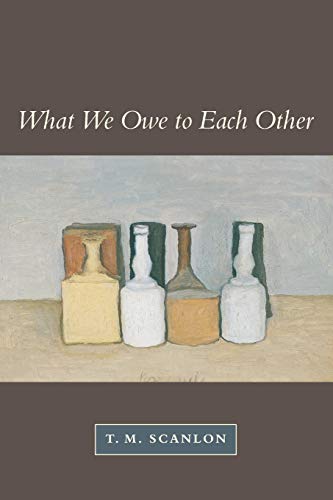
Synopsis
"This magnificent book...opens up a novel, arresting position on matters that have been debated for thousands of years." --Times Literary Supplement
How do we judge whether an action is morally right or wrong? If an action is wrong, what reason does that give us not to do it? Why should we give such reasons priority over our other concerns and values? In this book, T. M. Scanlon offers new answers to these questions, as they apply to the central part of morality that concerns what we owe to each other. According to his contractualist view, thinking about right and wrong is thinking about what we do in terms that could be justified to others and that they could not reasonably reject. He shows how the special authority of conclusions about right and wrong arises from the value of being related to others in this way, and he shows how familiar moral ideas such as fairness and responsibility can be understood through their role in this process of mutual justification and criticism. Scanlon bases his contractualism on a broader account of reasons, value, and individual well-being that challenges standard views about these crucial notions. He argues that desires do not provide us with reasons, that states of affairs are not the primary bearers of value, and that well-being is not as important for rational decision-making as it is commonly held to be. Scanlon is a pluralist about both moral and non-moral values. He argues that, taking this plurality of values into account, contractualism allows for most of the variability in moral requirements that relativists have claimed, while still accounting for the full force of our judgments of right and wrong.Les informations fournies dans la section « Synopsis » peuvent faire référence à une autre édition de ce titre.
À propos de l'auteur
T. M. Scanlon is Alford Professor of Natural Religion, Moral Philosophy, and Civil Polity, Emeritus, at Harvard University.
Les informations fournies dans la section « A propos du livre » peuvent faire référence à une autre édition de ce titre.
Résultats de recherche pour What We Owe To Each Other

Image fournie par le vendeur
What We Owe to Each Other
Edité par
Belknap Press: An Imprint of Harvard University Press, 2000
ISBN 10 : 067400423X
ISBN 13 : 9780674004238
Ancien ou d'occasion
Couverture souple
Vendeur : Dream Books Co., Denver, CO, Etats-Unis
Évaluation du vendeur 5 sur 5 étoiles

Etat : acceptable. This copy has clearly been enjoyedâ"expect noticeable shelf wear and some minor creases to the cover. Binding is strong, and all pages are legible. May contain previous library markings or stamps. N° de réf. du vendeur DBV.067400423X.A
Acheter D'occasion
EUR 17,39
Livraison gratuite
Expédition nationale : Etats-Unis
Expédition nationale : Etats-Unis
Quantité disponible : 1 disponible(s)
Image d'archives
What We Owe to Each Other
Edité par
Belknap Press: An Imprint of Har, 2000
ISBN 10 : 067400423X
ISBN 13 : 9780674004238
Ancien ou d'occasion
Paperback
Vendeur : HPB-Red, Dallas, TX, Etats-Unis
Évaluation du vendeur 5 sur 5 étoiles
Paperback. Etat : Good. Connecting readers with great books since 1972! Used textbooks may not include companion materials such as access codes, etc. May have some wear or writing/highlighting. We ship orders daily and Customer Service is our top priority! N° de réf. du vendeur S_482685712
Acheter D'occasion
EUR 18,68
Expédition à EUR 3,35
Expédition nationale : Etats-Unis
Expédition nationale : Etats-Unis
Quantité disponible : 1 disponible(s)
Image fournie par le vendeur
What We Owe to Each Other
Edité par
Belknap Press: An Imprint of Harvard University Press, 2000
ISBN 10 : 067400423X
ISBN 13 : 9780674004238
Ancien ou d'occasion
Couverture souple
Vendeur : MusicMagpie, Stockport, Royaume-Uni
Évaluation du vendeur 5 sur 5 étoiles
Etat : Very Good. 1791458072. 10/8/2026 11:14:32 AM. N° de réf. du vendeur U9780674004238
Acheter D'occasion
EUR 20,99
Expédition à EUR 6,49
Expédition depuis Royaume-Uni vers Etats-Unis
Expédition depuis Royaume-Uni vers Etats-Unis
Quantité disponible : 1 disponible(s)
Image d'archives
What We Owe to Each Other
Edité par
Belknap Press: An Imprint of Harvard University Press, 2000
ISBN 10 : 067400423X
ISBN 13 : 9780674004238
Neuf
Paperback
Vendeur : Textbook Bookie, Little Rock, AR, Etats-Unis
Évaluation du vendeur 5 sur 5 étoiles
Paperback. Etat : New. Book in New condition. N° de réf. du vendeur 9780674004238-new
Acheter neuf
EUR 24,37
Expédition à EUR 3,80
Expédition nationale : Etats-Unis
Expédition nationale : Etats-Unis
Quantité disponible : 1 disponible(s)
Image fournie par le vendeur
What We Owe to Each Other
Edité par
Belknap Press: An Imprint of Harvard University Press, 2000
ISBN 10 : 067400423X
ISBN 13 : 9780674004238
Neuf
Couverture souple
Vendeur : GreatBookPrices, Columbia, MD, Etats-Unis
Évaluation du vendeur 5 sur 5 étoiles
Etat : New. N° de réf. du vendeur 598615-n
Acheter neuf
EUR 25,84
Expédition à EUR 2,36
Expédition nationale : Etats-Unis
Expédition nationale : Etats-Unis
Quantité disponible : 1 disponible(s)
Image fournie par le vendeur
What We Owe to Each Other
Edité par
Belknap Press: An Imprint of Harvard University Press, 2000
ISBN 10 : 067400423X
ISBN 13 : 9780674004238
Ancien ou d'occasion
Couverture souple
Vendeur : GreatBookPrices, Columbia, MD, Etats-Unis
Évaluation du vendeur 5 sur 5 étoiles
Etat : As New. Unread book in perfect condition. N° de réf. du vendeur 598615
Acheter D'occasion
EUR 29,38
Expédition à EUR 2,36
Expédition nationale : Etats-Unis
Expédition nationale : Etats-Unis
Quantité disponible : 1 disponible(s)
Image fournie par le vendeur
What We Owe to Each Other
Edité par
Harvard University Press, US, 2000
ISBN 10 : 067400423X
ISBN 13 : 9780674004238
Neuf
Paperback
Vendeur : Rarewaves USA, HEBRON, KY, Etats-Unis
Évaluation du vendeur 5 sur 5 étoiles
Paperback. Etat : New. "This magnificent book.opens up a novel, arresting position on matters that have been debated for thousands of years." -Times Literary Supplement How do we judge whether an action is morally right or wrong? If an action is wrong, what reason does that give us not to do it? Why should we give such reasons priority over our other concerns and values? In this book, T. M. Scanlon offers new answers to these questions, as they apply to the central part of morality that concerns what we owe to each other. According to his contractualist view, thinking about right and wrong is thinking about what we do in terms that could be justified to others and that they could not reasonably reject. He shows how the special authority of conclusions about right and wrong arises from the value of being related to others in this way, and he shows how familiar moral ideas such as fairness and responsibility can be understood through their role in this process of mutual justification and criticism. Scanlon bases his contractualism on a broader account of reasons, value, and individual well-being that challenges standard views about these crucial notions. He argues that desires do not provide us with reasons, that states of affairs are not the primary bearers of value, and that well-being is not as important for rational decision-making as it is commonly held to be. Scanlon is a pluralist about both moral and non-moral values. He argues that, taking this plurality of values into account, contractualism allows for most of the variability in moral requirements that relativists have claimed, while still accounting for the full force of our judgments of right and wrong. N° de réf. du vendeur LU-9780674004238
Acheter neuf
EUR 31,93
Livraison gratuite
Expédition nationale : Etats-Unis
Expédition nationale : Etats-Unis
Quantité disponible : 10 disponible(s)
Image fournie par le vendeur
What We Owe to Each Other (Paperback or Softback)
Edité par
Belknap Press 11/15/2000, 2000
ISBN 10 : 067400423X
ISBN 13 : 9780674004238
Neuf
Paperback or Softback
Vendeur : BargainBookStores, Grand Rapids, MI, Etats-Unis
Évaluation du vendeur 5 sur 5 étoiles
Paperback or Softback. Etat : New. What We Owe to Each Other. Book. N° de réf. du vendeur BBS-9780674004238
Acheter neuf
EUR 33,21
Livraison gratuite
Expédition nationale : Etats-Unis
Expédition nationale : Etats-Unis
Quantité disponible : 5 disponible(s)
Image d'archives
What We Owe to Each Other
Vendeur : PBShop.store US, Wood Dale, IL, Etats-Unis
Évaluation du vendeur 5 sur 5 étoiles
PAP. Etat : New. New Book. Shipped from UK. Established seller since 2000. N° de réf. du vendeur WH-9780674004238
Acheter neuf
EUR 33,23
Livraison gratuite
Expédition nationale : Etats-Unis
Expédition nationale : Etats-Unis
Quantité disponible : 15 disponible(s)
Image fournie par le vendeur
What We Owe to Each Other
Edité par
Harvard University Press, US, 2000
ISBN 10 : 067400423X
ISBN 13 : 9780674004238
Neuf
Paperback
Vendeur : Rarewaves.com USA, London, LONDO, Royaume-Uni
Évaluation du vendeur 5 sur 5 étoiles
Paperback. Etat : New. "This magnificent book.opens up a novel, arresting position on matters that have been debated for thousands of years." -Times Literary Supplement How do we judge whether an action is morally right or wrong? If an action is wrong, what reason does that give us not to do it? Why should we give such reasons priority over our other concerns and values? In this book, T. M. Scanlon offers new answers to these questions, as they apply to the central part of morality that concerns what we owe to each other. According to his contractualist view, thinking about right and wrong is thinking about what we do in terms that could be justified to others and that they could not reasonably reject. He shows how the special authority of conclusions about right and wrong arises from the value of being related to others in this way, and he shows how familiar moral ideas such as fairness and responsibility can be understood through their role in this process of mutual justification and criticism. Scanlon bases his contractualism on a broader account of reasons, value, and individual well-being that challenges standard views about these crucial notions. He argues that desires do not provide us with reasons, that states of affairs are not the primary bearers of value, and that well-being is not as important for rational decision-making as it is commonly held to be. Scanlon is a pluralist about both moral and non-moral values. He argues that, taking this plurality of values into account, contractualism allows for most of the variability in moral requirements that relativists have claimed, while still accounting for the full force of our judgments of right and wrong. N° de réf. du vendeur LU-9780674004238
Acheter neuf
EUR 33,59
Livraison gratuite
Expédition depuis Royaume-Uni vers Etats-Unis
Expédition depuis Royaume-Uni vers Etats-Unis
Quantité disponible : Plus de 20 disponibles