
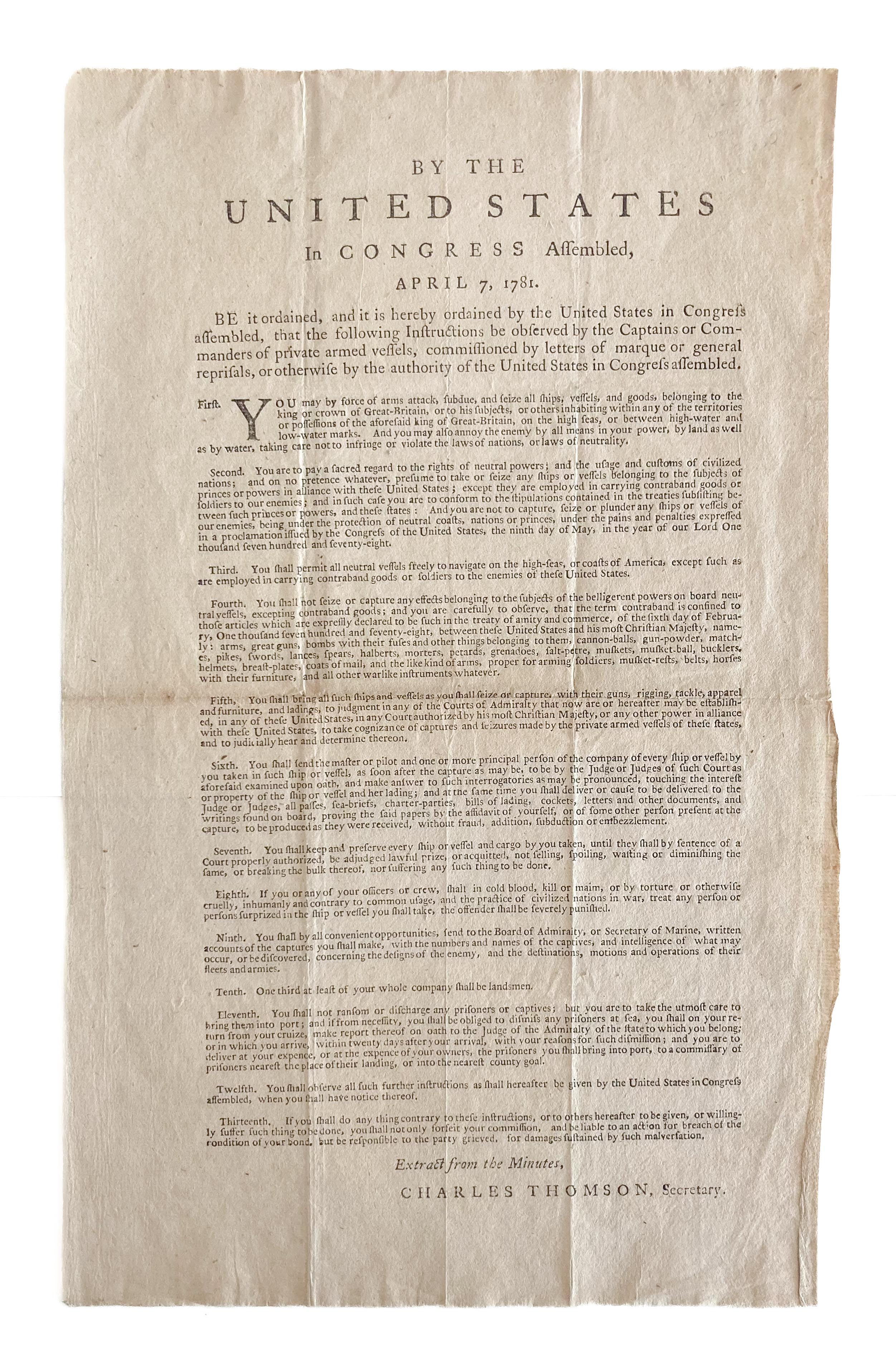
April 7, 1781 be it ordained . the Following Instructions be Observed by the Captains or Commanders of Private Armed Vessels .
[REVOLUTIONARY WAR] & U.S. CONGRESS.
Date d'édition : 1781
Ancien(s) ou d'occasion
Vendeur
Maggs Bros. Ltd ABA, ILAB, PBFA, London, Royaume-Uni
Évaluation du vendeur 5 sur 5 étoiles

Vendeur AbeBooks depuis 15 mai 2015
Nous sommes désolés, ce livre n'est plus disponible. AbeBooks référence des millions de livres. Veuillez saisir des termes de recherche ci-dessous pour identifier des exemplaires similaires.
A propos de cet article
Description :
Letterpress broadside measuring 335 by 205mm. Untrimmed with old folds, a little creased with a couple of spots, very good. In an archival mount. [Philadelphia, David C. Claypoole], While the exploits of John Paul Jones will be forever synonymous with American navy during the Revolutionary War, unlike "the army, there was nothing resembling a colonial structure for a navy, which meant American seapower relied totally on improvisation, every plan, promotion, and ship assignment required congressional support" (ANB). In fact, it wasn't until 1797 that John Adams convened the first joint session of Congress where he argued for the formation of a United States Navy, which meant during the Revolutionary War US was heavily reliant on not just her French allies, but also privateers. This scarce decree encapsulates the above, providing an overview of the terms under which privateers were employed to assist in the war at sea against the British. It was an ever-expanding list, originally numbering just five, which grew to eleven by May 2, 1780, and apparently culminated in this definitive list of thirteen detailed instructions. (There doesn't appear to be a further revision.) It makes no apologies for the matter at hand and the first instruction states: "You may by force of arms attack, subdue, and seize all ships, vessels, and goods, belonging to the king or crown of Great Britain . And you may also annoy the enemy by all means in your power, by land as well as by water, taking care not to infringe or violate the laws of nations, or laws of neutrality." The second, third, and fourth points concern rights of neutral powers and their vessels. The next three detail procedures regarding the capture of prizes: the presenting of such (vessels "with their guns, rigging, tackle, apparel and furniture, and ladings") to judges at the Courts of Admiralty at either ports in the United States or her allies. The eighth makes clear that privateers should abide by a code of conduct which severely punishes any instance where officers or crew "in cold blood, kill or maime, or by torture or otherwise cruelly, inhumanely and contrary to common usage, and the practice of civilized nations in war, treat any person surprized in the vessel of ship you shall take." Similarly prisoners were not to be ransomed or ill-treated. One can't help but wonder if precedent demanded so lengthy a clarification of these points. The instructions also confirm that privateers were seen as integral not just for the mayhem they should cause to the British naval fleet but also serve as means of gathering intelligence. Item nine states: "You shall by all convenient opportunities, send to the Board of Admiralty or Secretary of Marine, written accounts of the captures you shall make, with the numbers and names of the captives, and intelligence of what may occur, or be discovered, concerning the designs of the enemy ." 7 April 1781 was just two days after Samuel Huntington, then President of the Continental Congress, resigned due to ailing health. As such Congressional Secretary, Charles Thomson, has signed the document as Huntington's replacement had not yet been appointed. Of course, Great Britain and France also supplemented their fleets with privateers. By the end of the war, the US had commissioned over 500 private armed vessels. Scarce in the trade: RBH list just seven records between 1895 and 2015. Evans, 17384. N° de réf. du vendeur 245296
Détails bibliographiques
Titre : April 7, 1781 be it ordained . the Following...
Date d'édition : 1781
AbeBooks vous offre des millions de livres anciens, neufs, d'occasion et épuisés proposés par des milliers de vendeurs du monde entier. Acheter sur AbeBooks est simple, sûr et 100% sécurisé - effectuez votre recherche, passez commande sur notre site sécurisé et recevez votre ouvrage directement expédié par le vendeur.
Cherchez parmi des millions de livres proposés par des milliers de vendeurs
Livres anciens et de collection
Livres rares, manuscrits, incunables ou livres signés, découvrez notre page consacrée aux livres anciens et de collection.
Editions originales
Tirages limités, éditions spéciales ou numérotées, retrouvez notre sélection d'éditions originales.
Livres d'occasion


Meilleures ventes, idées lecture et lauréats à prix réduits, faites des économies grâce à nos bonnes affaires et à la livraison gratuite.