


De Omni Rerum Fossilium Genere, Gemmis, Lapidibus, Metallis, et huiusmodi, libri aliquot, plerique nunc primum editi. Opera Conradi Gesneri: Quorum Catalogum sequens folium cominet
GESNER (or GESSNER), Conrad, et al.
Edité par Jacob Gesner, Zürich, 1566
Ancien(s) ou d'occasion
Vendeur
SOPHIA RARE BOOKS, Koebenhavn V, Danemark
Évaluation du vendeur 4 sur 5 étoiles

Vendeur AbeBooks depuis 18 janvier 2013
Nous sommes désolés, ce livre n'est plus disponible. AbeBooks référence des millions de livres. Veuillez saisir des termes de recherche ci-dessous pour identifier des exemplaires similaires.
A propos de cet article
Description :
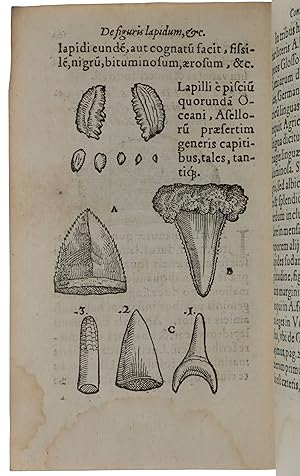
FIRST ILLUSTRATED BOOK ON FOSSILS . First edition and a fine copy in contemporary binding, very rare when complete, of this collection of eight treatises, the most important being De rerum fossilium [On fossil Objects], Gesner s last work, the earliest scientific attempt to classify the mineral kingdom, and the first illustrated book on fossils. "It presents a picture of the mineral kingdom as seen through the eyes of the greatest naturalist of his time" (Adams). Gesner s work contains numerous woodcuts after his own drawings, many of which are still preserved in Basel University Library. Gesner s book also famously contains the first printed illustration of a lead pencil (f. 104v). The other seven other works, by six authors, in this composite volume were all edited by Gesner. They include the first appearance of a catalogue of a mineral collection, that of Johannes Kentmann, "stated to have been the first man in Europe to make a collection of minerals." His catalogue contains entries for sixteen hundred specimens, making it a "conspectus of most of the minerals known at that time, with the localities from which they were derived as well as an exact equivalent in German of the various names by which they were known in Latin" (Adams, pp. 195-196). "On 28 July 1565 Conrad Gesner (1516-65), the greatest naturalist of his century, completed the book On fossil Objects. It is an appropriate date to choose as a starting point for [the] history of palaeontology. Gesner s book marked a crucial moment in the emergence of the science, for it incorporated three innovations of outstanding importance for the future … Gesner s concern for precise identification provides the context for the most important innovation … It was the first in which illustrations were used systematically to supplement a text on fossils. The importance of this can hardly be exaggerated … without illustrations no writer could be certain that he was applying a name in the same sense as his predecessors … The basis for [Gesner s] descriptive work was the formation of a collection of specimens. Published illustrations were, in effect, merely a convenient substitute for a museum … Agricola and other early writers may well have formed collections of their own, but Gesner s book is the first work on fossils that clearly refers to such a collection. Gesner expressed his gratitude to his friend the physician Johannes Kentmann of Torgau (1518-74) for sending him specimens to supplement his own, and he repaid the debt by placing the catalogue of Kentmann s collection at the front of the composite volume in which his own work was bound. The importance of the museum as an innovation in this branch of natural history is symbolised by the frontispiece of Kentmann s catalogue the only illustration it contained. His little cabinet with its numbered drawers was termed significantly an ark … [The third innovation is that Gesner s] is the first such work in which there is a clear expression of a programme of co-operative research on fossils. Gesner had already received specimens and drawings from Kentmann and several other correspondents, but his book was explicitly designed to elicit further information of the same kind" (Rudwick, pp. 1-11). ABPC/RBH list only two complete copies since Honeyman: Freilich (Sotheby s New York, January 11, 2001, lot 209, $87,000) and Macclesfield (Sotheby s, November 4, 2004, lot 890, £26,400 = $49,122). Provenance: Thomas Stewart Traill, M.D. (1781 1862), physician, chemist, meteorologist, zoologist and specialist in medical jurisprudence, FRSE from 1819 (engraved bookplate of on front pastedown and an inscription in brown ink "Purchased at the sale of Revd. George Loves Books and presented to Dr Thomas Stewart Traill of Tirlet, by his sincere friend, Wm. G. Watt" i.e., William Graham Watt (1776-1866), 7th Laird of Skaill House, Breckness Estate). Traill Island in Greenland and Mount Traill in Nigeria are named after him. When John James Audubon. N° de réf. du vendeur 5001
Détails bibliographiques
Titre : De Omni Rerum Fossilium Genere, Gemmis, ...
Éditeur : Jacob Gesner, Zürich
Date d'édition : 1566
AbeBooks vous offre des millions de livres anciens, neufs, d'occasion et épuisés proposés par des milliers de vendeurs du monde entier. Acheter sur AbeBooks est simple, sûr et 100% sécurisé - effectuez votre recherche, passez commande sur notre site sécurisé et recevez votre ouvrage directement expédié par le vendeur.
Cherchez parmi des millions de livres proposés par des milliers de vendeurs
Livres anciens et de collection
Livres rares, manuscrits, incunables ou livres signés, découvrez notre page consacrée aux livres anciens et de collection.
Editions originales
Tirages limités, éditions spéciales ou numérotées, retrouvez notre sélection d'éditions originales.
Livres d'occasion
Meilleures ventes, idées lecture et lauréats à prix réduits, faites des économies grâce à nos bonnes affaires et à la livraison gratuite.