
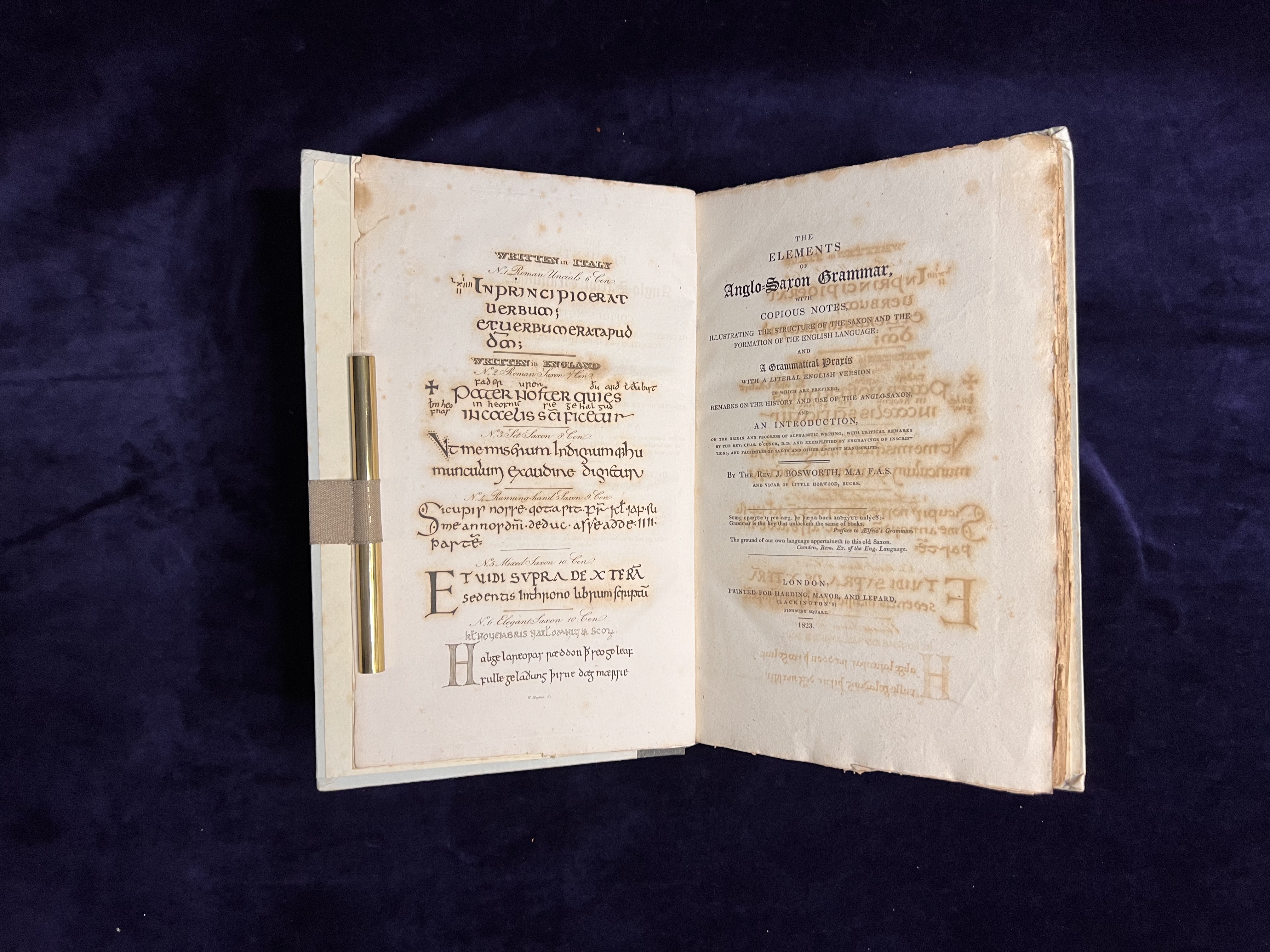

The Elements of Anglo-Saxon Grammar, with Copious Notes, illustrating the Structure of the Saxon and the Formation of the English Language; and A Grammatical Praxis with a Literal English Version: to which are prefixed, Remarks on the History and th USe of the Anglo-Saxon, and an Introduction, On the Origin and Progress of Alphanbetic Writing, with Critical Remarks by the Rev. Chas. O Conor, D.D. And Exemplified by Engraving of inscriptions, and Facsimiles of Saxon and Other Ancient Manuscripts
Joseph Bosworth
Edité par London: Printed for Harding, Mavor, and Lepard (Lackington s Finsbury Square), 1823
Ancien(s) ou d'occasion
Hardcover
Vendeur
Mobilis Books, Geneva, FL, Etats-Unis
Évaluation du vendeur 5 sur 5 étoiles

Vendeur AbeBooks depuis 6 décembre 2021
Nous sommes désolés, ce livre n'est plus disponible. AbeBooks référence des millions de livres. Veuillez saisir des termes de recherche ci-dessous pour identifier des exemplaires similaires.
A propos de cet article
Description :
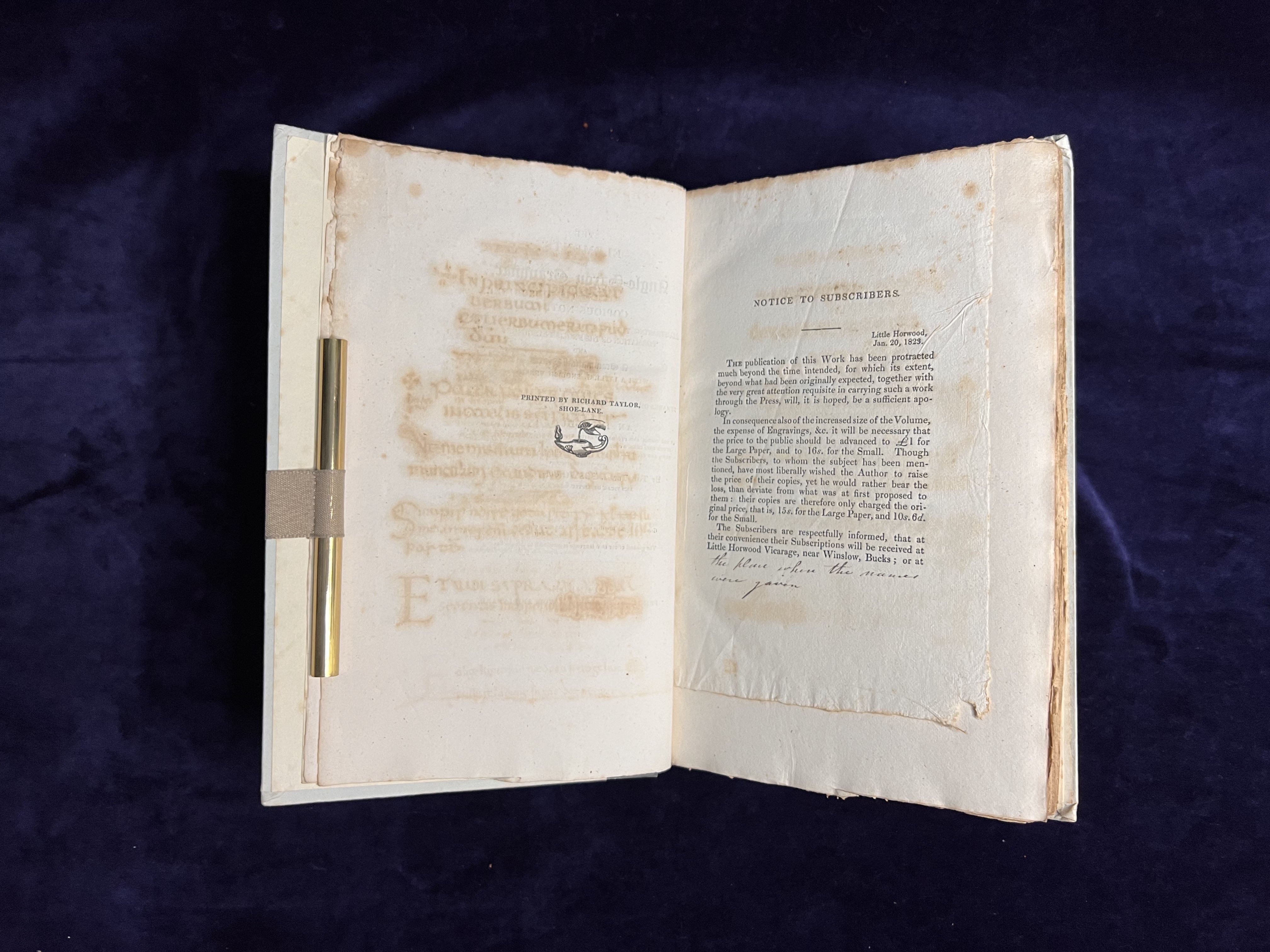
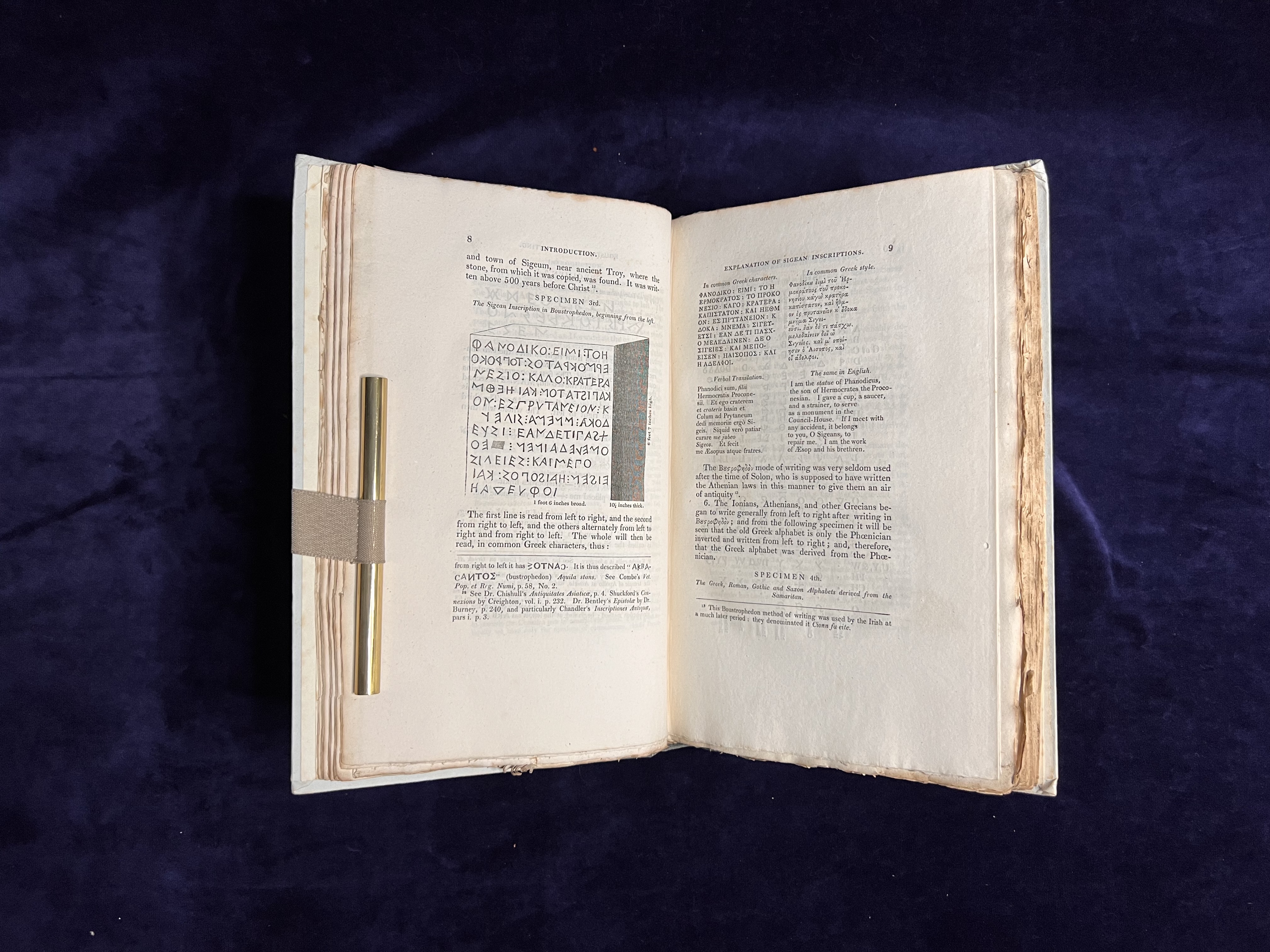
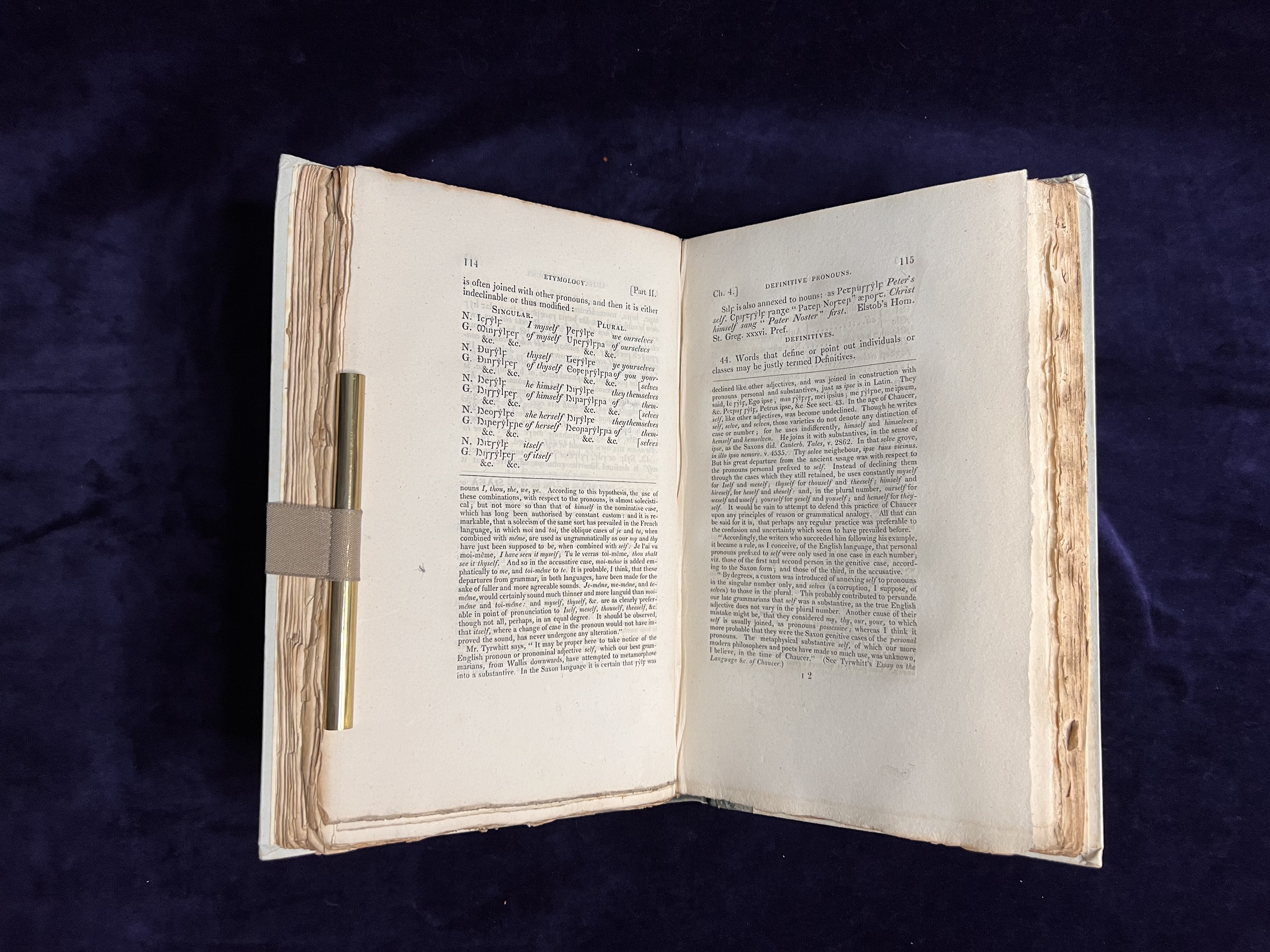
[HISTORY OF THE ENGLISH LANGUAGE, MEDIEVAL STUDIES] (260 x 170) pp. xlvii, 1- 332. Signatures: a-b8, c10, B9, C8, D7, E-X8, Y6 (despite the unusual signatures, the text is complete). Includes Notice to Subscribers, and handwritten addition completing the terminal statement The Subscribers are respectfully informed, that at their convenience their Subscriptions will be received at Little Horwood Vicarage, near Winslow, Buck; or at the place where the names were given. Paper bears 1822 watermark. With plates (ex. p. 8 depicting a Sigean Inscription in Boustrophedon). Many alphabets employed in typesetting. The ink, particularly around the Anglo-Saxon orthography has burn the pages, but this is not uncommon for this text. Some brown spots (not foxing). Bound in a work-a-day, later (20th c.) cardboard binding. Overall VERY GOOD condition. Scholars in the nineteenth century turned their interests to the Middle Ages, a newly coined term to describe what was happening before the Renaissance but after the Roman Empire (leaving aside the nuances of Late Antiquity and the transition from Medieval to Early Modern). While languages like French and Italian had not undergone too much change from the Medieval state to the Modern, English had experienced one major upheaval rendering the language difficult even for native speakers to penetrate past a certain date 1066. When the Normans invaded, bringing their French to the British Isles, the Germanic polyphony that populated the countryside (with incursions of Latin and the Celtic speakers) began to morph. Thus, in the undateable (but certainly well predating the Norman conquest) Beowulf, we open with the famous Old English lines of: Hwæt! We Gar-Dena in gear-dagum, þeod-cyninga, þrym gefrunon, hu ða æþelingas ellen fremedon! In the late 14th century, Middle English has been thoroughly infused with French and we come to the more legible lines opening Chaucer s Canterbury Tales: Whan that Aprill with his shoures soote/ When April with its sweet-smelling showers/ The droghte of March hath perced to the roote/ Has pierced the drought of March to the root… And none of this is to be confused with Shakespeare s English, which is Early Modern, and begins to look more like what we expect in Modern English : I am my selfe indifferent honest, but yet I could accuse me of such things, that it were better my Mother had not borne me. I am very prowd, reuengefull, Ambitious, with more offences at my becke then I haue thoughts to put them in imagination, to giue them shape, or time to acte them in. What should such Fellows as I do crawling between heaven and Earth. We are arrant knaues all, beleeue none of vs. So, the English language, having mutated this significantly, requires a bit more study to access the older material. Enter Joseph Bosworth. 1823 was a big year for him: he published Elements of Anglo-Saxon Grammar, and matriculated at Trinity College, Cambridge. He would become the Rawlinsonian Professor of Anglo-Saxon at Oxford a position inherited by J. R. R. Tolkien from 1925-1945. Later, Bosworth would found a professorship of Anglo-Saxon at Cambridge. The book itself is truly a tour-de-force of typesetting. In addition to the italic and roman Latin alphabet, the printer has graced us with, of course, the Anglo-Saxon fonts (including runic , gothic, and moeso-Gothic), as well as Greek, Phoenician, Roman epigraphical, Roman rustic, Hebrew, and a blackletter Fraktur. MB193. N° de réf. du vendeur ABE-1679654652400
Détails bibliographiques
Titre : The Elements of Anglo-Saxon Grammar, with ...
Éditeur : London: Printed for Harding, Mavor, and Lepard (Lackington s Finsbury Square)
Date d'édition : 1823
Reliure : Hardcover
Etat : Very Good
Edition : 1st Edition
AbeBooks vous offre des millions de livres anciens, neufs, d'occasion et épuisés proposés par des milliers de vendeurs du monde entier. Acheter sur AbeBooks est simple, sûr et 100% sécurisé - effectuez votre recherche, passez commande sur notre site sécurisé et recevez votre ouvrage directement expédié par le vendeur.
Cherchez parmi des millions de livres proposés par des milliers de vendeurs
Livres anciens et de collection
Livres rares, manuscrits, incunables ou livres signés, découvrez notre page consacrée aux livres anciens et de collection.
Editions originales
Tirages limités, éditions spéciales ou numérotées, retrouvez notre sélection d'éditions originales.
Livres d'occasion

Meilleures ventes, idées lecture et lauréats à prix réduits, faites des économies grâce à nos bonnes affaires et à la livraison gratuite.