


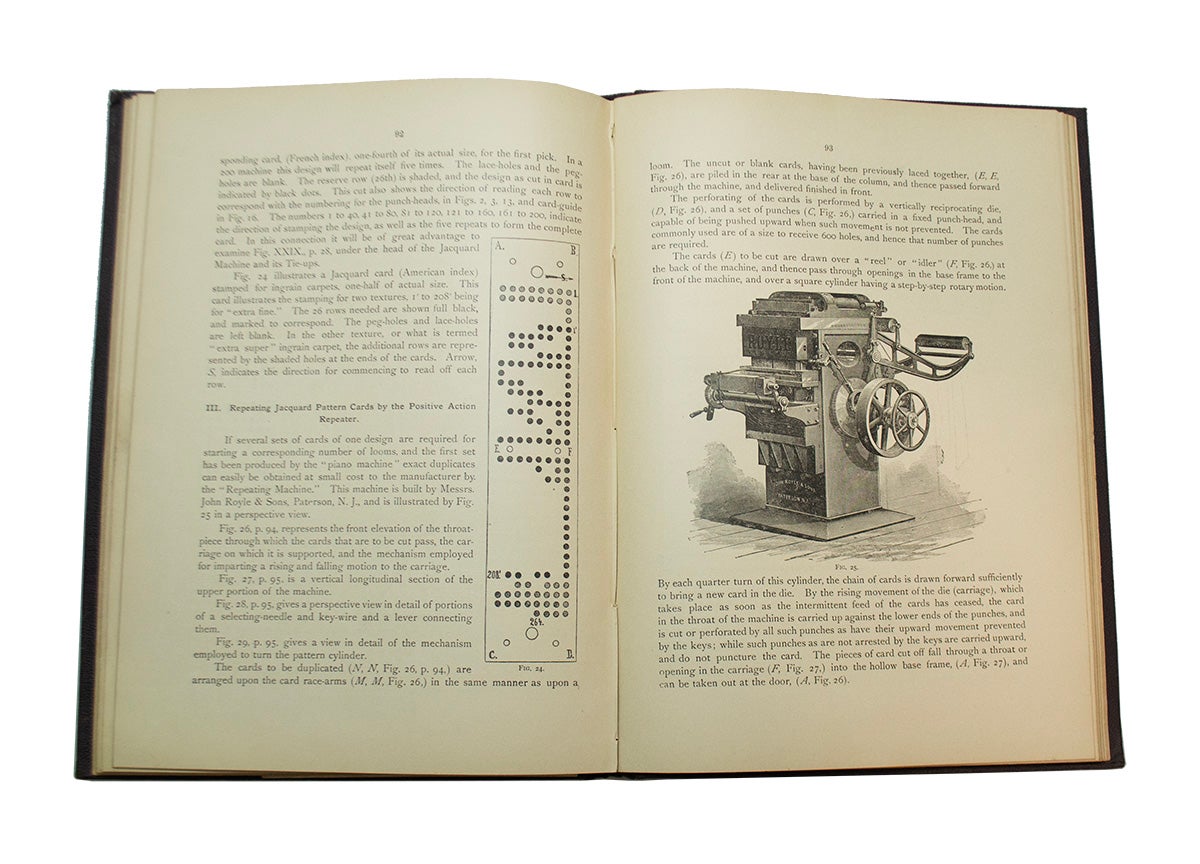

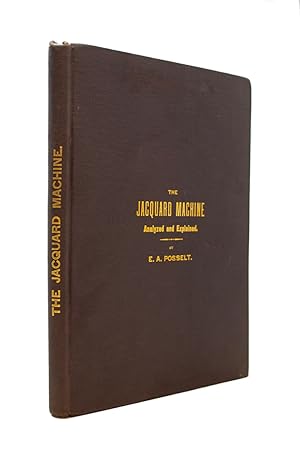
Jacquard Machine Analyzed and Explained With an Appendix on the Preparation of Jacquard Cards, and Practical Hints to Learners of Jacquard Designing. With 230 Illustrations.
POSSELT, Erich
Edité par Published under the Auspices of the School, Philadelphia, 1888
Ancien(s) ou d'occasion
Couverture rigide
Vendeur
Heritage Book Shop, ABAA, Beverly Hills, CA, Etats-Unis
Évaluation du vendeur 5 sur 5 étoiles

Vendeur AbeBooks depuis 25 mars 2008
Nous sommes désolés, ce livre n'est plus disponible. AbeBooks référence des millions de livres. Veuillez saisir des termes de recherche ci-dessous pour identifier des exemplaires similaires.
A propos de cet article
Description :
Full Description: POSSELT, Erich. The Jacquard Machine Analyzed and Explained: With an Appendix on the Preparation of Jacquard Cards, and Practical Hints to Learners of Jacquard Designing. With 230 Illustrations. Philadelphia: Published under the Auspices of the School [Pennsylvania Museum and School of Industrial Art], 1888. First edition. Small folio (10 7/8 x 7 7/8 inches; 275 x 200 mm). 127, [1, blank], [15, advertisements], [1, blank] pp. Illustrated throughout with 230 text diagrams including two folding plates. Publisher's full morocco-grain brown cloth. Front board and spine lettered in gilt. Some minor rubbing and bumping to cloth. A bit of offsetting to blank endpapers. The crease of folding diagram (figure xxxi) is fragile but holding. Overall a near fine copy of this important book on the advancement of computing. "This extensively illustrated work is the most detailed published account of the design and operation of the Jacquard loom, on which Jacquard himself appears to have never published any details. The book includes a brief history of the Jacquard loom, a detailed description of its mechanism, and an appendix on the preparation and stamping of Jacquard cards, illustrated with pictures of the stamping machines. The punched-card method of storing and processing data evolved from methods developed by textile manufacturers in the eighteenth and nineteenth centuries for weaving complex patterns in cloth." (Origins of Cyberspace 355). In addition to the Jacquard machine making huge technological leaps in the textile industry, its invention also a part of a huge advancement in the development of computing. "The Jac-quard sys-tem was developed in France in 1804-05 by Joseph-Marie Jacquard, improving on the original punched-card design of Jacques de Vaucanson's loom of 1745. The punched cards controlled the actions of the loom, allowing automatic production of intricate woven patterns. The punched-card idea was adopted later by Charles Babbage about 1830 to control his Analytical Engine, and later still by Herman Hollerith for tabulating the 1890 USA census. As Lady Ada Lovelace (the world's first programmer) said, regarding the use of punched cards as the control medium for the Babbage Analytical Engine, 'the Analytical Engine weaves algebraical patterns just as the Jacquard-loom weaves flowers and leaves.'" (Columbia University, Computing History). "Babbage's standing as the first pioneer of computing relies less on his difference engines than on his conception and design of the analytical engine. The most creatively active period of development occurred between 1834 and summer 1836, by which time the essential principles of the analytical engine had been established. He continued to work on improved designs until 1846 and then intermittently from the mid-1850s until his death. Unlike the difference engine, which was a fixed-function calculator, the analytical engine was conceived as a general-purpose machine capable of calculating virtually any mathematical function. It had a repertory of the four basic arithmetical functions (addition, subtraction, multiplication, and division) and was programmable that is, it could be instructed to perform any of these operations in any sequence. The machine was to be programmed using punched cards, a technique borrowed from the Jacquard loom, where it was used to control the patterns of woven thread. The analytical engine could be instructed to repeat the same sequence of operations a specifiable number of times (a process later called looping or iteration) and was capable of choosing alternative actions depending on the value of a result (conditional branching)." (Oxford DNB). Norman Origins of Cyberspace, 355. HBS 68984. $3,500. N° de réf. du vendeur 68984
Détails bibliographiques
Titre : Jacquard Machine Analyzed and Explained With...
Éditeur : Published under the Auspices of the School, Philadelphia
Date d'édition : 1888
Reliure : Couverture rigide
Edition : Edition originale
AbeBooks vous offre des millions de livres anciens, neufs, d'occasion et épuisés proposés par des milliers de vendeurs du monde entier. Acheter sur AbeBooks est simple, sûr et 100% sécurisé - effectuez votre recherche, passez commande sur notre site sécurisé et recevez votre ouvrage directement expédié par le vendeur.
Cherchez parmi des millions de livres proposés par des milliers de vendeurs
Livres anciens et de collection

Livres rares, manuscrits, incunables ou livres signés, découvrez notre page consacrée aux livres anciens et de collection.
Editions originales

Tirages limités, éditions spéciales ou numérotées, retrouvez notre sélection d'éditions originales.
Livres d'occasion

Meilleures ventes, idées lecture et lauréats à prix réduits, faites des économies grâce à nos bonnes affaires et à la livraison gratuite.