


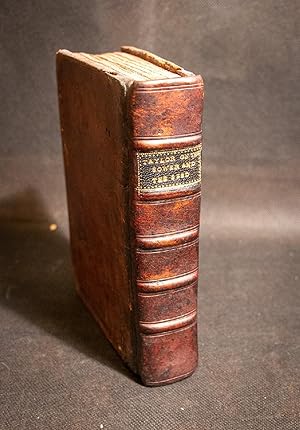
The parable of the sovver and of the seed. Declaring in foure seuerall grounds among other things: 1. How farre an hypocrite may goe in the way towards heauen, and wherein the sound Christian goeth beyond him. And, 2. In the last and best ground, largely discourseth of a good heart, describing it by very many signes of it, digested into a familiar method: which of it selfe is an entire treatise. And also, 3. From the constant fruit of the good ground, iustifieth the doctrine of the perseuerance of saints: oppugneth the fifth article of the late Arminians; and shortly and plainly answereth their most colourable arguments and euasions. By Thomas Taylor, late fellow of Christs Colledge in Cambridge and preacher of the Word of God, at Reding
TAYLOR, Thomas
Edité par Imprinted at London: By John Dawson, for Iohn Bartlet and are to be sold at the signe of the gilded Cup in the Goldsmiths Rowe in Cheapeside, 1623
Ancien(s) ou d'occasion
Hardcover
Vendeur
Stephen Butler Rare Books & Manuscripts, London, Royaume-Uni
Évaluation du vendeur 5 sur 5 étoiles

Vendeur AbeBooks depuis 3 novembre 2017
Nous sommes désolés, ce livre n'est plus disponible. AbeBooks référence des millions de livres. Veuillez saisir des termes de recherche ci-dessous pour identifier des exemplaires similaires.
A propos de cet article
Description :
Quarto. 180mm x 140mm. Engraved title page, chipped and browned at edges. Typographic title page. Lacks paste-down and end pages. [18],128, 123-451, 451-452, [17]pp. 1 large folding table inserted. No rear end-pages. Pages are very good with some dog ears and browning at extremities. Full contemporary C17th boards recently rebacked in style with raised bands and label.
The parable of the sovver and of the seed is one of the most searching and influential practical-theological treatises of early Stuart Puritanism, expounding Christ?s parable (Matthew 13) as a complete anatomy of the Christian life. Preached and written by the celebrated preacher Thomas Taylor, the work examines the four kinds of soil as moral and spiritual types, tracing the progress of the hypocrite and the true believer along the narrow path toward heaven.
With exceptional psychological acuity, Taylor analyses how far an unsound professor may advance in outward religion, and wherein the ?sound Christian? finally surpasses him. The heart of the book is the extended treatment of the ?good ground,? a self-contained treatise on the nature of a regenerate heart, described through a rich catalogue of signs, trials, and graces arranged in a clear and practical method.
In its final sections, the work turns polemical, offering one of the earliest English defences of the doctrine of the perseverance of the saints and a sustained refutation of the ?fifth article? of the Arminians. In doing so, Taylor situates the parable at the very centre of the Calvinist?Arminian controversy then reshaping English theology. Printed in 1623, this volume stands as both a masterpiece of Puritan casuistry and a major document in the doctrinal conflicts of the early seventeenth-century Church.
Thomas Taylor was one of the most admired Puritan preachers of the late Elizabethan and early Jacobean Church and a leading representative of practical divinity in early modern England. Educated at Christ?s College, Cambridge, where he became a fellow, he later served as lecturer and preacher at Reading, earning a reputation for clarity, doctrinal precision, and pastoral insight.
Taylor was a prolific author whose sermons and treatises circulated widely, addressing conversion, conscience, perseverance, and the marks of true grace. His works were particularly valued for their methodical structure and penetrating analysis of spiritual experience, making them staples of Puritan household reading.
Firmly Calvinist in doctrine, Taylor played an important role in the English response to the rise of Arminian theology in the 1620s. His defence of perseverance and his critique of conditional election aligned him with the orthodox Reformed mainstream of the English Puritan movement. Through works such as The Parable of the Sower and of the Seed, Taylor helped shape the language of self-examination and assurance that would dominate English Protestant spirituality for generations. N° de réf. du vendeur ABE-1576332483995
Détails bibliographiques
Titre : The parable of the sovver and of the seed. ...
Éditeur : Imprinted at London: By John Dawson, for Iohn Bartlet and are to be sold at the signe of the gilded Cup in the Goldsmiths Rowe in Cheapeside
Date d'édition : 1623
Reliure : Hardcover
Etat : Very Good
Edition : 2nd Edition
AbeBooks vous offre des millions de livres anciens, neufs, d'occasion et épuisés proposés par des milliers de vendeurs du monde entier. Acheter sur AbeBooks est simple, sûr et 100% sécurisé - effectuez votre recherche, passez commande sur notre site sécurisé et recevez votre ouvrage directement expédié par le vendeur.
Cherchez parmi des millions de livres proposés par des milliers de vendeurs
Livres anciens et de collection
Livres rares, manuscrits, incunables ou livres signés, découvrez notre page consacrée aux livres anciens et de collection.
Editions originales
Tirages limités, éditions spéciales ou numérotées, retrouvez notre sélection d'éditions originales.
Livres d'occasion
Meilleures ventes, idées lecture et lauréats à prix réduits, faites des économies grâce à nos bonnes affaires et à la livraison gratuite.