

Montant total (1 article articles) :
Destination de la commande :

structuralism (4 résultats)
Passer aux résultats principaux de la recherche
Filtres de recherche
Type d'article
- Tous les types de produits
- Livres (4)
- Magazines & Périodiques (Aucun autre résultat ne correspond à ces critères)
- Bandes dessinées (Aucun autre résultat ne correspond à ces critères)
- Partitions de musique (Aucun autre résultat ne correspond à ces critères)
- Art, Affiches et Gravures (Aucun autre résultat ne correspond à ces critères)
- Photographies (Aucun autre résultat ne correspond à ces critères)
- Cartes (Aucun autre résultat ne correspond à ces critères)
- Manuscrits & Papiers anciens (Aucun autre résultat ne correspond à ces critères)
Etat En savoir plus
- Neuf (1)
- Comme neuf, Très bon ou Bon (Aucun autre résultat ne correspond à ces critères)
- Assez bon ou satisfaisant (2)
- Moyen ou mauvais (Aucun autre résultat ne correspond à ces critères)
- Conformément à la description (1)
Reliure
- Toutes
- Couverture rigide (Aucun autre résultat ne correspond à ces critères)
- Couverture souple (3)
Particularités
- Ed. originale (1)
- Signé (Aucun autre résultat ne correspond à ces critères)
- Jaquette (Aucun autre résultat ne correspond à ces critères)
- Avec images (2)
- Sans impressions à la demande (4)
Langue (2)
Prix
- Tous les prix
- Moins de EUR 20 (Aucun autre résultat ne correspond à ces critères)
- EUR 20 à EUR 40
- Plus de EUR 40
Livraison gratuite
- Livraison gratuite à destination de Etats-Unis (Aucun autre résultat ne correspond à ces critères)
Pays
Evaluation du vendeur
-

Relief Structures. Eric Gibson, Colin Jones, Peter Lowe, Andrew Tilberis. Institute of Contemporary Arts, London, May 1966.
Edité par Institute of Contemporary Arts., 1966
Vendeur : Roe and Moore, London, Royaume-Uni
Évaluation du vendeur 4 sur 5 étoiles

Edition originale
EUR 21,19
Expédition à EUR 10,86
Expédition depuis Royaume-Uni vers Etats-UnisQuantité disponible : 1 disponible(s)
Ajouter au panierSoft cover. Etat : Very Good. 1st Edition. Sq.8vo. Folding 3 panel sheet Essay by Joost Baljeu, 4 b/w plates, short biogs, 16 item catalogue.
-

An Introduction to Benjamin Peret [in] Radical America Vol. IV No. 6. General Editor Paul Buhle
Edité par the journal, 1970
Vendeur : Stock & Trade LLC, Portland, OR, Etats-Unis
Évaluation du vendeur 4 sur 5 étoiles
EUR 43,63
Expédition à EUR 3,81
Expédition nationale : Etats-UnisQuantité disponible : 1 disponible(s)
Ajouter au panierPaperback. Etat : Very Good. A nice pamphlet with a tight binding and an unmarked text.From a private smoke free collection. Shipping within 24 hours, tracking number and delivery Confirmation.
-
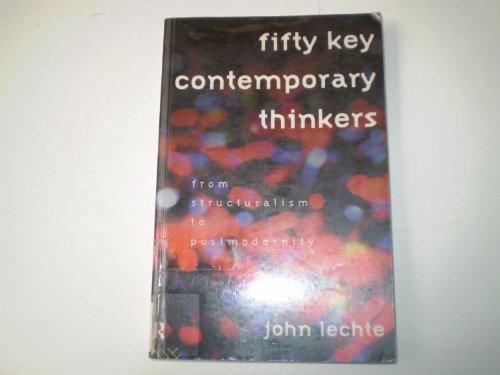
Fifty Key Contemporary Thinkers: From Structuralism to Postmodernity Lechte, John
Vendeur : Aragon Books Canada, OTTAWA, ON, Canada
Évaluation du vendeur 3 sur 5 étoiles

EUR 56,72
Expédition à EUR 19,49
Expédition depuis Canada vers Etats-UnisQuantité disponible : 1 disponible(s)
Ajouter au panierEtat : New.
-

Tel Quel. Nos 1-50 (Été 1960 to Printemps 1972)
Edité par Éditions du Seuil 1960-72, Paris, 1960
Vendeur : Lorne Bair Rare Books, ABAA, Winchester, VA, Etats-Unis
Membre d'association : ABAA ILAB IOBA
Évaluation du vendeur 5 sur 5 étoiles

EUR 1 919,87
Expédition à EUR 5,51
Expédition nationale : Etats-UnisQuantité disponible : 1 disponible(s)
Ajouter au panierFifty octavo issues in original printed wrapers, about half retaining the original wrap-around bands; generally ca. 90-120pp per issue. Occasional light wear or soil to wrappers, still a bright, beautifully-preserved run, internally free of markings or wear. Also included is the 1995 retrospective, "Tel Quel À L'Infini," which offers essays by Sollers, Kristeva, Marcelin Pleynet, Philippe Forest, and others. Texts entirely in French. Uncommonly long and unbroken run, comprising the first 50 of the 94 issues published of this groundbreaking quarterly which in many ways was the wellspring for the radical shift in French literary theory that took place in the decades of the sixties and seventies. Founded in 1960 by a still little-known Philippe Sollers, Tel Quel would soon come to serve as the intellectual gathering-place for numerous writers and thinkers now most closely associated with that radical shift Jacques Derrida, Luce Irigaray, Julia Kristeva, Roman Jakobson, Tzvetan Todorov, Michel Foucault, Alain Robbe-Grillet, Roland Barthes and a host of others, not least Sollers himself, who through his long editorship and many published works would establish himself as a doyen of the French avant-garde during this period. If the journal had a unifying theme, it was difficulty the difficulty of analyzing "creative" discourse in a 20th-century context; the transmission of that difficulty to the reader through texts stubbornly opposed to clear interpretation. In the words of one critic, ".the best description of Tel Quel is that there is no way to describe it: it was very deliberately indescribable. The unreasonably difficult works of its members ran the gamut of not only the genres, but also of the various forms of discourse that make up both expository and literary prose." (Matthew Landry, The Beginning: Tel Quel in the 1960s; PhD thesis, U.C. Santa Cruz, 2016). Among the ground-breaking essays and creative work to make their first appearance in the pages of Tel Quel were Robbe-Grillet's scenario for the film L'annee dernière à Marienbad (Spring 1961); Foucault's key early essay "La langage à l'infini" (Autumn 1963); Jacques Derrida's "La pharmacie de Platon" (in two parts, Fall & Winter 1968; a foundational work of Deconstruction); Kristeva's "Pour une sémiologie des paragrammes," and many many others. Contemporary non-French writers who appeared in translation included William S. Burroughs, Charles Olson, Jorge Luis Borges, Robert Creeley, and others. This run is long enough to embody Tel Quel's somewhat protean political philosophy. In the early years, politics seemed relatively incidental to Sollers' editorial approach; by the mid-Sixties, the magazine had adopted at least a putative Leninist stance, exemplified by the Fall 1968 issue, edited by Kristeva, devoted entirely to "La Sémiologie Aujourd'hui en U.R.S.S.," with contributions by Lotman, Syrkine, Toporov and others. But in 1971 the journal abruptly repudiated Soviet communism, declaring itself a Maoist publication (Sollers, "Sur la contradiction," Spring 1971). By the mid-Seventies the editors would shift back to a basically left-sympathetic but aesthetically apolitical position (though this later shift is not reflected in the current run of issues). This dynamic, so clearly reflective of the political zeitgeist within the left bourgeoisie during the same period, neatly diagrams the interrelationships between poststructuralist theory, its dissemination outside of France, and the development of the New Left. This is a rich vein for study, still (in this cataloguer's estimation) insufficiently mined. The earliest issues of Tel Quel appear very infrequently in commerce. Even at the height of its influence, the journal never had a large circulation (reportedly around 1,000 copies) - making cohesive runs such as this very scarce indeed. This a very nicely-preserved run representing the journal at the height of its creative power and influence.


