

Montant total (1 article articles) :
Destination de la commande :

9780141978024 - Why Information Grows: The Evolution of Order, from Atoms to Economies de Hidalgo, César (24 résultats)
Passer aux résultats principaux de la recherche
Filtres de recherche
Type d'article
- Tous les types de produits
- Livres (24)
- Magazines & Périodiques (Aucun autre résultat ne correspond à ces critères)
- Bandes dessinées (Aucun autre résultat ne correspond à ces critères)
- Partitions de musique (Aucun autre résultat ne correspond à ces critères)
- Art, Affiches et Gravures (Aucun autre résultat ne correspond à ces critères)
- Photographies (Aucun autre résultat ne correspond à ces critères)
- Cartes (Aucun autre résultat ne correspond à ces critères)
- Manuscrits & Papiers anciens (Aucun autre résultat ne correspond à ces critères)
Etat En savoir plus
- Neuf (19)
- Comme neuf, Très bon ou Bon (2)
- Assez bon ou satisfaisant (2)
- Moyen ou mauvais (1)
- Conformément à la description (Aucun autre résultat ne correspond à ces critères)
Reliure
- Toutes
- Couverture rigide (Aucun autre résultat ne correspond à ces critères)
- Couverture souple (22)
Particularités
- Ed. originale (Aucun autre résultat ne correspond à ces critères)
- Signé (Aucun autre résultat ne correspond à ces critères)
- Jaquette (Aucun autre résultat ne correspond à ces critères)
- Avec images (10)
- Sans impressions à la demande (24)
Langue (2)
Prix
- Tous les prix
- Moins de EUR 20
- EUR 20 à EUR 45
- Plus de EUR 45 (Aucun autre résultat ne correspond à ces critères)
Livraison gratuite
Pays
Evaluation du vendeur
-
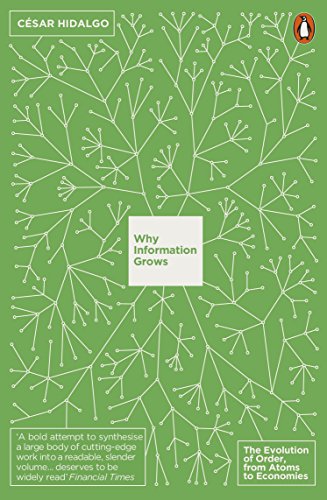
Why Information Grows: The Evolution of Order, from Atoms to Economies
Vendeur : WorldofBooks, Goring-By-Sea, WS, Royaume-Uni
Évaluation du vendeur 5 sur 5 étoiles

EUR 3,14
Expédition à EUR 6,57
Expédition depuis Royaume-Uni vers Etats-UnisQuantité disponible : 7 disponible(s)
Ajouter au panierPaperback. Etat : Very Good. The book has been read, but is in excellent condition. Pages are intact and not marred by notes or highlighting. The spine remains undamaged.
-
Why Information Grows : The Evolution of Order, from Atoms to Economies
Vendeur : Better World Books Ltd, Dunfermline, Royaume-Uni
Évaluation du vendeur 5 sur 5 étoiles
EUR 6,04
Expédition à EUR 5,86
Expédition depuis Royaume-Uni vers Etats-UnisQuantité disponible : 1 disponible(s)
Ajouter au panierEtat : Good. Former library copy. Pages intact with minimal writing/highlighting. The binding may be loose and creased. Dust jackets/supplements are not included. Includes library markings. Stock photo provided. Product includes identifying sticker. Better World Books: Buy Books. Do Good.
-
Why Information Grows (Paperback)
Langue: anglais
Edité par Penguin Books Ltd, London, 2016
ISBN 10 : 0141978023 ISBN 13 : 9780141978024
Vendeur : Grand Eagle Retail, Bensenville, IL, Etats-Unis
Évaluation du vendeur 5 sur 5 étoiles
EUR 17,38
Livraison gratuite
Expédition nationale : Etats-UnisQuantité disponible : 1 disponible(s)
Ajouter au panierPaperback. Etat : new. Paperback. In Why Information Grows, rising star Cesar Hidalgo offers a radical interpretation of global economicsWhat is economic growth? And why, historically, has it occurred in only a few places? Previous efforts to answer these questions have focused on institutions, geography, finances, and psychology. But MIT professor Cesar Hidalgo argues that in order to fully grasp the nature of economic growth we need to transcend the social sciences and turn to the science of information, networks and complexity. The growth of economies, he explains, is deeply connected with the growth of order - or information.At first glance, the universe seems hostile to order. Thermodynamics dictates that over time, order will disappear. But thermodynamics also has loopholes that promote the growth of information in pockets. Our cities are such pockets where information grows, but they are not all the same. For every Silicon Valley, Tokyo, and London, there are dozens of places with underdeveloped economies. Why does the US economy outstrip Brazil's, and Brazil's that of Chad? Why did the technology corridor along Boston's Route 128 languish while Silicon Valley blossomed? In each case, the key is how people, companies, and the networks they form process information - it is all about their knowledge, knowhow and imagination. As Hidalgo compellingly shows, economies are made of networks of people and society is a collective computer. The problem of economic development is in fact the problem of making these networks more powerful.A radical new interpretation of global economics, Why Information Grows overturns traditional assumptions about the development of economies and the origins of wealth and takes a crucial step toward making economics less the dismal science and more the insightful one. What is economic growth? And why, historically, has it occurred in only a few places? Previous efforts to answer these questions have focused on institutions, geography, finances, and psychology. This book argues that in order to fully grasp the nature of economic growth we need to turn to the science of information, networks and complexity. Shipping may be from multiple locations in the US or from the UK, depending on stock availability.
-

Why Information Grows
Vendeur : Rarewaves.com USA, London, LONDO, Royaume-Uni
Évaluation du vendeur 5 sur 5 étoiles
EUR 17,38
Livraison gratuite
Expédition depuis Royaume-Uni vers Etats-UnisQuantité disponible : 4 disponible(s)
Ajouter au panierPaperback. Etat : New. In Why Information Grows, rising star César Hidalgo offers a radical interpretation of global economicsWhat is economic growth? And why, historically, has it occurred in only a few places? Previous efforts to answer these questions have focused on institutions, geography, finances, and psychology. But MIT professor César Hidalgo argues that in order to fully grasp the nature of economic growth we need to transcend the social sciences and turn to the science of information, networks and complexity. The growth of economies, he explains, is deeply connected with the growth of order - or information.At first glance, the universe seems hostile to order. Thermodynamics dictates that over time, order will disappear. But thermodynamics also has loopholes that promote the growth of information in pockets. Our cities are such pockets where information grows, but they are not all the same. For every Silicon Valley, Tokyo, and London, there are dozens of places with underdeveloped economies. Why does the US economy outstrip Brazil's, and Brazil's that of Chad? Why did the technology corridor along Boston's Route 128 languish while Silicon Valley blossomed? In each case, the key is how people, companies, and the networks they form process information - it is all about their knowledge, knowhow and imagination. As Hidalgo compellingly shows, economies are made of networks of people and society is a collective computer. The problem of economic development is in fact the problem of making these networks more powerful.A radical new interpretation of global economics, Why Information Grows overturns traditional assumptions about the development of economies and the origins of wealth and takes a crucial step toward making economics less the dismal science and more the insightful one.
-
Why Information Grows
Vendeur : PBShop.store UK, Fairford, GLOS, Royaume-Uni
Évaluation du vendeur 5 sur 5 étoiles
EUR 14,28
Expédition à EUR 3,86
Expédition depuis Royaume-Uni vers Etats-UnisQuantité disponible : 7 disponible(s)
Ajouter au panierPAP. Etat : New. New Book. Shipped from UK. Established seller since 2000.
-
Why Information Grows: The Evolution of Order, from Atoms to Economies
Vendeur : AproposBooks&Comics, London, Royaume-Uni
Évaluation du vendeur 4 sur 5 étoiles

EUR 4,77
Expédition à EUR 17,53
Expédition depuis Royaume-Uni vers Etats-UnisQuantité disponible : 1 disponible(s)
Ajouter au panierSoft cover. Etat : Near Fine.
-
Why Information Grows: The Evolution of Order, from Atoms to Economies
Vendeur : Revaluation Books, Exeter, Royaume-Uni
Évaluation du vendeur 5 sur 5 étoiles
EUR 12,24
Expédition à EUR 11,73
Expédition depuis Royaume-Uni vers Etats-UnisQuantité disponible : 2 disponible(s)
Ajouter au panierPaperback. Etat : Brand New. 256 pages. 7.80x5.04x0.71 inches. In Stock.
-
Why Information Grows: The Evolution of Order, from Atoms to Economies
Vendeur : Kennys Bookshop and Art Galleries Ltd., Galway, GY, Irlande
Évaluation du vendeur 5 sur 5 étoiles
EUR 13,87
Expédition à EUR 10,50
Expédition depuis Irlande vers Etats-UnisQuantité disponible : Plus de 20 disponibles
Ajouter au panierEtat : New. Num Pages: 256 pages. BIC Classification: KCY. Category: (P) Professional & Vocational; (U) Tertiary Education (US: College). Dimension: 198 x 129. . . 2016. Paperback. . . . .
-
Why Information Grows: The Evolution of Order, from Atoms to Economies
Vendeur : Kennys Bookstore, Olney, MD, Etats-Unis
Évaluation du vendeur 5 sur 5 étoiles
EUR 16,56
Expédition à EUR 9,19
Expédition nationale : Etats-UnisQuantité disponible : Plus de 20 disponibles
Ajouter au panierEtat : New. Num Pages: 256 pages. BIC Classification: KCY. Category: (P) Professional & Vocational; (U) Tertiary Education (US: College). Dimension: 198 x 129. . . 2016. Paperback. . . . . Books ship from the US and Ireland.
-
Why Information Grows: The Evolution of Order, from Atoms to Economies
Vendeur : Ria Christie Collections, Uxbridge, Royaume-Uni
Évaluation du vendeur 5 sur 5 étoiles
EUR 13,30
Expédition à EUR 14,05
Expédition depuis Royaume-Uni vers Etats-UnisQuantité disponible : Plus de 20 disponibles
Ajouter au panierEtat : New. In.
-
Why Information Grows: The Evolution of Order, from Atoms to Economies
Vendeur : Chiron Media, Wallingford, Royaume-Uni
Évaluation du vendeur 5 sur 5 étoiles
EUR 10,44
Expédition à EUR 18,16
Expédition depuis Royaume-Uni vers Etats-UnisQuantité disponible : 7 disponible(s)
Ajouter au panierpaperback. Etat : New.
-
Why Information Grows: The Evolution of Order, from Atoms to Economies
Vendeur : THE SAINT BOOKSTORE, Southport, Royaume-Uni
Évaluation du vendeur 5 sur 5 étoiles
EUR 12,76
Expédition à EUR 16,48
Expédition depuis Royaume-Uni vers Etats-UnisQuantité disponible : Plus de 20 disponibles
Ajouter au panierPaperback / softback. Etat : New. New copy - Usually dispatched within 4 working days.
-

Why Information Grows : The Evolution of Order, from Atoms to Economies
Vendeur : GreatBookPricesUK, Woodford Green, Royaume-Uni
Évaluation du vendeur 5 sur 5 étoiles
EUR 13,29
Expédition à EUR 17,59
Expédition depuis Royaume-Uni vers Etats-UnisQuantité disponible : 2 disponible(s)
Ajouter au panierEtat : New.
-

Why Information Grows : The Evolution of Order, from Atoms to Economies
Vendeur : GreatBookPricesUK, Woodford Green, Royaume-Uni
Évaluation du vendeur 5 sur 5 étoiles
EUR 15,81
Expédition à EUR 17,59
Expédition depuis Royaume-Uni vers Etats-UnisQuantité disponible : 2 disponible(s)
Ajouter au panierEtat : As New. Unread book in perfect condition.
-
Why Information Grows: The Evolution of Order, from Atoms to Economies
Vendeur : Stephen White Books, Bradford, Royaume-Uni
Évaluation du vendeur 5 sur 5 étoiles
EUR 2,31
Expédition à EUR 38,99
Expédition depuis Royaume-Uni vers Etats-UnisQuantité disponible : 1 disponible(s)
Ajouter au panierpaperback. Etat : Acceptable. Ex-library book, usual marking. Clean copy in good condition. Stain at top edge. Quick dispatch from UK seller.
-
Why Information Grows (Paperback)
Langue: anglais
Edité par Penguin Books Ltd, London, 2016
ISBN 10 : 0141978023 ISBN 13 : 9780141978024
Vendeur : CitiRetail, Stevenage, Royaume-Uni
Évaluation du vendeur 5 sur 5 étoiles
EUR 13,87
Expédition à EUR 43,39
Expédition depuis Royaume-Uni vers Etats-UnisQuantité disponible : 1 disponible(s)
Ajouter au panierPaperback. Etat : new. Paperback. In Why Information Grows, rising star Cesar Hidalgo offers a radical interpretation of global economicsWhat is economic growth? And why, historically, has it occurred in only a few places? Previous efforts to answer these questions have focused on institutions, geography, finances, and psychology. But MIT professor Cesar Hidalgo argues that in order to fully grasp the nature of economic growth we need to transcend the social sciences and turn to the science of information, networks and complexity. The growth of economies, he explains, is deeply connected with the growth of order - or information.At first glance, the universe seems hostile to order. Thermodynamics dictates that over time, order will disappear. But thermodynamics also has loopholes that promote the growth of information in pockets. Our cities are such pockets where information grows, but they are not all the same. For every Silicon Valley, Tokyo, and London, there are dozens of places with underdeveloped economies. Why does the US economy outstrip Brazil's, and Brazil's that of Chad? Why did the technology corridor along Boston's Route 128 languish while Silicon Valley blossomed? In each case, the key is how people, companies, and the networks they form process information - it is all about their knowledge, knowhow and imagination. As Hidalgo compellingly shows, economies are made of networks of people and society is a collective computer. The problem of economic development is in fact the problem of making these networks more powerful.A radical new interpretation of global economics, Why Information Grows overturns traditional assumptions about the development of economies and the origins of wealth and takes a crucial step toward making economics less the dismal science and more the insightful one. What is economic growth? And why, historically, has it occurred in only a few places? Previous efforts to answer these questions have focused on institutions, geography, finances, and psychology. This book argues that in order to fully grasp the nature of economic growth we need to turn to the science of information, networks and complexity. Shipping may be from our UK warehouse or from our Australian or US warehouses, depending on stock availability.
-
Why Information Grows (Paperback)
Langue: anglais
Edité par Penguin Books Ltd, London, 2016
ISBN 10 : 0141978023 ISBN 13 : 9780141978024
Vendeur : AussieBookSeller, Truganina, VIC, Australie
Évaluation du vendeur 5 sur 5 étoiles
EUR 26,85
Expédition à EUR 32,39
Expédition depuis Australie vers Etats-UnisQuantité disponible : 1 disponible(s)
Ajouter au panierPaperback. Etat : new. Paperback. In Why Information Grows, rising star Cesar Hidalgo offers a radical interpretation of global economicsWhat is economic growth? And why, historically, has it occurred in only a few places? Previous efforts to answer these questions have focused on institutions, geography, finances, and psychology. But MIT professor Cesar Hidalgo argues that in order to fully grasp the nature of economic growth we need to transcend the social sciences and turn to the science of information, networks and complexity. The growth of economies, he explains, is deeply connected with the growth of order - or information.At first glance, the universe seems hostile to order. Thermodynamics dictates that over time, order will disappear. But thermodynamics also has loopholes that promote the growth of information in pockets. Our cities are such pockets where information grows, but they are not all the same. For every Silicon Valley, Tokyo, and London, there are dozens of places with underdeveloped economies. Why does the US economy outstrip Brazil's, and Brazil's that of Chad? Why did the technology corridor along Boston's Route 128 languish while Silicon Valley blossomed? In each case, the key is how people, companies, and the networks they form process information - it is all about their knowledge, knowhow and imagination. As Hidalgo compellingly shows, economies are made of networks of people and society is a collective computer. The problem of economic development is in fact the problem of making these networks more powerful.A radical new interpretation of global economics, Why Information Grows overturns traditional assumptions about the development of economies and the origins of wealth and takes a crucial step toward making economics less the dismal science and more the insightful one. What is economic growth? And why, historically, has it occurred in only a few places? Previous efforts to answer these questions have focused on institutions, geography, finances, and psychology. This book argues that in order to fully grasp the nature of economic growth we need to turn to the science of information, networks and complexity. Shipping may be from our Sydney, NSW warehouse or from our UK or US warehouse, depending on stock availability.
-
WHY INFORMATION GROWS
Vendeur : Speedyhen, Hertfordshire, Royaume-Uni
Évaluation du vendeur 5 sur 5 étoiles
EUR 12,77
Expédition à EUR 48,08
Expédition depuis Royaume-Uni vers Etats-UnisQuantité disponible : 7 disponible(s)
Ajouter au panierEtat : NEW.
-

Why Information Grows
Langue: anglais
Edité par Penguin Books UK|Penguin, 2016
ISBN 10 : 0141978023 ISBN 13 : 9780141978024
EUR 17,24
Expédition à EUR 48,99
Expédition depuis Allemagne vers Etats-UnisQuantité disponible : 5 disponible(s)
Ajouter au panierEtat : New. What is economic growth? And why, historically, has it occurred in only a few places? Previous efforts to answer these questions have focused on institutions, geography, finances, and psychology. This book argues that in order to fully grasp the nature of e.
-

Why Information Grows : The Evolution of Order, from Atoms to Economies
Langue: anglais
Edité par Penguin Books Ltd Apr 2016, 2016
ISBN 10 : 0141978023 ISBN 13 : 9780141978024
Vendeur : AHA-BUCH GmbH, Einbeck, Allemagne
Évaluation du vendeur 5 sur 5 étoiles
EUR 14,74
Expédition à EUR 60,93
Expédition depuis Allemagne vers Etats-UnisQuantité disponible : 2 disponible(s)
Ajouter au panierTaschenbuch. Etat : Neu. Neuware - In Why Information Grows, rising star César Hidalgo offers a radical interpretation of global economicsWhat is economic growth And why, historically, has it occurred in only a few places Previous efforts to answer these questions have focused on institutions, geography, finances, and psychology. But MIT professor César Hidalgo argues that in order to fully grasp the nature of economic growth we need to transcend the social sciences and turn to the science of information, networks and complexity. The growth of economies, he explains, is deeply connected with the growth of order - or information.At first glance, the universe seems hostile to order. Thermodynamics dictates that over time, order will disappear. But thermodynamics also has loopholes that promote the growth of information in pockets. Our cities are such pockets where information grows, but they are not all the same. For every Silicon Valley, Tokyo, and London, there are dozens of places with underdeveloped economies. Why does the US economy outstrip Brazil's, and Brazil's that of Chad Why did the technology corridor along Boston's Route 128 languish while Silicon Valley blossomed In each case, the key is how people, companies, and the networks they form process information - it is all about their knowledge, knowhow and imagination. As Hidalgo compellingly shows, economies are made of networks of people and society is a collective computer. The problem of economic development is in fact the problem of making these networks more powerful.A radical new interpretation of global economics, Why Information Grows overturns traditional assumptions about the development of economies and the origins of wealth and takes a crucial step toward making economics less the dismal science and more the insightful one.
-

Why Information Grows
Vendeur : Rarewaves.com UK, London, Royaume-Uni
Évaluation du vendeur 5 sur 5 étoiles
EUR 12,75
Expédition à EUR 76,22
Expédition depuis Royaume-Uni vers Etats-UnisQuantité disponible : 4 disponible(s)
Ajouter au panierPaperback. Etat : New. In Why Information Grows, rising star César Hidalgo offers a radical interpretation of global economicsWhat is economic growth? And why, historically, has it occurred in only a few places? Previous efforts to answer these questions have focused on institutions, geography, finances, and psychology. But MIT professor César Hidalgo argues that in order to fully grasp the nature of economic growth we need to transcend the social sciences and turn to the science of information, networks and complexity. The growth of economies, he explains, is deeply connected with the growth of order - or information.At first glance, the universe seems hostile to order. Thermodynamics dictates that over time, order will disappear. But thermodynamics also has loopholes that promote the growth of information in pockets. Our cities are such pockets where information grows, but they are not all the same. For every Silicon Valley, Tokyo, and London, there are dozens of places with underdeveloped economies. Why does the US economy outstrip Brazil's, and Brazil's that of Chad? Why did the technology corridor along Boston's Route 128 languish while Silicon Valley blossomed? In each case, the key is how people, companies, and the networks they form process information - it is all about their knowledge, knowhow and imagination. As Hidalgo compellingly shows, economies are made of networks of people and society is a collective computer. The problem of economic development is in fact the problem of making these networks more powerful.A radical new interpretation of global economics, Why Information Grows overturns traditional assumptions about the development of economies and the origins of wealth and takes a crucial step toward making economics less the dismal science and more the insightful one.
-

EUR 17,50
Expédition à EUR 70
Expédition depuis Allemagne vers Etats-UnisQuantité disponible : 1 disponible(s)
Ajouter au panierTaschenbuch. Etat : Neu. Why Information Grows | The Evolution of Order, from Atoms to Economies | César Hidalgo | Taschenbuch | Kartoniert / Broschiert | Englisch | 2016 | Vintage Classics | EAN 9780141978024 | Verantwortliche Person für die EU: Ansata, ein Label der Penguin Random House Verlagsgruppe GmbH, Neumarkter Str. 28, 81673 München, kundenservice[at]penguinrandomhouse[dot]de | Anbieter: preigu.
-
Return to Ghost Camp (Goosebumps Series 2000, No 19)
ISBN 10 : 0141978023 ISBN 13 : 9780141978024
Vendeur : Majestic Books, Hounslow, Royaume-Uni
Évaluation du vendeur 4 sur 5 étoiles
EUR 17,10
Expédition à EUR 7,62
Expédition depuis Royaume-Uni vers Etats-UnisQuantité disponible : 3 disponible(s)
Ajouter au panierEtat : New. pp. 256.
-
Return to Ghost Camp (Goosebumps Series 2000, No 19)
ISBN 10 : 0141978023 ISBN 13 : 9780141978024
Vendeur : Biblios, Frankfurt am main, HESSE, Allemagne
Évaluation du vendeur 4 sur 5 étoiles
EUR 30,86
Expédition à EUR 9,95
Expédition depuis Allemagne vers Etats-UnisQuantité disponible : 3 disponible(s)
Ajouter au panierEtat : New. pp. 256.

