

Montant total (1 article articles) :
Destination de la commande :

9786202552219 - Deep Learning for News Recommender Systems: Designing neural architectures to tackle the challenges of news recommendation de Moreira, Gabriel; Cunha, Adilson (6 résultats)
Passer aux résultats principaux de la recherche
Filtres de recherche
Type d'article
- Tous les types de produits
- Livres (6)
- Magazines & Périodiques (Aucun autre résultat ne correspond à ces critères)
- Bandes dessinées (Aucun autre résultat ne correspond à ces critères)
- Partitions de musique (Aucun autre résultat ne correspond à ces critères)
- Art, Affiches et Gravures (Aucun autre résultat ne correspond à ces critères)
- Photographies (Aucun autre résultat ne correspond à ces critères)
- Cartes (Aucun autre résultat ne correspond à ces critères)
- Manuscrits & Papiers anciens (Aucun autre résultat ne correspond à ces critères)
Etat En savoir plus
- Neuf (5)
- Comme neuf, Très bon ou Bon (Aucun autre résultat ne correspond à ces critères)
- Assez bon ou satisfaisant (1)
- Moyen ou mauvais (Aucun autre résultat ne correspond à ces critères)
- Conformément à la description (Aucun autre résultat ne correspond à ces critères)
Reliure
- Toutes
- Couverture rigide (Aucun autre résultat ne correspond à ces critères)
- Couverture souple (6)
Particularités
- Ed. originale (Aucun autre résultat ne correspond à ces critères)
- Signé (Aucun autre résultat ne correspond à ces critères)
- Jaquette (Aucun autre résultat ne correspond à ces critères)
- Avec images (5)
- Sans impressions à la demande (2)
Langue (1)
Prix
- Tous les prix
- Moins de EUR 20 (Aucun autre résultat ne correspond à ces critères)
- EUR 20 à EUR 45
- Plus de EUR 45
Livraison gratuite
- Livraison gratuite à destination de Etats-Unis (Aucun autre résultat ne correspond à ces critères)
Pays
Evaluation du vendeur
-

Deep Learning for News Recommender Systems: Designing neural architectures to tackle the challenges of news recommendation
Langue: anglais
Edité par LAP LAMBERT Academic Publishing, 2020
ISBN 10 : 6202552212 ISBN 13 : 9786202552219
Vendeur : HPB-Red, Dallas, TX, Etats-Unis
Évaluation du vendeur 5 sur 5 étoiles

EUR 39,12
Expédition à EUR 3,20
Expédition nationale : Etats-UnisQuantité disponible : 1 disponible(s)
Ajouter au panierpaperback. Etat : Good. Connecting readers with great books since 1972! Used textbooks may not include companion materials such as access codes, etc. May have some wear or writing/highlighting. We ship orders daily and Customer Service is our top priority!
-

Deep Learning for News Recommender Systems | Designing neural architectures to tackle the challenges of news recommendation
Langue: anglais
Edité par LAP LAMBERT Academic Publishing, 2020
ISBN 10 : 6202552212 ISBN 13 : 9786202552219
EUR 41,65
Expédition à EUR 70
Expédition depuis Allemagne vers Etats-UnisQuantité disponible : 5 disponible(s)
Ajouter au panierTaschenbuch. Etat : Neu. Deep Learning for News Recommender Systems | Designing neural architectures to tackle the challenges of news recommendation | Gabriel Moreira (u. a.) | Taschenbuch | 188 S. | Englisch | 2020 | LAP LAMBERT Academic Publishing | EAN 9786202552219 | Verantwortliche Person für die EU: BoD - Books on Demand, In de Tarpen 42, 22848 Norderstedt, info[at]bod[dot]de | Anbieter: preigu.
-

Deep Learning for News Recommender Systems
Langue: anglais
Edité par LAP LAMBERT Academic Publishing Mai 2020, 2020
ISBN 10 : 6202552212 ISBN 13 : 9786202552219
Vendeur : BuchWeltWeit Ludwig Meier e.K., Bergisch Gladbach, Allemagne
Évaluation du vendeur 5 sur 5 étoiles
EUR 46,90
Expédition à EUR 23
Expédition depuis Allemagne vers Etats-UnisQuantité disponible : 2 disponible(s)
Ajouter au panierTaschenbuch. Etat : Neu. This item is printed on demand - it takes 3-4 days longer - Neuware -Recommender Systems (RS) have been popular in assisting users with their choices, thus enhancing their engagement with online services. News RS are aimed to personalize users experiences and help them discover relevant articles from a large and dynamic search space. Therefore, it is a challenging scenario for recommendations. Large publishers release hundreds of news daily, implying that they must deal with fast-growing numbers of items that get quickly outdated. News readers exhibit more unstable consumption behavior than users in other domains. External events, like breaking news, affect readers interests. In addition, the news domain experiences extreme levels of sparsity, as most users are anonymous.In this book, we provide a comprehensive introduction about Deep Learning architectures for RS and an effective neural meta-architecture is proposed: the CHAMELEON. Experiments performed with two large datasets have shown the effectiveness of the CHAMELEON for news recommendation on many quality factors such as accuracy, item coverage, novelty, and reduced item cold-start problem, when compared to other traditional and state-of-the-art session-based recommendation algorithms. 188 pp. Englisch.
-

Deep Learning for News Recommender Systems
Langue: anglais
Edité par LAP LAMBERT Academic Publishing, 2020
ISBN 10 : 6202552212 ISBN 13 : 9786202552219
EUR 39,48
Expédition à EUR 48,99
Expédition depuis Allemagne vers Etats-UnisQuantité disponible : Plus de 20 disponibles
Ajouter au panierEtat : New. Dieser Artikel ist ein Print on Demand Artikel und wird nach Ihrer Bestellung fuer Sie gedruckt. Autor/Autorin: Moreira GabrielGabriel Moreira obtained his DSc. degree at ITA (Brazil), researching about Deep Recommender Systems. Was recognized as a Google Developer Expert (GDE) for Machine Learning, being a featured speaker in conferences and .
-
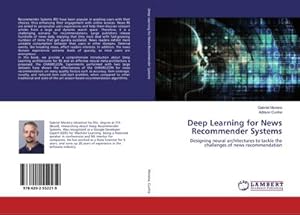
Deep Learning for News Recommender Systems
Langue: anglais
Edité par LAP LAMBERT Academic Publishing Mai 2020, 2020
ISBN 10 : 6202552212 ISBN 13 : 9786202552219
Vendeur : buchversandmimpf2000, Emtmannsberg, BAYE, Allemagne
Évaluation du vendeur 5 sur 5 étoiles
EUR 46,90
Expédition à EUR 60
Expédition depuis Allemagne vers Etats-UnisQuantité disponible : 1 disponible(s)
Ajouter au panierTaschenbuch. Etat : Neu. This item is printed on demand - Print on Demand Titel. Neuware -Recommender Systems (RS) have been popular in assisting users with their choices, thus enhancing their engagement with online services. News RS are aimed to personalize users experiences and help them discover relevant articles from a large and dynamic search space. Therefore, it is a challenging scenario for recommendations. Large publishers release hundreds of news daily, implying that they must deal with fast-growing numbers of items that get quickly outdated. News readers exhibit more unstable consumption behavior than users in other domains. External events, like breaking news, affect readers interests. In addition, the news domain experiences extreme levels of sparsity, as most users are anonymous.In this book, we provide a comprehensive introduction about Deep Learning architectures for RS and an effective neural meta-architecture is proposed: the CHAMELEON. Experiments performed with two large datasets have shown the effectiveness of the CHAMELEON for news recommendation on many quality factors such as accuracy, item coverage, novelty, and reduced item cold-start problem, when compared to other traditional and state-of-the-art session-based recommendation algorithms.VDM Verlag, Dudweiler Landstraße 99, 66123 Saarbrücken 188 pp. Englisch.
-

Deep Learning for News Recommender Systems : Designing neural architectures to tackle the challenges of news recommendation
Langue: anglais
Edité par LAP LAMBERT Academic Publishing, 2020
ISBN 10 : 6202552212 ISBN 13 : 9786202552219
Vendeur : AHA-BUCH GmbH, Einbeck, Allemagne
Évaluation du vendeur 5 sur 5 étoiles
EUR 47,46
Expédition à EUR 61,49
Expédition depuis Allemagne vers Etats-UnisQuantité disponible : 1 disponible(s)
Ajouter au panierTaschenbuch. Etat : Neu. nach der Bestellung gedruckt Neuware - Printed after ordering - Recommender Systems (RS) have been popular in assisting users with their choices, thus enhancing their engagement with online services. News RS are aimed to personalize users experiences and help them discover relevant articles from a large and dynamic search space. Therefore, it is a challenging scenario for recommendations. Large publishers release hundreds of news daily, implying that they must deal with fast-growing numbers of items that get quickly outdated. News readers exhibit more unstable consumption behavior than users in other domains. External events, like breaking news, affect readers interests. In addition, the news domain experiences extreme levels of sparsity, as most users are anonymous.In this book, we provide a comprehensive introduction about Deep Learning architectures for RS and an effective neural meta-architecture is proposed: the CHAMELEON. Experiments performed with two large datasets have shown the effectiveness of the CHAMELEON for news recommendation on many quality factors such as accuracy, item coverage, novelty, and reduced item cold-start problem, when compared to other traditional and state-of-the-art session-based recommendation algorithms.
