Montant total (1 article articles) :
Destination de la commande :

algorithm machine calculation complex fourier de cooley james john tukey (2 résultats)
Passer aux résultats principaux de la recherche
Filtres de recherche
Type d'article
- Tous les types de produits
- Livres (2)
- Magazines & Périodiques (Aucun autre résultat ne correspond à ces critères)
- Bandes dessinées (Aucun autre résultat ne correspond à ces critères)
- Partitions de musique (Aucun autre résultat ne correspond à ces critères)
- Art, Affiches et Gravures (Aucun autre résultat ne correspond à ces critères)
- Photographies (Aucun autre résultat ne correspond à ces critères)
- Cartes (Aucun autre résultat ne correspond à ces critères)
- Manuscrits & Papiers anciens (Aucun autre résultat ne correspond à ces critères)
Etat En savoir plus
- Neuf (Aucun autre résultat ne correspond à ces critères)
- Comme neuf, Très bon ou Bon (Aucun autre résultat ne correspond à ces critères)
- Assez bon ou satisfaisant (1)
- Moyen ou mauvais (Aucun autre résultat ne correspond à ces critères)
- Conformément à la description (1)
Particularités
- Ed. originale (2)
- Signé (Aucun autre résultat ne correspond à ces critères)
- Jaquette (Aucun autre résultat ne correspond à ces critères)
- Avec images (2)
- Sans impressions à la demande (2)
Langue (1)
Prix
- Tous les prix
- Moins de EUR 20 (Aucun autre résultat ne correspond à ces critères)
- EUR 20 à EUR 45 (Aucun autre résultat ne correspond à ces critères)
- Plus de EUR 45
Livraison gratuite
- Livraison gratuite à destination de Etats-Unis (Aucun autre résultat ne correspond à ces critères)
Pays
Evaluation du vendeur
-
An Algorithm for the Machine Calculation of Complex Fourier Series [within] Mathematics of Computation XIX Nos. 89-92 1965
Edité par American Mathematical Society, 1965
Vendeur : Midway Book Store (ABAA), St. Paul, MN, Etats-Unis
Membre d'association : ABAA ILAB MWABA
Évaluation du vendeur 5 sur 5 étoiles

Edition originale
EUR 657,66
EUR 5,96 shipping
Expédition nationale : Etats-UnisQuantité disponible : 1 disponible(s)
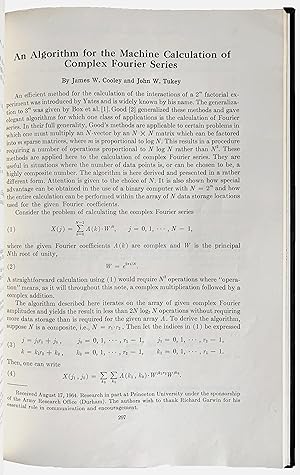
Ajouter au panierHardcover. Etat : Very Good. First edition. 25.5 x 17.5 cm. 724pp. Four issues of the Journal Mathematics of Computation 19, bound together into green boards. The table of contents are present and printed on stiff blue paper, the original covers are not present. The highlight is pages 297-302 which contain the paper "An Algorithm for the Machine Calculation of Complex Fourier Series" by Cooley and Tukey. Provenance: From the Autonetics Research Library with stamps on the bottom foredge. First publication of the Cooley-Tukey Fast Fourier Transform Algorithm (FFT), a faster method for calculating the discrete Fourier transform (DFT). The Cooley-Tukey algorithm is a divide and conquer algorithm which calculates the DFT directly with fewer summations and without matrix mulitplication. A similar algorithm was discovered by Frederick Gauss in 1805, though Cooley and Tukey independently discovered it at are credited with the invention of the modern FFT algorithm during a meeting of President Kennedy's Science Advisory Committee. References: Jeremy Norman's History of Information website and his bibliography. Origins of Cyberspace, 548. C. Sidney Burrus's article on FFTs on LibreTexts. The article "What Makes a Fourier Transform Fast" on the site algorithm-archive by Jamers Schloss.
-
An Algorithm for the Machine Calculation of Complex Fourier Series.
Edité par National Academy of Sciences-National Research Council, 1965., (Providence, RI):, 1965
Vendeur : Jeff Weber Rare Books, Neuchatel, NEUCH, Suisse
Membre d'association : ABAA ILAB
Évaluation du vendeur 5 sur 5 étoiles
Edition originale
EUR 876,88
EUR 25 shipping
Expédition depuis Suisse vers Etats-UnisQuantité disponible : 1 disponible(s)
Ajouter au panierContained in Mathematics of Computation, Vol. 19, No. 90, pp. 297-301. 8vo. pp. 177-364. Original printed wrappers bound in. Black cloth, printed paper spine label. Institutional exlib stamp on printed wrapper cover, ownership marks on printed covers. Fine. FIRST EDITION. This important work on the fast Fourier transform (FFT) algorithm, which is an efficient algorithm to compute the discrete Fourier transform (DFT) and its inverse. FFTs are of great importance to a wide variety of applications, from digital signal processing and solving partial differential equations to algorithms for quick multiplication of large integers. "By far the most common FFT is the Cooley-Tukey algorithm. This is a divide and conquer algorithm that recursively breaks down a DFT of any composite size N = N1N2 into many smaller DFTs of sizes N1 and N2, along with O(N) multiplications by complex roots of unity, traditionally called twiddle factors (after Gentleman and Sande, 1966). This method (and the general idea of an FFT) was popularized by a publication of J. W. Cooley and J. W. Tukey in 1965, but it was later discovered that those two authors had independently re-invented an algorithm known to Carl Friedrich Gauss around 1805 (and subsequently rediscovered several times in limited forms). The most well-known use of the Cooley-Tukey algorithm is to divide the transform into two pieces of size N / 2 at each step, and is therefore limited to power-of-two sizes, but any factorization can be used in general (as was known to both Gauss and Cooley/Tukey). These are called the radix-2 and mixed-radix cases, respectively (and other variants such as the split-radix FFT have their own names as well). Although the basic idea is recursive, most traditional implementations rearrange the algorithm to avoid explicit recursion. Also, because the Cooley-Tukey algorithm breaks the DFT into smaller DFTs, it can be combined arbitrarily with any other algorithm for the DFT." [Wikip.]. Norman, Origins of Cyberspace 548.
![Image du vendeur pour An Algorithm for the Machine Calculation of Complex Fourier Series [within] Mathematics of Computation XIX Nos. 89-92 1965 mis en vente par Midway Book Store (ABAA)](https://pictures.abebooks.com/inventory/md/md31632170776.jpg)