
Montant total (1 article articles) :
Destination de la commande :

computational analysis polymer processing (13 résultats)
Passer aux résultats principaux de la recherche
Filtres de recherche
Type d'article
- Tous les types de produits
- Livres (13)
- Magazines & Périodiques (Aucun autre résultat ne correspond à ces critères)
- Bandes dessinées (Aucun autre résultat ne correspond à ces critères)
- Partitions de musique (Aucun autre résultat ne correspond à ces critères)
- Art, Affiches et Gravures (Aucun autre résultat ne correspond à ces critères)
- Photographies (Aucun autre résultat ne correspond à ces critères)
- Cartes (Aucun autre résultat ne correspond à ces critères)
- Manuscrits & Papiers anciens (Aucun autre résultat ne correspond à ces critères)
Etat En savoir plus
- Neuf (10)
- Comme neuf, Très bon ou Bon (2)
- Assez bon ou satisfaisant (1)
- Moyen ou mauvais (Aucun autre résultat ne correspond à ces critères)
- Conformément à la description (Aucun autre résultat ne correspond à ces critères)
Particularités
- Ed. originale (1)
- Signé (Aucun autre résultat ne correspond à ces critères)
- Jaquette (Aucun autre résultat ne correspond à ces critères)
- Avec images (6)
- Sans impressions à la demande (10)
Langue (1)
Prix
- Tous les prix
- Moins de EUR 20 (Aucun autre résultat ne correspond à ces critères)
- EUR 20 à EUR 40 (Aucun autre résultat ne correspond à ces critères)
- Plus de EUR 40
Livraison gratuite
Pays
Evaluation du vendeur
-

Computational Analysis of Polymer Processing (Paperback)
Vendeur : Grand Eagle Retail, Bensenville, IL, Etats-Unis
Évaluation du vendeur 5 sur 5 étoiles

EUR 54,66
Livraison gratuite
Expédition nationale : Etats-UnisQuantité disponible : 1 disponible(s)
Ajouter au panierPaperback. Etat : new. Paperback. Large, fast, digital computers have been widely used in engineering practice and their use has had a large impact in many fields. Polymer processing is no exception, and there is already a substantial amount of literature describing ways in which processes can be analysed, designed or controlled using the potentialities of modern computers. The emphasis given varies with the application, and most authors tend to quote the results of their calculations rather than describing in any detail the way the calculations were undertaken or the difficulties experienced in carrying them out. We aim to give here as useful and connected an account as we can of a wide class of applications, for the benefit of scientists and engineers who find themselves working on polymer processing problems and feel the need to undertake such calculations. The major application we have in mind is the simulation of the dynamics ofthe various physical phenomena which arise in a polymer process treated as a complex engineering system. This requires that the system be reasonably well represented by a limited number of relatively simple subprocesses whose connections can be clearly identified, that the domi nant physical effects relevant to each subprocess can be well defined in a suitable mathematical form and that the sets of equations and boundary conditions developed to describe the whole system can be successfully discretised and solved numerically. Large, fast, digital computers have been widely used in engineering practice and their use has had a large impact in many fields. Polymer processing is no exception, and there is already a substantial amount of literature describing ways in which processes can be analysed, designed or controlled using the potentialities of modern computers. The emphasis given varies with the application, and most authors tend to quote the results of their calculations rather than describing in any detail the way the calculations were undertaken or the difficulties experienced in carrying them out. We aim to give here as useful and connected an account as we can of a wide class of applications, for the benefit of scientists and engineers who find themselves working on polymer processing problems and feel the need to undertake such calculations. The major application we have in mind is the simulation of the dynamics ofthe various physical phenomena which arise in a polymer process treated as a complex engineering system. This requires that the system be reasonably well represented by a limited number of relatively simple subprocesses whose connections can be clearly identified, that the domiA nant physical effects relevant to each subprocess can be well defined in a suitable mathematical form and that the sets of equations and boundary conditions developed to describe the whole system can be successfully discretised and solved numerically Shipping may be from multiple locations in the US or from the UK, depending on stock availability.
-

Computational Analysis of Polymer Processing
Vendeur : GreatBookPrices, Columbia, MD, Etats-Unis
Évaluation du vendeur 5 sur 5 étoiles
EUR 52,40
Expédition à EUR 2,21
Expédition nationale : Etats-UnisQuantité disponible : 15 disponible(s)
Ajouter au panierEtat : New.
-
Computational Analysis of Polymer Processing
Vendeur : Lucky's Textbooks, Dallas, TX, Etats-Unis
Évaluation du vendeur 5 sur 5 étoiles
EUR 51,25
Expédition à EUR 3,33
Expédition nationale : Etats-UnisQuantité disponible : Plus de 20 disponibles
Ajouter au panierEtat : New.
-

Computational Analysis of Polymer Processing
Vendeur : GreatBookPrices, Columbia, MD, Etats-Unis
Évaluation du vendeur 5 sur 5 étoiles
EUR 59,20
Expédition à EUR 2,21
Expédition nationale : Etats-UnisQuantité disponible : 15 disponible(s)
Ajouter au panierEtat : As New. Unread book in perfect condition.
-
Computational Analysis of Polymer Processing
Vendeur : Ria Christie Collections, Uxbridge, Royaume-Uni
Évaluation du vendeur 5 sur 5 étoiles
EUR 58,59
Expédition à EUR 13,82
Expédition depuis Royaume-Uni vers Etats-UnisQuantité disponible : Plus de 20 disponibles
Ajouter au panierEtat : New. In.
-
Computational Analysis of Polymer Processing
Langue: anglais
Edité par Applied Science Publishers, 2013
ISBN 10 : 9400966369 ISBN 13 : 9789400966369
Vendeur : Revaluation Books, Exeter, Royaume-Uni
Évaluation du vendeur 5 sur 5 étoiles
EUR 76,50
Expédition à EUR 11,54
Expédition depuis Royaume-Uni vers Etats-UnisQuantité disponible : 2 disponible(s)
Ajouter au panierPaperback. Etat : Brand New. 360 pages. 8.50x5.51x0.82 inches. In Stock.
-
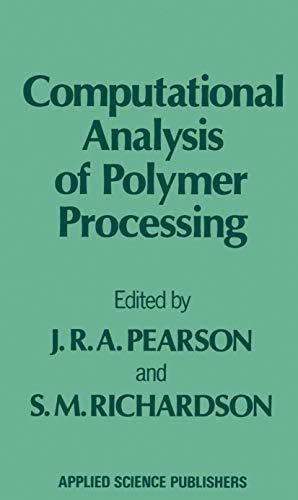
Computational Analysis of Polymer Processing
Vendeur : Stephen White Books, Bradford, Royaume-Uni
Évaluation du vendeur 5 sur 5 étoiles
EUR 50,41
Expédition à EUR 38,36
Expédition depuis Royaume-Uni vers Etats-UnisQuantité disponible : 1 disponible(s)
Ajouter au panierHardcover. Etat : Good. Ex-library book, usual markings. Hardcover/Hardback. Clean copy in good condition. Quick dispatch from UK seller.
-
Computational Analysis of Polymer Processing
Langue: anglais
Edité par Washington, D.C., U.S.A.: Elsevier Applied Science, 1983
ISBN 10 : 0853341885 ISBN 13 : 9780853341888
Vendeur : Bingo Books 2, Vancouver, WA, Etats-Unis
Évaluation du vendeur 5 sur 5 étoiles
Edition originale
EUR 84,35
Expédition à EUR 5,26
Expédition nationale : Etats-UnisQuantité disponible : 1 disponible(s)
Ajouter au panierHardcover. Etat : Near Fine. 1st Edition. hardback book in near fine condition,company name stamped on end pages.
-

Computational Analysis of Polymer Processing
Vendeur : AHA-BUCH GmbH, Einbeck, Allemagne
Évaluation du vendeur 5 sur 5 étoiles
EUR 59,97
Expédition à EUR 62,27
Expédition depuis Allemagne vers Etats-UnisQuantité disponible : 1 disponible(s)
Ajouter au panierTaschenbuch. Etat : Neu. Druck auf Anfrage Neuware - Printed after ordering - Large, fast, digital computers have been widely used in engineering practice and their use has had a large impact in many fields. Polymer processing is no exception, and there is already a substantial amount of literature describing ways in which processes can be analysed, designed or controlled using the potentialities of modern computers. The emphasis given varies with the application, and most authors tend to quote the results of their calculations rather than describing in any detail the way the calculations were undertaken or the difficulties experienced in carrying them out. We aim to give here as useful and connected an account as we can of a wide class of applications, for the benefit of scientists and engineers who find themselves working on polymer processing problems and feel the need to undertake such calculations. The major application we have in mind is the simulation of the dynamics ofthe various physical phenomena which arise in a polymer process treated as a complex engineering system. This requires that the system be reasonably well represented by a limited number of relatively simple subprocesses whose connections can be clearly identified, that the domi nant physical effects relevant to each subprocess can be well defined in a suitable mathematical form and that the sets of equations and boundary conditions developed to describe the whole system can be successfully discretised and solved numerically.
-
Computational Analysis of Polymer Processing (Paperback)
Vendeur : AussieBookSeller, Truganina, VIC, Australie
Évaluation du vendeur 5 sur 5 étoiles
EUR 111,63
Expédition à EUR 30,92
Expédition depuis Australie vers Etats-UnisQuantité disponible : 1 disponible(s)
Ajouter au panierPaperback. Etat : new. Paperback. Large, fast, digital computers have been widely used in engineering practice and their use has had a large impact in many fields. Polymer processing is no exception, and there is already a substantial amount of literature describing ways in which processes can be analysed, designed or controlled using the potentialities of modern computers. The emphasis given varies with the application, and most authors tend to quote the results of their calculations rather than describing in any detail the way the calculations were undertaken or the difficulties experienced in carrying them out. We aim to give here as useful and connected an account as we can of a wide class of applications, for the benefit of scientists and engineers who find themselves working on polymer processing problems and feel the need to undertake such calculations. The major application we have in mind is the simulation of the dynamics ofthe various physical phenomena which arise in a polymer process treated as a complex engineering system. This requires that the system be reasonably well represented by a limited number of relatively simple subprocesses whose connections can be clearly identified, that the domi nant physical effects relevant to each subprocess can be well defined in a suitable mathematical form and that the sets of equations and boundary conditions developed to describe the whole system can be successfully discretised and solved numerically. Large, fast, digital computers have been widely used in engineering practice and their use has had a large impact in many fields. Polymer processing is no exception, and there is already a substantial amount of literature describing ways in which processes can be analysed, designed or controlled using the potentialities of modern computers. The emphasis given varies with the application, and most authors tend to quote the results of their calculations rather than describing in any detail the way the calculations were undertaken or the difficulties experienced in carrying them out. We aim to give here as useful and connected an account as we can of a wide class of applications, for the benefit of scientists and engineers who find themselves working on polymer processing problems and feel the need to undertake such calculations. The major application we have in mind is the simulation of the dynamics ofthe various physical phenomena which arise in a polymer process treated as a complex engineering system. This requires that the system be reasonably well represented by a limited number of relatively simple subprocesses whose connections can be clearly identified, that the domiA nant physical effects relevant to each subprocess can be well defined in a suitable mathematical form and that the sets of equations and boundary conditions developed to describe the whole system can be successfully discretised and solved numerically Shipping may be from our Sydney, NSW warehouse or from our UK or US warehouse, depending on stock availability.
-

Computational Analysis of Polymer Processing
Langue: anglais
Edité par Springer, Springer Nov 2011, 2011
ISBN 10 : 9400966369 ISBN 13 : 9789400966369
Vendeur : BuchWeltWeit Ludwig Meier e.K., Bergisch Gladbach, Allemagne
Évaluation du vendeur 5 sur 5 étoiles
EUR 53,49
Expédition à EUR 23
Expédition depuis Allemagne vers Etats-UnisQuantité disponible : 2 disponible(s)
Ajouter au panierTaschenbuch. Etat : Neu. This item is printed on demand - it takes 3-4 days longer - Neuware -Large, fast, digital computers have been widely used in engineering practice and their use has had a large impact in many fields. Polymer processing is no exception, and there is already a substantial amount of literature describing ways in which processes can be analysed, designed or controlled using the potentialities of modern computers. The emphasis given varies with the application, and most authors tend to quote the results of their calculations rather than describing in any detail the way the calculations were undertaken or the difficulties experienced in carrying them out. We aim to give here as useful and connected an account as we can of a wide class of applications, for the benefit of scientists and engineers who find themselves working on polymer processing problems and feel the need to undertake such calculations. The major application we have in mind is the simulation of the dynamics ofthe various physical phenomena which arise in a polymer process treated as a complex engineering system. This requires that the system be reasonably well represented by a limited number of relatively simple subprocesses whose connections can be clearly identified, that the domi nant physical effects relevant to each subprocess can be well defined in a suitable mathematical form and that the sets of equations and boundary conditions developed to describe the whole system can be successfully discretised and solved numerically. 360 pp. Englisch.
-

EUR 48,37
Expédition à EUR 48,99
Expédition depuis Allemagne vers Etats-UnisQuantité disponible : Plus de 20 disponibles
Ajouter au panierEtat : New. Dieser Artikel ist ein Print on Demand Artikel und wird nach Ihrer Bestellung fuer Sie gedruckt. Large, fast, digital computers have been widely used in engineering practice and their use has had a large impact in many fields. Polymer processing is no exception, and there is already a substantial amount of literature describing ways in which processes .
-

Computational Analysis of Polymer Processing
Langue: anglais
Edité par Springer Netherlands, Springer Netherlands Nov 2011, 2011
ISBN 10 : 9400966369 ISBN 13 : 9789400966369
Vendeur : buchversandmimpf2000, Emtmannsberg, BAYE, Allemagne
Évaluation du vendeur 5 sur 5 étoiles
EUR 53,49
Expédition à EUR 60
Expédition depuis Allemagne vers Etats-UnisQuantité disponible : 1 disponible(s)
Ajouter au panierTaschenbuch. Etat : Neu. This item is printed on demand - Print on Demand Titel. Neuware -Large, fast, digital computers have been widely used in engineering practice and their use has had a large impact in many fields. Polymer processing is no exception, and there is already a substantial amount of literature describing ways in which processes can be analysed, designed or controlled using the potentialities of modern computers. The emphasis given varies with the application, and most authors tend to quote the results of their calculations rather than describing in any detail the way the calculations were undertaken or the difficulties experienced in carrying them out. We aim to give here as useful and connected an account as we can of a wide class of applications, for the benefit of scientists and engineers who find themselves working on polymer processing problems and feel the need to undertake such calculations. The major application we have in mind is the simulation of the dynamics ofthe various physical phenomena which arise in a polymer process treated as a complex engineering system. This requires that the system be reasonably well represented by a limited number of relatively simple subprocesses whose connections can be clearly identified, that the domi nant physical effects relevant to each subprocess can be well defined in a suitable mathematical form and that the sets of equations and boundary conditions developed to describe the whole system can be successfully discretised and solved numerically.Springer Verlag GmbH, Tiergartenstr. 17, 69121 Heidelberg 360 pp. Englisch.

