
Deep learning textual low data par bayer markus (10 résultats)

- Couverture souple
Vendeur : Grand Eagle Retail, Bensenville, IL, Etats-UnisGrand Eagle Retail
Contacter le vendeurVendeur avec une évaluation de 5 étoilesEtat: Neuf
EUR 125,91
Frais de port gratuitsExpédition nationale : Etats-UnisQuantité disponible : 1 disponible
Paperback. Etat : new. Paperback. In today's fast-paced cybersecurity landscape, professionals are increasingly challenged by the vast volumes of cyber threat data, making it difficult to identify and mitigate threats effectively. Traditional clustering methods help in broadly categorizing threats but fall short when it comes to the fine-grained analysis necessary for precise threat management. Supervised machine learning offers a potential solution, but the rapidly changing nature of cyber threats renders static models ineffective and the creation of new models too labor-intensive. This book addresses these challenges by introducing innovative low-data regime methods that enhance the machine learning process with minimal labeled data. The proposed approach spans four key stages:Data Acquisition: Leveraging active learning with advanced models like GPT-4 to optimize data labeling.Preprocessing: Utilizing GPT-2 and GPT-3 for data augmentation to enrich and diversify datasets.Model Selection: Developing a specialized cybersecurity language model and using multi-level transfer learning.Prediction: Introducing a novel adversarial example generation method, grounded in explainable AI, to improve model accuracy and resilience. mso-ascii-theme-font: minor-latin; mso-hansi-theme-font: minor-latin; mso-bidi-theme-font: minor-latin; Supervised machine learning offers a potential solution, but the rapidly changing nature of cyber threats renders static models ineffective and the creation of new models too labor-intensive. mso-ascii-theme-font: minor-latin; Shipping may be from multiple locations in the US or from the UK, depending on stock availability.…
- Couverture souple
Vendeur : Books Puddle, Woodside, NY, Etats-UnisBooks Puddle
Contacter le vendeurVendeur avec une évaluation de 4 étoilesEtat: Neuf
EUR 173,82
EUR 3,56 expéditionExpédition nationale : Etats-UnisQuantité disponible : 4 disponibles
Etat : New.
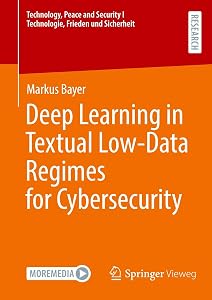
- Couverture souple
Vendeur : preigu, Osnabrück, Allemagnepreigu
Contacter le vendeurVendeur avec une évaluation de 5 étoilesEtat: Neuf
EUR 104,25
EUR 70,00 expéditionExpédition depuis Allemagne vers Etats-UnisQuantité disponible : 5 disponibles
Taschenbuch. Etat : Neu. Deep Learning in Textual Low-Data Regimes for Cybersecurity | Markus Bayer | Taschenbuch | Technology, Peace and Security I Technologie, Frieden und Sicherheit | xxviii | Englisch | 2025 | Springer Gabler | EAN 9783658487775 | Verantwortliche Person für die EU: Springer Vieweg in Springer Science + Business Media, Abraham-Lincoln-Str. 46, 65189 Wiesbaden, juergen[dot]hartmann[at]springer[dot]com | Anbieter: preigu.…
- Couverture souple
Vendeur : AussieBookSeller, Truganina, VIC, AustralieAussieBookSeller
Contacter le vendeurVendeur avec une évaluation de 5 étoilesEtat: Neuf
EUR 188,60
EUR 33,03 expéditionExpédition depuis Australie vers Etats-UnisQuantité disponible : 1 disponible
Paperback. Etat : new. Paperback. In today's fast-paced cybersecurity landscape, professionals are increasingly challenged by the vast volumes of cyber threat data, making it difficult to identify and mitigate threats effectively. Traditional clustering methods help in broadly categorizing threats but fall short when it comes to the fine-grained analysis necessary for precise threat management. Supervised machine learning offers a potential solution, but the rapidly changing nature of cyber threats renders static models ineffective and the creation of new models too labor-intensive. This book addresses these challenges by introducing innovative low-data regime methods that enhance the machine learning process with minimal labeled data. The proposed approach spans four key stages:Data Acquisition: Leveraging active learning with advanced models like GPT-4 to optimize data labeling.Preprocessing: Utilizing GPT-2 and GPT-3 for data augmentation to enrich and diversify datasets.Model Selection: Developing a specialized cybersecurity language model and using multi-level transfer learning.Prediction: Introducing a novel adversarial example generation method, grounded in explainable AI, to improve model accuracy and resilience. mso-ascii-theme-font: minor-latin; mso-hansi-theme-font: minor-latin; mso-bidi-theme-font: minor-latin; Supervised machine learning offers a potential solution, but the rapidly changing nature of cyber threats renders static models ineffective and the creation of new models too labor-intensive. mso-ascii-theme-font: minor-latin; Shipping may be from our Sydney, NSW warehouse or from our UK or US warehouse, depending on stock availability.…
- Couverture souple
- impression à la demande
Vendeur : Brook Bookstore On Demand, Napoli, NA, ItalieBrook Bookstore On Demand
Contacter le vendeurVendeur avec une évaluation de 5 étoilesEtat: Neuf
EUR 94,25
EUR 5,50 expéditionExpédition depuis Italie vers Etats-UnisQuantité disponible : Plus de 20 disponibles
Etat : new. Questo è un articolo print on demand.

Langue : anglais
Edité par Springer, Berlin, Springer Fachmedien Wiesbaden, Springer Vieweg, 2025
- Couverture souple
- impression à la demande
Vendeur : BuchWeltWeit Ludwig Meier e.K., Bergisch Gladbach, AllemagneBuchWeltWeit Ludwig Meier e.K.
Contacter le vendeurVendeur avec une évaluation de 5 étoilesEtat: Neuf
EUR 117,69
EUR 23,00 expéditionExpédition depuis Allemagne vers Etats-UnisQuantité disponible : 2 disponibles
Taschenbuch. Etat : Neu. This item is printed on demand - it takes 3-4 days longer - Neuware -In today's fast-paced cybersecurity landscape, professionals are increasingly challenged by the vast volumes of cyber threat data, making it difficult to identify and mitigate threats effectively. Traditional clustering methods help in broadly categorizing threats but fall short when it comes to the fine-grained analysis necessary for precise threat management. Supervised machine learning offers a potential solution, but the rapidly changing nature of cyber threats renders static models ineffective and the creation of new models too labor-intensive. This book addresses these challenges by introducing innovative low-data regime methods that enhance the machine learning process with minimal labeled data. The proposed approach spans four key stages:Data Acquisition: Leveraging active learning with advanced models like GPT-4 to optimize data labeling.Preprocessing: Utilizing GPT-2 and GPT-3 for data augmentation to enrich and diversify datasets.Model Selection: Developing a specialized cybersecurity language model and using multi-level transfer learning.Prediction: Introducing a novel adversarial example generation method, grounded in explainable AI, to improve model accuracy and resilience. 347 pp. Englisch. …

- Couverture souple
- impression à la demande
Vendeur : buchversandmimpf2000, Emtmannsberg, BAYE, Allemagnebuchversandmimpf2000
Contacter le vendeurVendeur avec une évaluation de 5 étoilesEtat: Neuf
EUR 117,69
EUR 60,00 expéditionExpédition depuis Allemagne vers Etats-UnisQuantité disponible : 1 disponible
Taschenbuch. Etat : Neu. This item is printed on demand - Print on Demand Titel. Neuware -In today's fast-paced cybersecurity landscape, professionals are increasingly challenged by the vast volumes of cyber threat data, making it difficult to identify and mitigate threats effectively. Traditional clustering methods help in broadly categorizing threats but fall short when it comes to the fine-grained analysis necessary for precise threat management. Supervised machine learning offers a potential solution, but the rapidly changing nature of cyber threats renders static models ineffective and the creation of new models too labor-intensive. This book addresses these challenges by introducing innovative low-data regime methods that enhance the machine learning process with minimal labeled data. The proposed approach spans four key stages:Data Acquisition: Leveraging active learning with advanced models like GPT-4 to optimize data labeling.Preprocessing: Utilizing GPT-2 and GPT-3 for data augmentation to enrich and diversify datasets.Model Selection: Developing a specialized cybersecurity language model and using multi-level transfer learning.Prediction: Introducing a novel adversarial example generation method, grounded in explainable AI, to improve model accuracy and resilience.Springer-Verlag GmbH, Tiergartenstr. 17, 69121 Heidelberg 376 pp. Englisch.…
- Couverture souple
- impression à la demande
Vendeur : CitiRetail, Stevenage, Royaume-UniCitiRetail
Contacter le vendeurVendeur avec une évaluation de 5 étoilesEtat: Neuf
EUR 140,18
EUR 43,79 expéditionExpédition depuis Royaume-Uni vers Etats-UnisQuantité disponible : 1 disponible
Paperback. Etat : new. Paperback. In today's fast-paced cybersecurity landscape, professionals are increasingly challenged by the vast volumes of cyber threat data, making it difficult to identify and mitigate threats effectively. Traditional clustering methods help in broadly categorizing threats but fall short when it comes to the fine-grained analysis necessary for precise threat management. Supervised machine learning offers a potential solution, but the rapidly changing nature of cyber threats renders static models ineffective and the creation of new models too labor-intensive. This book addresses these challenges by introducing innovative low-data regime methods that enhance the machine learning process with minimal labeled data. The proposed approach spans four key stages:Data Acquisition: Leveraging active learning with advanced models like GPT-4 to optimize data labeling.Preprocessing: Utilizing GPT-2 and GPT-3 for data augmentation to enrich and diversify datasets.Model Selection: Developing a specialized cybersecurity language model and using multi-level transfer learning.Prediction: Introducing a novel adversarial example generation method, grounded in explainable AI, to improve model accuracy and resilience. mso-ascii-theme-font: minor-latin; mso-hansi-theme-font: minor-latin; mso-bidi-theme-font: minor-latin; Supervised machine learning offers a potential solution, but the rapidly changing nature of cyber threats renders static models ineffective and the creation of new models too labor-intensive. mso-ascii-theme-font: minor-latin; This item is printed on demand. Shipping may be from our UK warehouse or from our Australian or US warehouses, depending on stock availability.…
- Couverture souple
- impression à la demande
Vendeur : Majestic Books, Hounslow, Royaume-UniMajestic Books
Contacter le vendeurVendeur avec une évaluation de 4 étoilesEtat: Neuf
EUR 181,69
EUR 7,69 expéditionExpédition depuis Royaume-Uni vers Etats-UnisQuantité disponible : 4 disponibles
Etat : New. Print on Demand.
- Couverture souple
- impression à la demande
Vendeur : Biblios, frankfurt am main, HESSE, AllemagneBiblios
Contacter le vendeurVendeur avec une évaluation de 4 étoilesEtat: Neuf
EUR 179,30
EUR 9,95 expéditionExpédition depuis Allemagne vers Etats-UnisQuantité disponible : 4 disponibles
Etat : New. PRINT ON DEMAND.


