
Montant total (1 article articles) :
Destination de la commande :

linear fractional programming theory methods de bajalinov e b (20 résultats)
Passer aux résultats principaux de la recherche
Filtres de recherche
Type d'article
- Tous les types de produits
- Livres (20)
- Magazines & Périodiques (Aucun autre résultat ne correspond à ces critères)
- Bandes dessinées (Aucun autre résultat ne correspond à ces critères)
- Partitions de musique (Aucun autre résultat ne correspond à ces critères)
- Art, Affiches et Gravures (Aucun autre résultat ne correspond à ces critères)
- Photographies (Aucun autre résultat ne correspond à ces critères)
- Cartes (Aucun autre résultat ne correspond à ces critères)
- Manuscrits & Papiers anciens (Aucun autre résultat ne correspond à ces critères)
Etat En savoir plus
- Neuf (15)
- Comme neuf, Très bon ou Bon (2)
- Assez bon ou satisfaisant (Aucun autre résultat ne correspond à ces critères)
- Moyen ou mauvais (Aucun autre résultat ne correspond à ces critères)
- Conformément à la description (3)
Particularités
- Ed. originale (Aucun autre résultat ne correspond à ces critères)
- Signé (Aucun autre résultat ne correspond à ces critères)
- Jaquette (Aucun autre résultat ne correspond à ces critères)
- Avec images (10)
- Sans impressions à la demande (15)
Langue (1)
Prix
- Tous les prix
- Moins de EUR 20 (Aucun autre résultat ne correspond à ces critères)
- EUR 20 à EUR 45 (Aucun autre résultat ne correspond à ces critères)
- Plus de EUR 45
Livraison gratuite
- Livraison gratuite à destination de Etats-Unis (Aucun autre résultat ne correspond à ces critères)
Pays
Evaluation du vendeur
-

Linear-Fractional Programming Theory, Methods, Applications and Software
Vendeur : Books Puddle, New York, NY, Etats-Unis
Évaluation du vendeur 4 sur 5 étoiles

EUR 145,38
EUR 3,44 expédition vers Etats-UnisQuantité disponible : 1 disponible(s)
Ajouter au panierEtat : Used. pp. 456.
-

Linear-Fractional Programming Theory, Methods, Applications and Software (Applied Optimization)
Vendeur : Lucky's Textbooks, Dallas, TX, Etats-Unis
Évaluation du vendeur 5 sur 5 étoiles

EUR 159,05
EUR 3,44 expédition vers Etats-UnisQuantité disponible : Plus de 20 disponibles
Ajouter au panierEtat : New.
-
Linear-Fractional Programming Theory, Methods, Applications and Software (Applied Optimization, 84)
Vendeur : Lucky's Textbooks, Dallas, TX, Etats-Unis
Évaluation du vendeur 5 sur 5 étoiles
EUR 159,05
EUR 3,44 expédition vers Etats-UnisQuantité disponible : Plus de 20 disponibles
Ajouter au panierEtat : New.
-
Linear-Fractional Programming Theory, Methods, Applications and Software
Vendeur : Majestic Books, Hounslow, Royaume-Uni
Évaluation du vendeur 4 sur 5 étoiles
EUR 155,04
EUR 7,38 expédition depuis Royaume-Uni vers Etats-UnisQuantité disponible : 1 disponible(s)
Ajouter au panierEtat : Used. pp. 456 Illus.
-
Linear-Fractional Programming Theory, Methods, Applications and Software
Vendeur : Biblios, Frankfurt am main, HESSE, Allemagne
Évaluation du vendeur 4 sur 5 étoiles
EUR 154,93
EUR 9,95 expédition depuis Allemagne vers Etats-UnisQuantité disponible : 1 disponible(s)
Ajouter au panierEtat : Used. pp. 456.
-
Linear-Fractional Programming Theory, Methods, Applications and Software (Applied Optimization)
Vendeur : Ria Christie Collections, Uxbridge, Royaume-Uni
Évaluation du vendeur 5 sur 5 étoiles
EUR 156,80
EUR 13,60 expédition depuis Royaume-Uni vers Etats-UnisQuantité disponible : Plus de 20 disponibles
Ajouter au panierEtat : New. In.
-
Linear-Fractional Programming Theory, Methods, Applications and Software (Applied Optimization, 84)
Vendeur : Ria Christie Collections, Uxbridge, Royaume-Uni
Évaluation du vendeur 5 sur 5 étoiles
EUR 156,80
EUR 13,60 expédition depuis Royaume-Uni vers Etats-UnisQuantité disponible : Plus de 20 disponibles
Ajouter au panierEtat : New. In.
-
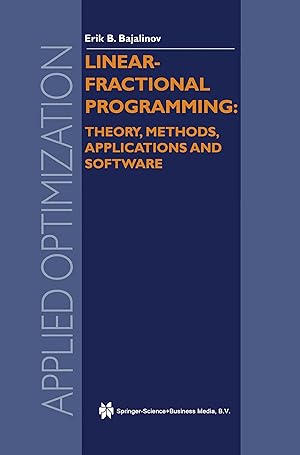
EUR 136,16
EUR 48,99 expédition depuis Allemagne vers Etats-UnisQuantité disponible : Plus de 20 disponibles
Ajouter au panierEtat : New.
-
EUR 136,16
EUR 48,99 expédition depuis Allemagne vers Etats-UnisQuantité disponible : Plus de 20 disponibles
Ajouter au panierGebunden. Etat : New.
-
EUR 141,30
EUR 70 expédition depuis Allemagne vers Etats-UnisQuantité disponible : 5 disponible(s)
Ajouter au panierTaschenbuch. Etat : Neu. Linear-Fractional Programming Theory, Methods, Applications and Software | E. B. Bajalinov | Taschenbuch | xxviii | Englisch | 2013 | Springer US | EAN 9781461348221 | Verantwortliche Person für die EU: Springer Verlag GmbH, Tiergartenstr. 17, 69121 Heidelberg, juergen[dot]hartmann[at]springer[dot]com | Anbieter: preigu.
-
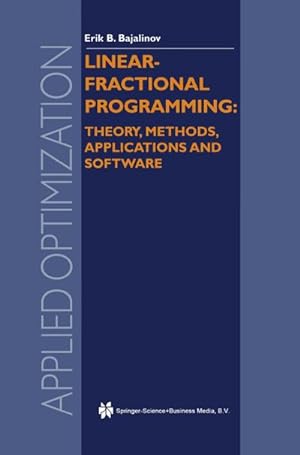
Linear-Fractional Programming Theory, Methods, Applications and Software
Vendeur : AHA-BUCH GmbH, Einbeck, Allemagne
Évaluation du vendeur 5 sur 5 étoiles
EUR 164,49
EUR 63,43 expédition depuis Allemagne vers Etats-UnisQuantité disponible : 1 disponible(s)
Ajouter au panierTaschenbuch. Etat : Neu. Druck auf Anfrage Neuware - Printed after ordering - This is a book on Linear-Fractional Programming (here and in what follows we will refer to it as 'LFP'). The field of LFP, largely developed by Hungarian mathematician B. Martos and his associates in the 1960's, is concerned with problems of op timization. LFP problems deal with determining the best possible allo cation of available resources to meet certain specifications. In particular, they may deal with situations where a number of resources, such as people, materials, machines, and land, are available and are to be combined to yield several products. In linear-fractional programming, the goal is to determine a per missible allocation of resources that will maximize or minimize some specific showing, such as profit gained per unit of cost, or cost of unit of product produced, etc. Strictly speaking, linear-fractional programming is a special case of the broader field of Mathematical Programming. LFP deals with that class of mathematical programming problems in which the relations among the variables are linear: the con straint relations (i.e. the restrictions) must be in linear form and the function to be optimized (i.e. the objective function) must be a ratio of two linear functions.
-
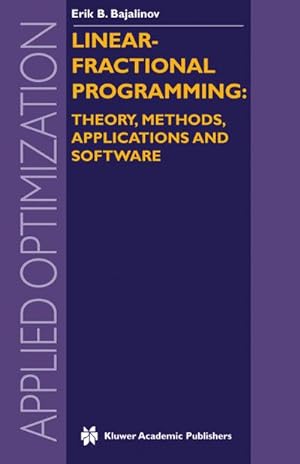
Linear-Fractional Programming Theory, Methods, Applications and Software
Edité par Springer US, Springer US, 2003
ISBN 10 : 1402076266 ISBN 13 : 9781402076268
Langue: anglais
Vendeur : AHA-BUCH GmbH, Einbeck, Allemagne
Évaluation du vendeur 5 sur 5 étoiles
EUR 168,73
EUR 64,23 expédition depuis Allemagne vers Etats-UnisQuantité disponible : 1 disponible(s)
Ajouter au panierBuch. Etat : Neu. Druck auf Anfrage Neuware - Printed after ordering - This is a book on Linear-Fractional Programming (here and in what follows we will refer to it as 'LFP'). The field of LFP, largely developed by Hungarian mathematician B. Martos and his associates in the 1960's, is concerned with problems of op timization. LFP problems deal with determining the best possible allo cation of available resources to meet certain specifications. In particular, they may deal with situations where a number of resources, such as people, materials, machines, and land, are available and are to be combined to yield several products. In linear-fractional programming, the goal is to determine a per missible allocation of resources that will maximize or minimize some specific showing, such as profit gained per unit of cost, or cost of unit of product produced, etc. Strictly speaking, linear-fractional programming is a special case of the broader field of Mathematical Programming. LFP deals with that class of mathematical programming problems in which the relations among the variables are linear: the con straint relations (i.e. the restrictions) must be in linear form and the function to be optimized (i.e. the objective function) must be a ratio of two linear functions.
-
Linear-Fractional Programming Theory, Methods, Applications and Software (Applied Optimization)
Vendeur : Revaluation Books, Exeter, Royaume-Uni
Évaluation du vendeur 5 sur 5 étoiles
EUR 236,09
EUR 14,19 expédition depuis Royaume-Uni vers Etats-UnisQuantité disponible : 2 disponible(s)
Ajouter au panierPaperback. Etat : Brand New. 453 pages. 9.30x6.20x1.00 inches. In Stock.
-
Linear-Fractional Programming Theory, Methods, Applications and Software (Applied Optimization, 84)
Vendeur : Mispah books, Redhill, SURRE, Royaume-Uni
Évaluation du vendeur 4 sur 5 étoiles
EUR 256,02
EUR 28,37 expédition depuis Royaume-Uni vers Etats-UnisQuantité disponible : 1 disponible(s)
Ajouter au panierPaperback. Etat : Like New. Like New. book.
-
Linear-Fractional Programming: Theory, Methods, Applications and Software (Applied Optimization)
Vendeur : Mispah books, Redhill, SURRE, Royaume-Uni
Évaluation du vendeur 4 sur 5 étoiles
EUR 363,57
EUR 28,37 expédition depuis Royaume-Uni vers Etats-UnisQuantité disponible : 1 disponible(s)
Ajouter au panierHardcover. Etat : Like New. Like New. book.
-
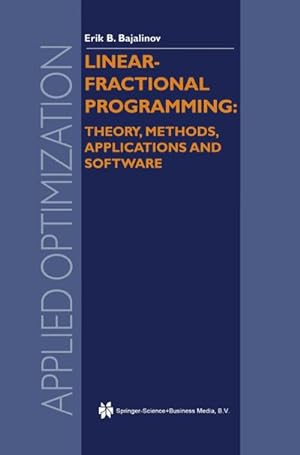
Linear-Fractional Programming Theory, Methods, Applications and Software
Vendeur : BuchWeltWeit Ludwig Meier e.K., Bergisch Gladbach, Allemagne
Évaluation du vendeur 5 sur 5 étoiles
EUR 160,49
EUR 23 expédition depuis Allemagne vers Etats-UnisQuantité disponible : 2 disponible(s)
Ajouter au panierTaschenbuch. Etat : Neu. This item is printed on demand - it takes 3-4 days longer - Neuware -This is a book on Linear-Fractional Programming (here and in what follows we will refer to it as 'LFP'). The field of LFP, largely developed by Hungarian mathematician B. Martos and his associates in the 1960's, is concerned with problems of op timization. LFP problems deal with determining the best possible allo cation of available resources to meet certain specifications. In particular, they may deal with situations where a number of resources, such as people, materials, machines, and land, are available and are to be combined to yield several products. In linear-fractional programming, the goal is to determine a per missible allocation of resources that will maximize or minimize some specific showing, such as profit gained per unit of cost, or cost of unit of product produced, etc. Strictly speaking, linear-fractional programming is a special case of the broader field of Mathematical Programming. LFP deals with that class of mathematical programming problems in which the relations among the variables are linear: the con straint relations (i.e. the restrictions) must be in linear form and the function to be optimized (i.e. the objective function) must be a ratio of two linear functions. 456 pp. Englisch.
-
EUR 141,30
EUR 70 expédition depuis Allemagne vers Etats-UnisQuantité disponible : 5 disponible(s)
Ajouter au panierBuch. Etat : Neu. Linear-Fractional Programming Theory, Methods, Applications and Software | E. B. Bajalinov | Buch | xxviii | Englisch | 2003 | Springer US | EAN 9781402076268 | Verantwortliche Person für die EU: Springer Verlag GmbH, Tiergartenstr. 17, 69121 Heidelberg, juergen[dot]hartmann[at]springer[dot]com | Anbieter: preigu Print on Demand.
-

Linear-Fractional Programming Theory, Methods, Applications and Software
Edité par Springer US, Springer US Nov 2003, 2003
ISBN 10 : 1402076266 ISBN 13 : 9781402076268
Langue: anglais
Vendeur : buchversandmimpf2000, Emtmannsberg, BAYE, Allemagne
Évaluation du vendeur 5 sur 5 étoiles
EUR 160,49
EUR 60 expédition depuis Allemagne vers Etats-UnisQuantité disponible : 1 disponible(s)
Ajouter au panierBuch. Etat : Neu. This item is printed on demand - Print on Demand Titel. Neuware -This is a book on Linear-Fractional Programming (here and in what follows we will refer to it as 'LFP'). The field of LFP, largely developed by Hungarian mathematician B. Martos and his associates in the 1960's, is concerned with problems of op timization. LFP problems deal with determining the best possible allo cation of available resources to meet certain specifications. In particular, they may deal with situations where a number of resources, such as people, materials, machines, and land, are available and are to be combined to yield several products. In linear-fractional programming, the goal is to determine a per missible allocation of resources that will maximize or minimize some specific showing, such as profit gained per unit of cost, or cost of unit of product produced, etc. Strictly speaking, linear-fractional programming is a special case of the broader field of Mathematical Programming. LFP deals with that class of mathematical programming problems in which the relations among the variables are linear: the con straint relations (i.e. the restrictions) must be in linear form and the function to be optimized (i.e. the objective function) must be a ratio of two linear functions.Springer Verlag GmbH, Tiergartenstr. 17, 69121 Heidelberg 456 pp. Englisch.
-

Linear-Fractional Programming Theory, Methods, Applications and Software
Edité par Springer US, Springer New York Dez 2013, 2013
ISBN 10 : 1461348226 ISBN 13 : 9781461348221
Langue: anglais
Vendeur : buchversandmimpf2000, Emtmannsberg, BAYE, Allemagne
Évaluation du vendeur 5 sur 5 étoiles
EUR 160,49
EUR 60 expédition depuis Allemagne vers Etats-UnisQuantité disponible : 1 disponible(s)
Ajouter au panierTaschenbuch. Etat : Neu. This item is printed on demand - Print on Demand Titel. Neuware -This is a book on Linear-Fractional Programming (here and in what follows we will refer to it as 'LFP'). The field of LFP, largely developed by Hungarian mathematician B. Martos and his associates in the 1960's, is concerned with problems of op timization. LFP problems deal with determining the best possible allo cation of available resources to meet certain specifications. In particular, they may deal with situations where a number of resources, such as people, materials, machines, and land, are available and are to be combined to yield several products. In linear-fractional programming, the goal is to determine a per missible allocation of resources that will maximize or minimize some specific showing, such as profit gained per unit of cost, or cost of unit of product produced, etc. Strictly speaking, linear-fractional programming is a special case of the broader field of Mathematical Programming. LFP deals with that class of mathematical programming problems in which the relations among the variables are linear: the con straint relations (i.e. the restrictions) must be in linear form and the function to be optimized (i.e. the objective function) must be a ratio of two linear functions.Springer Verlag GmbH, Tiergartenstr. 17, 69121 Heidelberg 456 pp. Englisch.
-
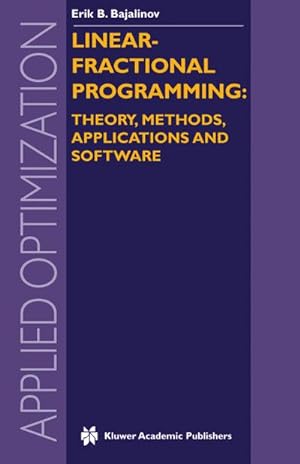
Linear-Fractional Programming Theory, Methods, Applications and Software
Vendeur : BuchWeltWeit Ludwig Meier e.K., Bergisch Gladbach, Allemagne
Évaluation du vendeur 5 sur 5 étoiles
EUR 287,83
EUR 23 expédition depuis Allemagne vers Etats-UnisQuantité disponible : 2 disponible(s)
Ajouter au panierBuch. Etat : Neu. This item is printed on demand - it takes 3-4 days longer - Neuware -This is a book on Linear-Fractional Programming (here and in what follows we will refer to it as 'LFP'). The field of LFP, largely developed by Hungarian mathematician B. Martos and his associates in the 1960's, is concerned with problems of op timization. LFP problems deal with determining the best possible allo cation of available resources to meet certain specifications. In particular, they may deal with situations where a number of resources, such as people, materials, machines, and land, are available and are to be combined to yield several products. In linear-fractional programming, the goal is to determine a per missible allocation of resources that will maximize or minimize some specific showing, such as profit gained per unit of cost, or cost of unit of product produced, etc. Strictly speaking, linear-fractional programming is a special case of the broader field of Mathematical Programming. LFP deals with that class of mathematical programming problems in which the relations among the variables are linear: the con straint relations (i.e. the restrictions) must be in linear form and the function to be optimized (i.e. the objective function) must be a ratio of two linear functions. 456 pp. Englisch.


