

Montant total (1 article articles) :
Destination de la commande :

modern methods geochemical analysis (13 résultats)
Passer aux résultats principaux de la recherche
Filtres de recherche
Type d'article
- Tous les types de produits
- Livres (13)
- Magazines & Périodiques (Aucun autre résultat ne correspond à ces critères)
- Bandes dessinées (Aucun autre résultat ne correspond à ces critères)
- Partitions de musique (Aucun autre résultat ne correspond à ces critères)
- Art, Affiches et Gravures (Aucun autre résultat ne correspond à ces critères)
- Photographies (Aucun autre résultat ne correspond à ces critères)
- Cartes (Aucun autre résultat ne correspond à ces critères)
- Manuscrits & Papiers anciens (Aucun autre résultat ne correspond à ces critères)
Etat En savoir plus
- Neuf (11)
- Comme neuf, Très bon ou Bon (1)
- Assez bon ou satisfaisant (1)
- Moyen ou mauvais (Aucun autre résultat ne correspond à ces critères)
- Conformément à la description (Aucun autre résultat ne correspond à ces critères)
Particularités
- Ed. originale (Aucun autre résultat ne correspond à ces critères)
- Signé (Aucun autre résultat ne correspond à ces critères)
- Jaquette (Aucun autre résultat ne correspond à ces critères)
- Avec images (5)
- Sans impressions à la demande (7)
Langue (1)
Livraison gratuite
- Livraison gratuite à destination de Etats-Unis (Aucun autre résultat ne correspond à ces critères)
Pays
Evaluation du vendeur
-
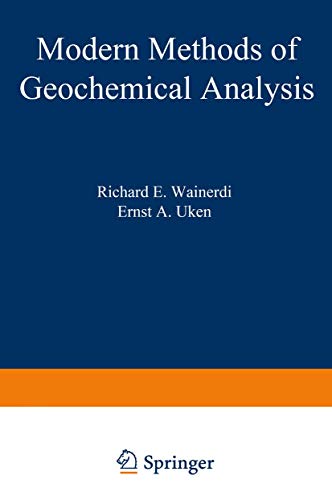
Modern Methods of Geochemical Analysis
Vendeur : Anybook.com, Lincoln, Royaume-Uni
Évaluation du vendeur 5 sur 5 étoiles

EUR 9,48
Expédition à EUR 16,02
Expédition depuis Royaume-Uni vers Etats-UnisQuantité disponible : 1 disponible(s)
Ajouter au panierEtat : Good. This is an ex-library book and may have the usual library/used-book markings inside.This book has hardback covers. In good all round condition. No dust jacket. Please note the Image in this listing is a stock photo and may not match the covers of the actual item,750grams, ISBN:0306304740.
-

Modern Methods of Geochemical Analysis (Monographs in Geoscience)
Vendeur : Ria Christie Collections, Uxbridge, Royaume-Uni
Évaluation du vendeur 5 sur 5 étoiles
EUR 117,51
Expédition à EUR 14,11
Expédition depuis Royaume-Uni vers Etats-UnisQuantité disponible : Plus de 20 disponibles
Ajouter au panierEtat : New. In.
-
EUR 92,27
Expédition à EUR 48,99
Expédition depuis Allemagne vers Etats-UnisQuantité disponible : Plus de 20 disponibles
Ajouter au panierEtat : New.
-
Modern Methods of Geochemical Analysis
Vendeur : Books Puddle, New York, NY, Etats-Unis
Évaluation du vendeur 4 sur 5 étoiles

EUR 149,74
Expédition à EUR 3,49
Expédition nationale : Etats-UnisQuantité disponible : 4 disponible(s)
Ajouter au panierEtat : New. pp. 416.
-
Modern Methods of Geochemical Analysis (Monographs in Geoscience)
Vendeur : Revaluation Books, Exeter, Royaume-Uni
Évaluation du vendeur 5 sur 5 étoiles
EUR 156,05
Expédition à EUR 14,72
Expédition depuis Royaume-Uni vers Etats-UnisQuantité disponible : 2 disponible(s)
Ajouter au panierPaperback. Etat : Brand New. reprint edition. 416 pages. 9.02x5.98x0.94 inches. In Stock.
-
Modern Methods of Geochemical Analysis
Vendeur : AHA-BUCH GmbH, Einbeck, Allemagne
Évaluation du vendeur 5 sur 5 étoiles
EUR 114,36
Expédition à EUR 63
Expédition depuis Allemagne vers Etats-UnisQuantité disponible : 1 disponible(s)
Ajouter au panierTaschenbuch. Etat : Neu. Druck auf Anfrage Neuware - Printed after ordering - The founders of geology at the beginning of the last century were suspicious oflaboratories. Hutton's well-known dictum illustrates the point: 'There are also superficial reasoning men . . . they judge of the great oper ations of the mineral kingdom from having kindled a fire, and looked into the bottom of a little crucible. ' The idea was not unreasonable; the earth is so large and its changes are so slow and so complicated that labo ratory tests and experiments were of little help. The earth had to be studied in its own terms and geology grew up as a separate science and not as a branch of physics or chemistry. Its practitioners were, for the most part, experts in structure, stratigraphy, or paleontology, not in silicate chemistry or mechanics. The chemists broke into this closed circle before the physicists did. The problems of the classification of rocks, particularly igneous rocks, and of the nature and genesis of ores are obviously chemical and, by the mid- 19th century, chemistry was in a state where rocks could be effectively analyzed, and a classification built up depending partly on chemistry and partly on the optical study of thin specimens. Gradually the chemical study of rocks became one of the central themes of earth science.
-
Modern Methods of Geochemical Analysis (Monographs in Geoscience)
Vendeur : Mispah books, Redhill, SURRE, Royaume-Uni
Évaluation du vendeur 4 sur 5 étoiles
EUR 166,17
Expédition à EUR 29,44
Expédition depuis Royaume-Uni vers Etats-UnisQuantité disponible : 1 disponible(s)
Ajouter au panierPaperback. Etat : Like New. Like New. book.
-
Modern Methods of Geochemical Analysis (eng)
Vendeur : Brook Bookstore On Demand, Napoli, NA, Italie
Évaluation du vendeur 5 sur 5 étoiles
EUR 86,24
Expédition à EUR 6,80
Expédition depuis Italie vers Etats-UnisQuantité disponible : Plus de 20 disponibles
Ajouter au panierEtat : new. Questo è un articolo print on demand.
-
Modern Methods of Geochemical Analysis
Langue: anglais
Edité par Springer, Springer Dez 2012, 2012
ISBN 10 : 1468418327 ISBN 13 : 9781468418323
Vendeur : BuchWeltWeit Ludwig Meier e.K., Bergisch Gladbach, Allemagne
Évaluation du vendeur 5 sur 5 étoiles
EUR 106,99
Expédition à EUR 23
Expédition depuis Allemagne vers Etats-UnisQuantité disponible : 2 disponible(s)
Ajouter au panierTaschenbuch. Etat : Neu. This item is printed on demand - it takes 3-4 days longer - Neuware -The founders of geology at the beginning of the last century were suspicious oflaboratories. Hutton's well-known dictum illustrates the point: 'There are also superficial reasoning men . . . they judge of the great oper ations of the mineral kingdom from having kindled a fire, and looked into the bottom of a little crucible. ' The idea was not unreasonable; the earth is so large and its changes are so slow and so complicated that labo ratory tests and experiments were of little help. The earth had to be studied in its own terms and geology grew up as a separate science and not as a branch of physics or chemistry. Its practitioners were, for the most part, experts in structure, stratigraphy, or paleontology, not in silicate chemistry or mechanics. The chemists broke into this closed circle before the physicists did. The problems of the classification of rocks, particularly igneous rocks, and of the nature and genesis of ores are obviously chemical and, by the mid- 19th century, chemistry was in a state where rocks could be effectively analyzed, and a classification built up depending partly on chemistry and partly on the optical study of thin specimens. Gradually the chemical study of rocks became one of the central themes of earth science. 416 pp. Englisch.
-
Modern Methods of Geochemical Analysis
Vendeur : Majestic Books, Hounslow, Royaume-Uni
Évaluation du vendeur 4 sur 5 étoiles
EUR 156,24
Expédition à EUR 7,65
Expédition depuis Royaume-Uni vers Etats-UnisQuantité disponible : 4 disponible(s)
Ajouter au panierEtat : New. Print on Demand pp. 416 23:B&W 6 x 9 in or 229 x 152 mm Perfect Bound on White w/Gloss Lam.
-
EUR 95,70
Expédition à EUR 70
Expédition depuis Allemagne vers Etats-UnisQuantité disponible : 5 disponible(s)
Ajouter au panierTaschenbuch. Etat : Neu. Modern Methods of Geochemical Analysis | Richard Wainerdi | Taschenbuch | xviii | Englisch | 2012 | Springer | EAN 9781468418323 | Verantwortliche Person für die EU: Springer Verlag GmbH, Tiergartenstr. 17, 69121 Heidelberg, juergen[dot]hartmann[at]springer[dot]com | Anbieter: preigu Print on Demand.
-
Modern Methods of Geochemical Analysis
Vendeur : Biblios, Frankfurt am main, HESSE, Allemagne
Évaluation du vendeur 4 sur 5 étoiles
EUR 156,51
Expédition à EUR 9,95
Expédition depuis Allemagne vers Etats-UnisQuantité disponible : 4 disponible(s)
Ajouter au panierEtat : New. PRINT ON DEMAND pp. 416.
-

Modern Methods of Geochemical Analysis
Langue: anglais
Edité par Springer, Springer New York Dez 2012, 2012
ISBN 10 : 1468418327 ISBN 13 : 9781468418323
Vendeur : buchversandmimpf2000, Emtmannsberg, BAYE, Allemagne
Évaluation du vendeur 5 sur 5 étoiles
EUR 106,99
Expédition à EUR 60
Expédition depuis Allemagne vers Etats-UnisQuantité disponible : 1 disponible(s)
Ajouter au panierTaschenbuch. Etat : Neu. This item is printed on demand - Print on Demand Titel. Neuware -The founders of geology at the beginning of the last century were suspicious oflaboratories. Hutton's well-known dictum illustrates the point: 'There are also superficial reasoning men . . . they judge of the great oper ations of the mineral kingdom from having kindled a fire, and looked into the bottom of a little crucible. ' The idea was not unreasonable; the earth is so large and its changes are so slow and so complicated that labo ratory tests and experiments were of little help. The earth had to be studied in its own terms and geology grew up as a separate science and not as a branch of physics or chemistry. Its practitioners were, for the most part, experts in structure, stratigraphy, or paleontology, not in silicate chemistry or mechanics. The chemists broke into this closed circle before the physicists did. The problems of the classification of rocks, particularly igneous rocks, and of the nature and genesis of ores are obviously chemical and, by the mid- 19th century, chemistry was in a state where rocks could be effectively analyzed, and a classification built up depending partly on chemistry and partly on the optical study of thin specimens. Gradually the chemical study of rocks became one of the central themes of earth science.Springer-Verlag KG, Sachsenplatz 4-6, 1201 Wien 416 pp. Englisch.


