
Montant total (1 article articles) :
Destination de la commande :

programmed cells basic neuroscience (24 résultats)
Passer aux résultats principaux de la recherche
Filtres de recherche
Type d'article
- Tous les types de produits
- Livres (24)
- Magazines & Périodiques (Aucun autre résultat ne correspond à ces critères)
- Bandes dessinées (Aucun autre résultat ne correspond à ces critères)
- Partitions de musique (Aucun autre résultat ne correspond à ces critères)
- Art, Affiches et Gravures (Aucun autre résultat ne correspond à ces critères)
- Photographies (Aucun autre résultat ne correspond à ces critères)
- Cartes (Aucun autre résultat ne correspond à ces critères)
- Manuscrits & Papiers anciens (Aucun autre résultat ne correspond à ces critères)
Etat En savoir plus
- Neuf (18)
- Comme neuf, Très bon ou Bon (4)
- Assez bon ou satisfaisant (Aucun autre résultat ne correspond à ces critères)
- Moyen ou mauvais (Aucun autre résultat ne correspond à ces critères)
- Conformément à la description (2)
Particularités
- Ed. originale (Aucun autre résultat ne correspond à ces critères)
- Signé (Aucun autre résultat ne correspond à ces critères)
- Jaquette (Aucun autre résultat ne correspond à ces critères)
- Avec images (10)
- Sans impressions à la demande (17)
Langue (1)
Livraison gratuite
Pays
Evaluation du vendeur
-

Programmed Cells from Basic Neuroscience to Therapy.
Livre 10 sur 14 : Research and Perspectives in NeurosciencesLangue: anglais
Edité par Berlin, Springer Berlin., 2013
ISBN 10 : 3642366473 ISBN 13 : 9783642366475
Vendeur : Universitätsbuchhandlung Herta Hold GmbH, Berlin, Allemagne
Membre d'association : GIAQ ILAB VDA
Évaluation du vendeur 5 sur 5 étoiles

EUR 12
Expédition à EUR 30
Expédition depuis Allemagne vers Etats-UnisQuantité disponible : 1 disponible(s)
Ajouter au panierXII, 132 p. Hardcover. Versand aus Deutschland / We dispatch from Germany via Air Mail. Einband bestoßen, daher Mängelexemplar gestempelt, sonst sehr guter Zustand. Imperfect copy due to slightly bumped cover, apart from this in very good condition. Stamped. Stamped. Research and Perspectives in Neurosciences ; 20. Sprache: Englisch.
-
Programmed Cells from Basic Neuroscience to Therapy
Livre 10 sur 14 : Research and Perspectives in NeurosciencesEUR 14,39
Expédition à EUR 105
Expédition depuis Allemagne vers Etats-UnisQuantité disponible : 1 disponible(s)
Ajouter au panierEtat : Hervorragend. Zustand: Hervorragend | Sprache: Englisch | Produktart: Bücher | Keine Beschreibung verfügbar.
-
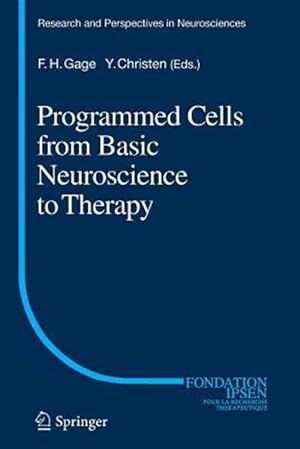
Programmed Cells from Basic Neuroscience to Therapy
Livre 10 sur 14 : Research and Perspectives in NeurosciencesVendeur : GreatBookPrices, Columbia, MD, Etats-Unis
Évaluation du vendeur 5 sur 5 étoiles
EUR 156,29
Expédition à EUR 2,23
Expédition nationale : Etats-UnisQuantité disponible : 15 disponible(s)
Ajouter au panierEtat : New.
-

Programmed Cells from Basic Neuroscience to Therapy (Research and Perspectives in Neurosciences, 20)
Livre 10 sur 14 : Research and Perspectives in NeurosciencesVendeur : Lucky's Textbooks, Dallas, TX, Etats-Unis
Évaluation du vendeur 5 sur 5 étoiles
EUR 155,13
Expédition à EUR 3,37
Expédition nationale : Etats-UnisQuantité disponible : Plus de 20 disponibles
Ajouter au panierEtat : New.
-
Programmed Cells from Basic Neuroscience to Therapy (Research and Perspectives in Neurosciences, 20)
Livre 10 sur 14 : Research and Perspectives in NeurosciencesVendeur : Ria Christie Collections, Uxbridge, Royaume-Uni
Évaluation du vendeur 5 sur 5 étoiles
EUR 157,63
Expédition à EUR 13,79
Expédition depuis Royaume-Uni vers Etats-UnisQuantité disponible : Plus de 20 disponibles
Ajouter au panierEtat : New. In.
-

Programmed Cells from Basic Neuroscience to Therapy
Livre 10 sur 14 : Research and Perspectives in NeurosciencesVendeur : GreatBookPricesUK, Woodford Green, Royaume-Uni
Évaluation du vendeur 5 sur 5 étoiles
EUR 158,79
Expédition à EUR 17,26
Expédition depuis Royaume-Uni vers Etats-UnisQuantité disponible : Plus de 20 disponibles
Ajouter au panierEtat : New.
-
Programmed Cells from Basic Neuroscience to Therapy (Research and Perspectives in Neurosciences, 20)
Livre 10 sur 14 : Research and Perspectives in NeurosciencesVendeur : California Books, Miami, FL, Etats-Unis
Évaluation du vendeur 5 sur 5 étoiles
EUR 175,92
Livraison gratuite
Expédition nationale : Etats-UnisQuantité disponible : Plus de 20 disponibles
Ajouter au panierEtat : New.
-
Programmed Cells from Basic Neuroscience to Therapy: 20 (Research and Perspectives in Neurosciences)
Livre 10 sur 14 : Research and Perspectives in NeurosciencesVendeur : Books Puddle, New York, NY, Etats-Unis
Évaluation du vendeur 4 sur 5 étoiles

EUR 191,11
Expédition à EUR 3,37
Expédition nationale : Etats-UnisQuantité disponible : 4 disponible(s)
Ajouter au panierEtat : New. pp. 142 Softcover reprint of the original 1st ed. 2013 edition NO-PA16APR2015-KAP.
-
Programmed Cells from Basic Neuroscience to Therapy (Research and Perspectives in Neurosciences, 20)
Livre 10 sur 14 : Research and Perspectives in NeurosciencesVendeur : Books Puddle, New York, NY, Etats-Unis
Évaluation du vendeur 4 sur 5 étoiles
EUR 201,14
Expédition à EUR 3,37
Expédition nationale : Etats-UnisQuantité disponible : 4 disponible(s)
Ajouter au panierEtat : New. pp. 150.
-

Programmed Cells from Basic Neuroscience to Therapy
Livre 10 sur 14 : Research and Perspectives in NeurosciencesEUR 138,20
Expédition à EUR 70
Expédition depuis Allemagne vers Etats-UnisQuantité disponible : 5 disponible(s)
Ajouter au panierTaschenbuch. Etat : Neu. Programmed Cells from Basic Neuroscience to Therapy | Fred H. Gage (u. a.) | Taschenbuch | Previously published in hardcover | xii | Englisch | 2016 | Springer | EAN 9783662512944 | Verantwortliche Person für die EU: Springer Verlag GmbH, Tiergartenstr. 17, 69121 Heidelberg, juergen[dot]hartmann[at]springer[dot]com | Anbieter: preigu.
-

Programmed Cells from Basic Neuroscience to Therapy
Livre 10 sur 14 : Research and Perspectives in NeurosciencesLangue: anglais
Edité par Springer, Berlin, Springer Berlin Heidelberg, Springer, 2013
ISBN 10 : 3642366473 ISBN 13 : 9783642366475
Vendeur : AHA-BUCH GmbH, Einbeck, Allemagne
Évaluation du vendeur 5 sur 5 étoiles
EUR 162,91
Expédition à EUR 61,75
Expédition depuis Allemagne vers Etats-UnisQuantité disponible : 2 disponible(s)
Ajouter au panierBuch. Etat : Neu. Druck auf Anfrage Neuware - Printed after ordering - The recent advances in Programming Somatic Cell (PSC) including induced Pluripotent Stem Cells (iPS) and Induced Neuronal phenotypes (iN), has changed our experimental landscape and opened new possibilities. The advances in PSC have provided an important tool for the study of human neuronal function as well as neurodegenerative and neurodevelopmental diseases in live human neurons in a controlled environment. For example, reprogramming cells from patients with neurological diseases allows the study of molecular pathways particular to specific subtypes of neurons such as dopaminergic neurons in Parkinson's Disease, Motor neurons for Amyolateral Sclerosis or myelin for Multiple Sclerosis. Detecting disease-specific molecular signatures in live human brain cells, opens possibilities for early intervention therapies and new diagnostic tools. Importantly, once the neurological neural phenotype is detected in vitro, the so-called 'disease-in-a-dish' approach allows for the screening of drugs that can ameliorate the disease-specific phenotype. New therapeutic drugs could either act on generalized pathways in all patients or be patient-specific and used in a personalized medicine approach. However, there are a number of pressing issues that need to be addressed and resolved before PSC technology can be extensively used for clinically relevant modeling of neurological diseases. Among these issues are the variability in PSC generation methods, variability between individuals, epigenetic/genetic instability and the ability to obtain disease-relevant subtypes of neurons . Current protocols for differentiating PSC into specific subtypes of neurons are under development, but more and better protocols are needed. Understanding the molecular pathways involved in human neural differentiation will facilitate the development of methods and tools to enrich and monitor the generation of specific subtypes of neurons that would be more relevant in modeling differentneurological diseases.
-

Programmed Cells from Basic Neuroscience to Therapy
Livre 10 sur 14 : Research and Perspectives in NeurosciencesLangue: anglais
Edité par Springer, Berlin, Springer Berlin Heidelberg, Springer, 2016
ISBN 10 : 3662512947 ISBN 13 : 9783662512944
Vendeur : AHA-BUCH GmbH, Einbeck, Allemagne
Évaluation du vendeur 5 sur 5 étoiles
EUR 165,03
Expédition à EUR 61,15
Expédition depuis Allemagne vers Etats-UnisQuantité disponible : 2 disponible(s)
Ajouter au panierTaschenbuch. Etat : Neu. Druck auf Anfrage Neuware - Printed after ordering - The recent advances in Programming Somatic Cell (PSC) including induced Pluripotent Stem Cells (iPS) and Induced Neuronal phenotypes (iN), has changed our experimental landscape and opened new possibilities. The advances in PSC have provided an important tool for the study of human neuronal function as well as neurodegenerative and neurodevelopmental diseases in live human neurons in a controlled environment. For example, reprogramming cells from patients with neurological diseases allows the study of molecular pathways particular to specific subtypes of neurons such as dopaminergic neurons in Parkinson's Disease, Motor neurons for Amyolateral Sclerosis or myelin for Multiple Sclerosis. Detecting disease-specific molecular signatures in live human brain cells, opens possibilities for early intervention therapies and new diagnostic tools. Importantly, once the neurological neural phenotype is detected in vitro, the so-called 'disease-in-a-dish' approach allows for the screening of drugs that can ameliorate the disease-specific phenotype. New therapeutic drugs could either act on generalized pathways in all patients or be patient-specific and used in a personalized medicine approach. However, there are a number of pressing issues that need to be addressed and resolved before PSC technology can be extensively used for clinically relevant modeling of neurological diseases. Among these issues are the variability in PSC generation methods, variability between individuals, epigenetic/genetic instability and the ability to obtain disease-relevant subtypes of neurons . Current protocols for differentiating PSC into specific subtypes of neurons are under development, but more and better protocols are needed. Understanding the molecular pathways involved in human neural differentiation will facilitate the development of methods and tools to enrich and monitor the generation of specific subtypes of neurons that would be more relevant in modeling differentneurological diseases.
-
Programmed Cells from Basic Neuroscience to Therapy
Livre 10 sur 14 : Research and Perspectives in NeurosciencesVendeur : Revaluation Books, Exeter, Royaume-Uni
Évaluation du vendeur 5 sur 5 étoiles
EUR 226,26
Expédition à EUR 23,01
Expédition depuis Royaume-Uni vers Etats-UnisQuantité disponible : 2 disponible(s)
Ajouter au panierPaperback. Etat : Brand New. reprint edition. 144 pages. 9.30x6.20x0.34 inches. In Stock.
-

Programmed Cells from Basic Neuroscience to Therapy
Livre 10 sur 14 : Research and Perspectives in NeurosciencesVendeur : GreatBookPricesUK, Woodford Green, Royaume-Uni
Évaluation du vendeur 5 sur 5 étoiles
EUR 242,96
Expédition à EUR 17,26
Expédition depuis Royaume-Uni vers Etats-UnisQuantité disponible : Plus de 20 disponibles
Ajouter au panierEtat : As New. Unread book in perfect condition.
-
Programmed Cells from Basic Neuroscience to Therapy (Research and Perspectives in Neurosciences, 20)
Livre 10 sur 14 : Research and Perspectives in NeurosciencesVendeur : Mispah books, Redhill, SURRE, Royaume-Uni
Évaluation du vendeur 4 sur 5 étoiles
EUR 233,49
Expédition à EUR 28,77
Expédition depuis Royaume-Uni vers Etats-UnisQuantité disponible : 1 disponible(s)
Ajouter au panierPaperback. Etat : Like New. Like New. book.
-
Programmed Cells from Basic Neuroscience to Therapy (Research and Perspectives in Neurosciences, 20)
Livre 10 sur 14 : Research and Perspectives in NeurosciencesVendeur : Mispah books, Redhill, SURRE, Royaume-Uni
Évaluation du vendeur 4 sur 5 étoiles
EUR 245,35
Expédition à EUR 28,77
Expédition depuis Royaume-Uni vers Etats-UnisQuantité disponible : 1 disponible(s)
Ajouter au panierHardcover. Etat : Like New. LIKE NEW. SHIPS FROM MULTIPLE LOCATIONS. book.
-

Programmed Cells from Basic Neuroscience to Therapy
Livre 10 sur 14 : Research and Perspectives in NeurosciencesVendeur : GreatBookPrices, Columbia, MD, Etats-Unis
Évaluation du vendeur 5 sur 5 étoiles
EUR 267,82
Expédition à EUR 2,23
Expédition nationale : Etats-UnisQuantité disponible : 15 disponible(s)
Ajouter au panierEtat : As New. Unread book in perfect condition.
-

Programmed Cells from Basic Neuroscience to Therapy
Livre 10 sur 14 : Research and Perspectives in NeurosciencesLangue: anglais
Edité par Berlin Springer Berlin Heidelberg Springer Jun 2013, 2013
ISBN 10 : 3642366473 ISBN 13 : 9783642366475
Vendeur : BuchWeltWeit Ludwig Meier e.K., Bergisch Gladbach, Allemagne
Évaluation du vendeur 5 sur 5 étoiles
EUR 160,49
Expédition à EUR 23
Expédition depuis Allemagne vers Etats-UnisQuantité disponible : 2 disponible(s)
Ajouter au panierBuch. Etat : Neu. This item is printed on demand - it takes 3-4 days longer - Neuware -The recent advances in Programming Somatic Cell (PSC) including induced Pluripotent Stem Cells (iPS) and Induced Neuronal phenotypes (iN), has changed our experimental landscape and opened new possibilities. The advances in PSC have provided an important tool for the study of human neuronal function as well as neurodegenerative and neurodevelopmental diseases in live human neurons in a controlled environment. For example, reprogramming cells from patients with neurological diseases allows the study of molecular pathways particular to specific subtypes of neurons such as dopaminergic neurons in Parkinson's Disease, Motor neurons for Amyolateral Sclerosis or myelin for Multiple Sclerosis. Detecting disease-specific molecular signatures in live human brain cells, opens possibilities for early intervention therapies and new diagnostic tools. Importantly, once the neurological neural phenotype is detected in vitro, the so-called 'disease-in-a-dish' approach allows for the screening of drugs that can ameliorate the disease-specific phenotype. New therapeutic drugs could either act on generalized pathways in all patients or be patient-specific and used in a personalized medicine approach. However, there are a number of pressing issues that need to be addressed and resolved before PSC technology can be extensively used for clinically relevant modeling of neurological diseases. Among these issues are the variability in PSC generation methods, variability between individuals, epigenetic/genetic instability and the ability to obtain disease-relevant subtypes of neurons . Current protocols for differentiating PSC into specific subtypes of neurons are under development, but more and better protocols are needed. Understanding the molecular pathways involved in human neural differentiation will facilitate the development of methods and tools to enrich and monitor the generation of specific subtypes of neurons that would be more relevant in modeling different neurological diseases. 130 pp. Englisch.
-

Programmed Cells from Basic Neuroscience to Therapy
Livre 10 sur 14 : Research and Perspectives in NeurosciencesLangue: anglais
Edité par Berlin Springer Berlin Heidelberg Springer Okt 2016, 2016
ISBN 10 : 3662512947 ISBN 13 : 9783662512944
Vendeur : BuchWeltWeit Ludwig Meier e.K., Bergisch Gladbach, Allemagne
Évaluation du vendeur 5 sur 5 étoiles
EUR 160,49
Expédition à EUR 23
Expédition depuis Allemagne vers Etats-UnisQuantité disponible : 2 disponible(s)
Ajouter au panierTaschenbuch. Etat : Neu. This item is printed on demand - it takes 3-4 days longer - Neuware -The recent advances in Programming Somatic Cell (PSC) including induced Pluripotent Stem Cells (iPS) and Induced Neuronal phenotypes (iN), has changed our experimental landscape and opened new possibilities. The advances in PSC have provided an important tool for the study of human neuronal function as well as neurodegenerative and neurodevelopmental diseases in live human neurons in a controlled environment. For example, reprogramming cells from patients with neurological diseases allows the study of molecular pathways particular to specific subtypes of neurons such as dopaminergic neurons in Parkinson's Disease, Motor neurons for Amyolateral Sclerosis or myelin for Multiple Sclerosis. Detecting disease-specific molecular signatures in live human brain cells, opens possibilities for early intervention therapies and new diagnostic tools. Importantly, once the neurological neural phenotype is detected in vitro, the so-called 'disease-in-a-dish' approach allows for the screening of drugs that can ameliorate the disease-specific phenotype. New therapeutic drugs could either act on generalized pathways in all patients or be patient-specific and used in a personalized medicine approach. However, there are a number of pressing issues that need to be addressed and resolved before PSC technology can be extensively used for clinically relevant modeling of neurological diseases. Among these issues are the variability in PSC generation methods, variability between individuals, epigenetic/genetic instability and the ability to obtain disease-relevant subtypes of neurons . Current protocols for differentiating PSC into specific subtypes of neurons are under development, but more and better protocols are needed. Understanding the molecular pathways involved in human neural differentiation will facilitate the development of methods and tools to enrich and monitor the generation of specific subtypes of neurons that would be more relevant in modeling different neurological diseases. 130 pp. Englisch.
-

Programmed Cells from Basic Neuroscience to Therapy
Livre 10 sur 14 : Research and Perspectives in NeurosciencesLangue: anglais
Edité par Springer Berlin Heidelberg, 2016
ISBN 10 : 3662512947 ISBN 13 : 9783662512944
EUR 137,26
Expédition à EUR 48,99
Expédition depuis Allemagne vers Etats-UnisQuantité disponible : Plus de 20 disponibles
Ajouter au panierEtat : New. Dieser Artikel ist ein Print on Demand Artikel und wird nach Ihrer Bestellung fuer Sie gedruckt. Presents latest research on neurodegenerative diseases Presents prospects for novel therapies Written by leading experts in the field The recent advances in Programming Somatic Cell (PSC) including induced Pluripotent Stem Cells (iP.
-
Programmed Cells from Basic Neuroscience to Therapy: 20 (Research and Perspectives in Neurosciences)
Livre 10 sur 14 : Research and Perspectives in NeurosciencesVendeur : Majestic Books, Hounslow, Royaume-Uni
Évaluation du vendeur 4 sur 5 étoiles
EUR 196,52
Expédition à EUR 7,48
Expédition depuis Royaume-Uni vers Etats-UnisQuantité disponible : 4 disponible(s)
Ajouter au panierEtat : New. Print on Demand pp. 142.
-
Programmed Cells from Basic Neuroscience to Therapy (Research and Perspectives in Neurosciences, 20)
Livre 10 sur 14 : Research and Perspectives in NeurosciencesVendeur : Majestic Books, Hounslow, Royaume-Uni
Évaluation du vendeur 4 sur 5 étoiles
EUR 206,77
Expédition à EUR 7,48
Expédition depuis Royaume-Uni vers Etats-UnisQuantité disponible : 4 disponible(s)
Ajouter au panierEtat : New. Print on Demand pp. 150.
-
Programmed Cells from Basic Neuroscience to Therapy: 20 (Research and Perspectives in Neurosciences)
Livre 10 sur 14 : Research and Perspectives in NeurosciencesVendeur : Biblios, Frankfurt am main, HESSE, Allemagne
Évaluation du vendeur 4 sur 5 étoiles
EUR 203,05
Expédition à EUR 9,95
Expédition depuis Allemagne vers Etats-UnisQuantité disponible : 4 disponible(s)
Ajouter au panierEtat : New. PRINT ON DEMAND pp. 142.
-
Programmed Cells from Basic Neuroscience to Therapy (Research and Perspectives in Neurosciences, 20)
Livre 10 sur 14 : Research and Perspectives in NeurosciencesVendeur : Biblios, Frankfurt am main, HESSE, Allemagne
Évaluation du vendeur 4 sur 5 étoiles
EUR 213,58
Expédition à EUR 9,95
Expédition depuis Allemagne vers Etats-UnisQuantité disponible : 4 disponible(s)
Ajouter au panierEtat : New. PRINT ON DEMAND pp. 150.

