

Montant total (1 article articles) :
Destination de la commande :

simulation diffraction based uncertainty de pohl alexander (5 résultats)
Passer aux résultats principaux de la recherche
Filtres de recherche
Type d'article
- Tous les types de produits
- Livres (5)
- Magazines & Périodiques (Aucun autre résultat ne correspond à ces critères)
- Bandes dessinées (Aucun autre résultat ne correspond à ces critères)
- Partitions de musique (Aucun autre résultat ne correspond à ces critères)
- Art, Affiches et Gravures (Aucun autre résultat ne correspond à ces critères)
- Photographies (Aucun autre résultat ne correspond à ces critères)
- Cartes (Aucun autre résultat ne correspond à ces critères)
- Manuscrits & Papiers anciens (Aucun autre résultat ne correspond à ces critères)
Etat En savoir plus
- Neuf (5)
- Comme neuf, Très bon ou Bon (Aucun autre résultat ne correspond à ces critères)
- Assez bon ou satisfaisant (Aucun autre résultat ne correspond à ces critères)
- Moyen ou mauvais (Aucun autre résultat ne correspond à ces critères)
- Conformément à la description (Aucun autre résultat ne correspond à ces critères)
Reliure
- Toutes
- Couverture rigide (Aucun autre résultat ne correspond à ces critères)
- Couverture souple (5)
Particularités
- Ed. originale (Aucun autre résultat ne correspond à ces critères)
- Signé (Aucun autre résultat ne correspond à ces critères)
- Jaquette (Aucun autre résultat ne correspond à ces critères)
- Avec images (4)
- Sans impressions à la demande (2)
Langue (1)
Prix
- Tous les prix
- Moins de EUR 20 (Aucun autre résultat ne correspond à ces critères)
- EUR 20 à EUR 45 (Aucun autre résultat ne correspond à ces critères)
- Plus de EUR 45
Livraison gratuite
- Livraison gratuite à destination de Etats-Unis (Aucun autre résultat ne correspond à ces critères)
Pays
Evaluation du vendeur
-

Simulation of Diffraction Based on the Uncertainty Relation
Vendeur : Revaluation Books, Exeter, Royaume-Uni
Évaluation du vendeur 5 sur 5 étoiles

EUR 85,90
Expédition à EUR 11,59
Expédition depuis Royaume-Uni vers Etats-UnisQuantité disponible : 1 disponible(s)
Ajouter au panierPaperback. Etat : Brand New. 268 pages. 8.27x5.83x0.63 inches. In Stock.
-
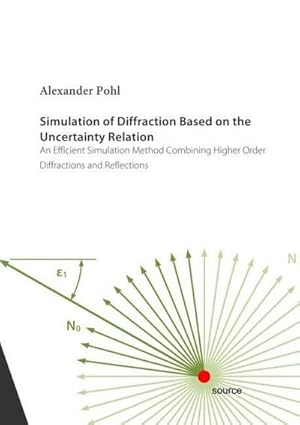
Simulation of Diffraction Based on the Uncertainty Relation : An Efficient Simulation Method Combining Higher Order Diffractions and Reflections
Vendeur : AHA-BUCH GmbH, Einbeck, Allemagne
Évaluation du vendeur 5 sur 5 étoiles
EUR 59,99
Expédition à EUR 62,07
Expédition depuis Allemagne vers Etats-UnisQuantité disponible : Plus de 20 disponibles
Ajouter au panierTaschenbuch. Etat : Neu. Druck auf Anfrage Neuware - Printed after ordering - In both room and city acoustics, the simulation of sound propagation is stillchallenging. The handling of diffraction is still topic of current research, especiallythe diffraction of higher orders. Due to the large scale of the environmentcompared to the typical wavelengths of sound, Geometrical Acoustic (GA)simulation methods are used rather than exact wave theoretical simulationmethods. These GA methods handle sound as particles instead of waves (waveparticledualism as known from optics). Based on this restriction, wave effects suchas diffraction have to be modelled explicitly.In this work, a diffraction formulation called Uncertainty relation Based Diffraction(UBD) by Stephenson is investigated and extended. The UBD is based onHeisenberg's uncertainty relation and the Fraunhofer diffraction theory. The greatadvantage of this formulation is that the straight forward propagation technique ofparticles can be used and integrated as a module in the simulation. However, it willbe shown that some assumptions of former publications are not well founded, suchthat alternative formulations are presented. Good agreements with the wavetheoretical reference methods are shown in almost all cases. In addition to formerpublications, the UBD method is extended to 3D.Unfortunately, the usage of the UBD diffraction module causes a split-up ofparticles, such that the computation time increases exponentially. To overcome thissplit-up, the reunification of particles is aspired. Quantized Pyramidal Beam Tracing(QPBT) and the Sound Particle Radiosity (SPR) aim at this reunification. It will beshown that SPR is both more efficient and more accurate than QPBT. However, thememory effort of the SPR yields a major bottleneck. First optimizations to decreasethe memory effort will be presented to overcome this issue.
-

Simulation of Diffraction Based on the Uncertainty Relation
Vendeur : Rheinberg-Buch Andreas Meier eK, Bergisch Gladbach, Allemagne
Évaluation du vendeur 5 sur 5 étoiles
EUR 59,99
Expédition à EUR 23
Expédition depuis Allemagne vers Etats-UnisQuantité disponible : 20 disponible(s)
Ajouter au panierTaschenbuch. Etat : Neu. This item is printed on demand - it takes 3-4 days longer - Neuware -In both room and city acoustics, the simulation of sound propagation is stillchallenging. The handling of diffraction is still topic of current research, especiallythe diffraction of higher orders. Due to the large scale of the environmentcompared to the typical wavelengths of sound, Geometrical Acoustic (GA)simulation methods are used rather than exact wave theoretical simulationmethods. These GA methods handle sound as particles instead of waves (waveparticledualism as known from optics). Based on this restriction, wave effects suchas diffraction have to be modelled explicitly.In this work, a diffraction formulation called Uncertainty relation Based Diffraction(UBD) by Stephenson is investigated and extended. The UBD is based onHeisenberg's uncertainty relation and the Fraunhofer diffraction theory. The greatadvantage of this formulation is that the straight forward propagation technique ofparticles can be used and integrated as a module in the simulation. However, it willbe shown that some assumptions of former publications are not well founded, suchthat alternative formulations are presented. Good agreements with the wavetheoretical reference methods are shown in almost all cases. In addition to formerpublications, the UBD method is extended to 3D.Unfortunately, the usage of the UBD diffraction module causes a split-up ofparticles, such that the computation time increases exponentially. To overcome thissplit-up, the reunification of particles is aspired. Quantized Pyramidal Beam Tracing(QPBT) and the Sound Particle Radiosity (SPR) aim at this reunification. It will beshown that SPR is both more efficient and more accurate than QPBT. However, thememory effort of the SPR yields a major bottleneck. First optimizations to decreasethe memory effort will be presented to overcome this issue. 268 pp. Englisch.
-

Simulation of Diffraction Based on the Uncertainty Relation
Vendeur : BuchWeltWeit Ludwig Meier e.K., Bergisch Gladbach, Allemagne
Évaluation du vendeur 5 sur 5 étoiles
EUR 59,99
Expédition à EUR 23
Expédition depuis Allemagne vers Etats-UnisQuantité disponible : 2 disponible(s)
Ajouter au panierTaschenbuch. Etat : Neu. This item is printed on demand - it takes 3-4 days longer - Neuware -In both room and city acoustics, the simulation of sound propagation is stillchallenging. The handling of diffraction is still topic of current research, especiallythe diffraction of higher orders. Due to the large scale of the environmentcompared to the typical wavelengths of sound, Geometrical Acoustic (GA)simulation methods are used rather than exact wave theoretical simulationmethods. These GA methods handle sound as particles instead of waves (waveparticledualism as known from optics). Based on this restriction, wave effects suchas diffraction have to be modelled explicitly.In this work, a diffraction formulation called Uncertainty relation Based Diffraction(UBD) by Stephenson is investigated and extended. The UBD is based onHeisenberg's uncertainty relation and the Fraunhofer diffraction theory. The greatadvantage of this formulation is that the straight forward propagation technique ofparticles can be used and integrated as a module in the simulation. However, it willbe shown that some assumptions of former publications are not well founded, suchthat alternative formulations are presented. Good agreements with the wavetheoretical reference methods are shown in almost all cases. In addition to formerpublications, the UBD method is extended to 3D.Unfortunately, the usage of the UBD diffraction module causes a split-up ofparticles, such that the computation time increases exponentially. To overcome thissplit-up, the reunification of particles is aspired. Quantized Pyramidal Beam Tracing(QPBT) and the Sound Particle Radiosity (SPR) aim at this reunification. It will beshown that SPR is both more efficient and more accurate than QPBT. However, thememory effort of the SPR yields a major bottleneck. First optimizations to decreasethe memory effort will be presented to overcome this issue. 268 pp. Englisch.
-

EUR 59,99
Expédition à EUR 48,99
Expédition depuis Allemagne vers Etats-UnisQuantité disponible : Plus de 20 disponibles
Ajouter au panierEtat : New. Dieser Artikel ist ein Print on Demand Artikel und wird nach Ihrer Bestellung fuer Sie gedruckt. Simulation of Diffraction Based on the Uncertainty RelationIn both room and city acoustics, the simulation of sound propagation is stillchallenging. The handling of diffraction is still topic of current research, especiallythe diffraction of higher orde.

