

Montant total (1 article articles) :
Destination de la commande :

transformation co operation conversion (29 résultats)
Passer aux résultats principaux de la recherche
Filtres de recherche
Type d'article
- Tous les types de produits
- Livres (29)
- Magazines & Périodiques (Aucun autre résultat ne correspond à ces critères)
- Bandes dessinées (Aucun autre résultat ne correspond à ces critères)
- Partitions de musique (Aucun autre résultat ne correspond à ces critères)
- Art, Affiches et Gravures (Aucun autre résultat ne correspond à ces critères)
- Photographies (Aucun autre résultat ne correspond à ces critères)
- Cartes (Aucun autre résultat ne correspond à ces critères)
- Manuscrits & Papiers anciens (Aucun autre résultat ne correspond à ces critères)
Etat En savoir plus
- Neuf (25)
- Comme neuf, Très bon ou Bon (4)
- Assez bon ou satisfaisant (Aucun autre résultat ne correspond à ces critères)
- Moyen ou mauvais (Aucun autre résultat ne correspond à ces critères)
- Conformément à la description (Aucun autre résultat ne correspond à ces critères)
Particularités
- Ed. originale (Aucun autre résultat ne correspond à ces critères)
- Signé (Aucun autre résultat ne correspond à ces critères)
- Jaquette (Aucun autre résultat ne correspond à ces critères)
- Avec images (14)
- Sans impressions à la demande (17)
Langue (1)
Livraison gratuite
Pays
Evaluation du vendeur
-
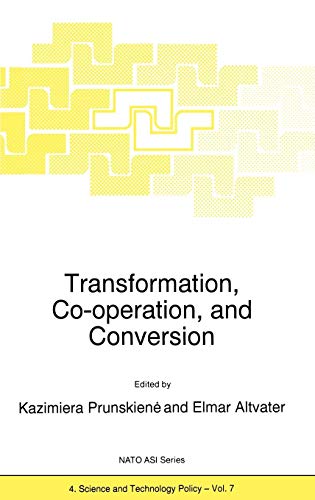
Transformation, Co-operation, and Conversion (Nato Science Partnership Subseries: 4)
Vendeur : Bookmonger.Ltd, HILLSIDE, NJ, Etats-Unis
Évaluation du vendeur 5 sur 5 étoiles

EUR 17,46
Expédition à EUR 3,40
Expédition nationale : Etats-UnisQuantité disponible : 2 disponible(s)
Ajouter au panierHardcover. Etat : Fine.
-

Transformation, Cooperation, and Conversion : Scientific and Technical Co-Operation of the Baltic States in the New Europe and the Conversion of Their Industry
Vendeur : GreatBookPrices, Columbia, MD, Etats-Unis
Évaluation du vendeur 5 sur 5 étoiles
EUR 113,11
Expédition à EUR 2,24
Expédition nationale : Etats-UnisQuantité disponible : Plus de 20 disponibles
Ajouter au panierEtat : New.
-
Transformation, Co-operation, and Conversion (NATO Science Partnership Subseries: 4, 7)
Vendeur : California Books, Miami, FL, Etats-Unis
Évaluation du vendeur 4 sur 5 étoiles

EUR 115,43
Livraison gratuite
Expédition nationale : Etats-UnisQuantité disponible : Plus de 20 disponibles
Ajouter au panierEtat : New.
-

Transformation, Cooperation, and Conversion : Scientific and Technical Co-Operation of the Baltic States in the New Europe and the Conversion of Their Industry
Vendeur : GreatBookPrices, Columbia, MD, Etats-Unis
Évaluation du vendeur 5 sur 5 étoiles
EUR 125,75
Expédition à EUR 2,24
Expédition nationale : Etats-UnisQuantité disponible : Plus de 20 disponibles
Ajouter au panierEtat : As New. Unread book in perfect condition.
-
Transformation, Co-operation, and Conversion (NATO Science Partnership Subseries: 4, 7)
Vendeur : Ria Christie Collections, Uxbridge, Royaume-Uni
Évaluation du vendeur 5 sur 5 étoiles
EUR 114,38
Expédition à EUR 13,84
Expédition depuis Royaume-Uni vers Etats-UnisQuantité disponible : Plus de 20 disponibles
Ajouter au panierEtat : New. In.
-

Transformation, Co-operation, and Conversion: 4 (closed)) (NATO Science Partnership Subseries: 4)
Vendeur : Ria Christie Collections, Uxbridge, Royaume-Uni
Évaluation du vendeur 5 sur 5 étoiles
EUR 114,38
Expédition à EUR 13,84
Expédition depuis Royaume-Uni vers Etats-UnisQuantité disponible : Plus de 20 disponibles
Ajouter au panierEtat : New. In.
-

Transformation, Cooperation, and Conversion : Scientific and Technical Co-Operation of the Baltic States in the New Europe and the Conversion of Their Industry
Vendeur : GreatBookPricesUK, Woodford Green, Royaume-Uni
Évaluation du vendeur 5 sur 5 étoiles
EUR 114,37
Expédition à EUR 17,32
Expédition depuis Royaume-Uni vers Etats-UnisQuantité disponible : Plus de 20 disponibles
Ajouter au panierEtat : New.
-
Transformation, Co-operation and Conversion
Langue: anglais
Edité par Kluwer Academic Publishers, 1996
ISBN 10 : 0792341783 ISBN 13 : 9780792341789
Vendeur : Kennys Bookshop and Art Galleries Ltd., Galway, GY, Irlande
Évaluation du vendeur 5 sur 5 étoiles
EUR 132,96
Expédition à EUR 10,50
Expédition depuis Irlande vers Etats-UnisQuantité disponible : 15 disponible(s)
Ajouter au panierEtat : New. Proceedings of the NATO Advanced Research Workshop on Scientific and Technical Co-operation of the Baltic States in the New Europe and the Conversion of Their Industry, Vilnius, Lithania, June 5-8, 1995 Editor(s): Prunskiene, Kazimiera; Altvater, Elmar. Series: NATO Science Partnership Subseries: 4. Num Pages: 156 pages, biography. BIC Classification: 1DV; 1QSB; KC. Category: (P) Professional & Vocational; (UP) Postgraduate, Research & Scholarly; (UU) Undergraduate. Dimension: 235 x 155 x 11. Weight in Grams: 890. . 1996. Hardback. . . . .
-
Transformation, Co-operation and Conversion
Vendeur : Books Puddle, New York, NY, Etats-Unis
Évaluation du vendeur 4 sur 5 étoiles
EUR 141,33
Expédition à EUR 3,39
Expédition nationale : Etats-UnisQuantité disponible : 4 disponible(s)
Ajouter au panierEtat : New. pp. x + 146.
-
Transformation, Co-operation, and Conversion
Vendeur : Books Puddle, New York, NY, Etats-Unis
Évaluation du vendeur 4 sur 5 étoiles
EUR 142,47
Expédition à EUR 3,39
Expédition nationale : Etats-UnisQuantité disponible : 4 disponible(s)
Ajouter au panierEtat : New. pp. 160.
-

Transformation, Cooperation, and Conversion : Scientific and Technical Co-Operation of the Baltic States in the New Europe and the Conversion of Their Industry
Vendeur : GreatBookPricesUK, Woodford Green, Royaume-Uni
Évaluation du vendeur 5 sur 5 étoiles
EUR 128,32
Expédition à EUR 17,32
Expédition depuis Royaume-Uni vers Etats-UnisQuantité disponible : Plus de 20 disponibles
Ajouter au panierEtat : As New. Unread book in perfect condition.
-
Transformation, Co-Operation, and Conversion (Nato Science Partnership Subseries: 4 (Closed))
Vendeur : Revaluation Books, Exeter, Royaume-Uni
Évaluation du vendeur 5 sur 5 étoiles
EUR 147,74
Expédition à EUR 11,55
Expédition depuis Royaume-Uni vers Etats-UnisQuantité disponible : 2 disponible(s)
Ajouter au panierPaperback. Etat : Brand New. reprint edition. 168 pages. 9.44x6.31x0.37 inches. In Stock.
-

EUR 95,70
Expédition à EUR 70
Expédition depuis Allemagne vers Etats-UnisQuantité disponible : 5 disponible(s)
Ajouter au panierTaschenbuch. Etat : Neu. Transformation, Co-operation, and Conversion | Kazimiera Prunskiene (u. a.) | Taschenbuch | x | Englisch | 2011 | Springer | EAN 9789401072847 | Verantwortliche Person für die EU: Springer Verlag GmbH, Tiergartenstr. 17, 69121 Heidelberg, juergen[dot]hartmann[at]springer[dot]com | Anbieter: preigu.
-
Transformation, Co-operation and Conversion
Langue: anglais
Edité par Kluwer Academic Publishers, 1996
ISBN 10 : 0792341783 ISBN 13 : 9780792341789
Vendeur : Kennys Bookstore, Olney, MD, Etats-Unis
Évaluation du vendeur 5 sur 5 étoiles
EUR 163,27
Expédition à EUR 8,91
Expédition nationale : Etats-UnisQuantité disponible : 15 disponible(s)
Ajouter au panierEtat : New. Proceedings of the NATO Advanced Research Workshop on Scientific and Technical Co-operation of the Baltic States in the New Europe and the Conversion of Their Industry, Vilnius, Lithania, June 5-8, 1995 Editor(s): Prunskiene, Kazimiera; Altvater, Elmar. Series: NATO Science Partnership Subseries: 4. Num Pages: 156 pages, biography. BIC Classification: 1DV; 1QSB; KC. Category: (P) Professional & Vocational; (UP) Postgraduate, Research & Scholarly; (UU) Undergraduate. Dimension: 235 x 155 x 11. Weight in Grams: 890. . 1996. Hardback. . . . . Books ship from the US and Ireland.
-

Transformation, Co-operation, and Conversion
Vendeur : AHA-BUCH GmbH, Einbeck, Allemagne
Évaluation du vendeur 5 sur 5 étoiles
EUR 112,77
Expédition à EUR 61,34
Expédition depuis Allemagne vers Etats-UnisQuantité disponible : 1 disponible(s)
Ajouter au panierTaschenbuch. Etat : Neu. Druck auf Anfrage Neuware - Printed after ordering - The scientific-technical potential of the Baltic States and their possibilities for co operation with Europe require in-depth, specific analysis. With the deterioration of the structures of science and technology of the former Soviet Union, the severance of communications with former clients, industry and science and technology, the Baltic States - the leaders of the former Soviet Union in this area, faced a difficult new situation. The government budgets of these countries, due to economic decline, are not capable of financing scientific research and project studies, and industry has lost a large part (in some branches this loss reaches even 2/3 or more) of its potential, losing both funds and interest in the sciences. The conversion of industry in the Baltic States is tied with the whole of its restructurisation, which still has not attained more precise directions for a new specialization or connections to the international market. The earlier dominant branches, such as machine production, electro-technology, radio-technology and the electronics industry, require essential modernization, which is possible only through co-operation with other developed countries, especially with the EU and NATO countries. This co-operation could include new mobilized capacities of science and technology. A longer period of stagnation and separation may adversely affect these capacities and lead to their dilution and weakening, due to the 'brain drain' of more qualified scientists and specialists to the commercial sector, which does not require high intellectual levels.
-
Transformation, Co-operation, and Conversion
Langue: anglais
Edité par Springer Netherlands, Springer Netherlands, 1996
ISBN 10 : 0792341783 ISBN 13 : 9780792341789
Vendeur : AHA-BUCH GmbH, Einbeck, Allemagne
Évaluation du vendeur 5 sur 5 étoiles
EUR 112,77
Expédition à EUR 62,05
Expédition depuis Allemagne vers Etats-UnisQuantité disponible : 1 disponible(s)
Ajouter au panierBuch. Etat : Neu. Druck auf Anfrage Neuware - Printed after ordering - The scientific-technical potential of the Baltic States and their possibilities for co operation with Europe require in-depth, specific analysis. With the deterioration of the structures of science and technology of the former Soviet Union, the severance of communications with former clients, industry and science and technology, the Baltic States - the leaders of the former Soviet Union in this area, faced a difficult new situation. The government budgets of these countries, due to economic decline, are not capable of financing scientific research and project studies, and industry has lost a large part (in some branches this loss reaches even 2/3 or more) of its potential, losing both funds and interest in the sciences. The conversion of industry in the Baltic States is tied with the whole of its restructurisation, which still has not attained more precise directions for a new specialization or connections to the international market. The earlier dominant branches, such as machine production, electro-technology, radio-technology and the electronics industry, require essential modernization, which is possible only through co-operation with other developed countries, especially with the EU and NATO countries. This co-operation could include new mobilized capacities of science and technology. A longer period of stagnation and separation may adversely affect these capacities and lead to their dilution and weakening, due to the 'brain drain' of more qualified scientists and specialists to the commercial sector, which does not require high intellectual levels.
-
Transformation, Co-operation, and Conversion (Nato Science Partnership Subseries: 4, 7)
Vendeur : Mispah books, Redhill, SURRE, Royaume-Uni
Évaluation du vendeur 4 sur 5 étoiles
EUR 162,98
Expédition à EUR 28,87
Expédition depuis Royaume-Uni vers Etats-UnisQuantité disponible : 1 disponible(s)
Ajouter au panierPaperback. Etat : Like New. Like New. book.
-
Transformation, Co-operation, and Conversion (eng)
Vendeur : Brook Bookstore On Demand, Napoli, NA, Italie
Évaluation du vendeur 4 sur 5 étoiles
EUR 86,24
Expédition à EUR 5,50
Expédition depuis Italie vers Etats-UnisQuantité disponible : Plus de 20 disponibles
Ajouter au panierEtat : new. Questo è un articolo print on demand.
-

Transformation, Co-operation, and Conversion
Langue: anglais
Edité par Springer, Springer Sep 2011, 2011
ISBN 10 : 9401072841 ISBN 13 : 9789401072847
Vendeur : BuchWeltWeit Ludwig Meier e.K., Bergisch Gladbach, Allemagne
Évaluation du vendeur 5 sur 5 étoiles
EUR 106,99
Expédition à EUR 23
Expédition depuis Allemagne vers Etats-UnisQuantité disponible : 2 disponible(s)
Ajouter au panierTaschenbuch. Etat : Neu. This item is printed on demand - it takes 3-4 days longer - Neuware -The scientific-technical potential of the Baltic States and their possibilities for co operation with Europe require in-depth, specific analysis. With the deterioration of the structures of science and technology of the former Soviet Union, the severance of communications with former clients, industry and science and technology, the Baltic States - the leaders of the former Soviet Union in this area, faced a difficult new situation. The government budgets of these countries, due to economic decline, are not capable of financing scientific research and project studies, and industry has lost a large part (in some branches this loss reaches even 2/3 or more) of its potential, losing both funds and interest in the sciences. The conversion of industry in the Baltic States is tied with the whole of its restructurisation, which still has not attained more precise directions for a new specialization or connections to the international market. The earlier dominant branches, such as machine production, electro-technology, radio-technology and the electronics industry, require essential modernization, which is possible only through co-operation with other developed countries, especially with the EU and NATO countries. This co-operation could include new mobilized capacities of science and technology. A longer period of stagnation and separation may adversely affect these capacities and lead to their dilution and weakening, due to the 'brain drain' of more qualified scientists and specialists to the commercial sector, which does not require high intellectual levels. 160 pp. Englisch.
-

EUR 92,27
Expédition à EUR 48,99
Expédition depuis Allemagne vers Etats-UnisQuantité disponible : Plus de 20 disponibles
Ajouter au panierGebunden. Etat : New. Dieser Artikel ist ein Print on Demand Artikel und wird nach Ihrer Bestellung fuer Sie gedruckt. Proceedings of the NATO Advanced Research Workshop on Scientific and Technical Co-operation of the Baltic States in the New Europe and the Conversion of Their Industry, Vilnius, Lithania, June 5-8, 1995 The scientific-technical potential of the Balti.
-

EUR 92,27
Expédition à EUR 48,99
Expédition depuis Allemagne vers Etats-UnisQuantité disponible : Plus de 20 disponibles
Ajouter au panierEtat : New. Dieser Artikel ist ein Print on Demand Artikel und wird nach Ihrer Bestellung fuer Sie gedruckt. Proceedings of the NATO Advanced Research Workshop on Scientific and Technical Co-operation of the Baltic States in the New Europe and the Conversion of Their Industry, Vilnius, Lithania, June 5-8, 1995 The scientific-technical potential of the Balti.
-
Transformation, Co-operation and Conversion
Vendeur : Majestic Books, Hounslow, Royaume-Uni
Évaluation du vendeur 4 sur 5 étoiles
EUR 144,78
Expédition à EUR 7,51
Expédition depuis Royaume-Uni vers Etats-UnisQuantité disponible : 4 disponible(s)
Ajouter au panierEtat : New. Print on Demand pp. x + 146.
-
Transformation, Co-operation, and Conversion
Vendeur : Majestic Books, Hounslow, Royaume-Uni
Évaluation du vendeur 4 sur 5 étoiles
EUR 145,57
Expédition à EUR 7,51
Expédition depuis Royaume-Uni vers Etats-UnisQuantité disponible : 4 disponible(s)
Ajouter au panierEtat : New. Print on Demand pp. 160 52:B&W 6.14 x 9.21in or 234 x 156mm (Royal 8vo) Case Laminate on White w/Gloss Lam.
-
Transformation, Co-operation and Conversion
Vendeur : Biblios, Frankfurt am main, HESSE, Allemagne
Évaluation du vendeur 4 sur 5 étoiles
EUR 148,75
Expédition à EUR 9,95
Expédition depuis Allemagne vers Etats-UnisQuantité disponible : 4 disponible(s)
Ajouter au panierEtat : New. PRINT ON DEMAND pp. x + 146.
-
Transformation, Co-operation, and Conversion
Vendeur : Biblios, Frankfurt am main, HESSE, Allemagne
Évaluation du vendeur 4 sur 5 étoiles
EUR 149,42
Expédition à EUR 9,95
Expédition depuis Allemagne vers Etats-UnisQuantité disponible : 4 disponible(s)
Ajouter au panierEtat : New. PRINT ON DEMAND pp. 160.
-
EUR 95,70
Expédition à EUR 70
Expédition depuis Allemagne vers Etats-UnisQuantité disponible : 5 disponible(s)
Ajouter au panierBuch. Etat : Neu. Transformation, Co-operation, and Conversion | Elmar Altvater (u. a.) | Buch | x | Englisch | 1996 | Springer Netherland | EAN 9780792341789 | Verantwortliche Person für die EU: Springer Verlag GmbH, Tiergartenstr. 17, 69121 Heidelberg, juergen[dot]hartmann[at]springer[dot]com | Anbieter: preigu Print on Demand.
-

Transformation, Co-operation, and Conversion
Langue: anglais
Edité par Springer Netherlands, Springer Netherlands Aug 1996, 1996
ISBN 10 : 0792341783 ISBN 13 : 9780792341789
Vendeur : buchversandmimpf2000, Emtmannsberg, BAYE, Allemagne
Évaluation du vendeur 5 sur 5 étoiles
EUR 106,99
Expédition à EUR 60
Expédition depuis Allemagne vers Etats-UnisQuantité disponible : 1 disponible(s)
Ajouter au panierBuch. Etat : Neu. This item is printed on demand - Print on Demand Titel. Neuware -The scientific-technical potential of the Baltic States and their possibilities for co operation with Europe require in-depth, specific analysis. With the deterioration of the structures of science and technology of the former Soviet Union, the severance of communications with former clients, industry and science and technology, the Baltic States - the leaders of the former Soviet Union in this area, faced a difficult new situation. The government budgets of these countries, due to economic decline, are not capable of financing scientific research and project studies, and industry has lost a large part (in some branches this loss reaches even 2/3 or more) of its potential, losing both funds and interest in the sciences. The conversion of industry in the Baltic States is tied with the whole of its restructurisation, which still has not attained more precise directions for a new specialization or connections to the international market. The earlier dominant branches, such as machine production, electro-technology, radio-technology and the electronics industry, require essential modernization, which is possible only through co-operation with other developed countries, especially with the EU and NATO countries. This co-operation could include new mobilized capacities of science and technology. A longer period of stagnation and separation may adversely affect these capacities and lead to their dilution and weakening, due to the 'brain drain' of more qualified scientists and specialists to the commercial sector, which does not require high intellectual levels.Springer-Verlag GmbH, Tiergartenstr. 17, 69121 Heidelberg 160 pp. Englisch.
-

Transformation, Co-operation, and Conversion
Langue: anglais
Edité par Springer, Springer Sep 2011, 2011
ISBN 10 : 9401072841 ISBN 13 : 9789401072847
Vendeur : buchversandmimpf2000, Emtmannsberg, BAYE, Allemagne
Évaluation du vendeur 5 sur 5 étoiles
EUR 106,99
Expédition à EUR 60
Expédition depuis Allemagne vers Etats-UnisQuantité disponible : 1 disponible(s)
Ajouter au panierTaschenbuch. Etat : Neu. This item is printed on demand - Print on Demand Titel. Neuware -The scientific-technical potential of the Baltic States and their possibilities for co operation with Europe require in-depth, specific analysis. With the deterioration of the structures of science and technology of the former Soviet Union, the severance of communications with former clients, industry and science and technology, the Baltic States - the leaders of the former Soviet Union in this area, faced a difficult new situation. The government budgets of these countries, due to economic decline, are not capable of financing scientific research and project studies, and industry has lost a large part (in some branches this loss reaches even 2/3 or more) of its potential, losing both funds and interest in the sciences. The conversion of industry in the Baltic States is tied with the whole of its restructurisation, which still has not attained more precise directions for a new specialization or connections to the international market. The earlier dominant branches, such as machine production, electro-technology, radio-technology and the electronics industry, require essential modernization, which is possible only through co-operation with other developed countries, especially with the EU and NATO countries. This co-operation could include new mobilized capacities of science and technology. A longer period of stagnation and separation may adversely affect these capacities and lead to their dilution and weakening, due to the 'brain drain' of more qualified scientists and specialists to the commercial sector, which does not require high intellectual levels.Springer-Verlag KG, Sachsenplatz 4-6, 1201 Wien 160 pp. Englisch.
-
Transformation, Co-operation, and Conversion
Langue: anglais
Edité par Springer Netherlands Aug 1996, 1996
ISBN 10 : 0792341783 ISBN 13 : 9780792341789
Vendeur : BuchWeltWeit Ludwig Meier e.K., Bergisch Gladbach, Allemagne
Évaluation du vendeur 5 sur 5 étoiles
EUR 160,49
Expédition à EUR 23
Expédition depuis Allemagne vers Etats-UnisQuantité disponible : 2 disponible(s)
Ajouter au panierBuch. Etat : Neu. This item is printed on demand - it takes 3-4 days longer - Neuware -The scientific-technical potential of the Baltic States and their possibilities for co operation with Europe require in-depth, specific analysis. With the deterioration of the structures of science and technology of the former Soviet Union, the severance of communications with former clients, industry and science and technology, the Baltic States - the leaders of the former Soviet Union in this area, faced a difficult new situation. The government budgets of these countries, due to economic decline, are not capable of financing scientific research and project studies, and industry has lost a large part (in some branches this loss reaches even 2/3 or more) of its potential, losing both funds and interest in the sciences. The conversion of industry in the Baltic States is tied with the whole of its restructurisation, which still has not attained more precise directions for a new specialization or connections to the international market. The earlier dominant branches, such as machine production, electro-technology, radio-technology and the electronics industry, require essential modernization, which is possible only through co-operation with other developed countries, especially with the EU and NATO countries. This co-operation could include new mobilized capacities of science and technology. A longer period of stagnation and separation may adversely affect these capacities and lead to their dilution and weakening, due to the 'brain drain' of more qualified scientists and specialists to the commercial sector, which does not require high intellectual levels. 156 pp. Englisch.


