Montant total (1 article articles) :
Destination de la commande :

two issues weekly register de niles william ogden (1 résultats)
Passer aux résultats principaux de la recherche
Filtres de recherche
Type d'article
- Tous les types de produits
- Livres (1)
- Magazines & Périodiques (Aucun autre résultat ne correspond à ces critères)
- Bandes dessinées (Aucun autre résultat ne correspond à ces critères)
- Partitions de musique (Aucun autre résultat ne correspond à ces critères)
- Art, Affiches et Gravures (Aucun autre résultat ne correspond à ces critères)
- Photographies (Aucun autre résultat ne correspond à ces critères)
- Cartes (Aucun autre résultat ne correspond à ces critères)
- Manuscrits & Papiers anciens (Aucun autre résultat ne correspond à ces critères)
Etat En savoir plus
- Neuf (Aucun autre résultat ne correspond à ces critères)
- Comme neuf, Très bon ou Bon (Aucun autre résultat ne correspond à ces critères)
- Assez bon ou satisfaisant (1)
- Moyen ou mauvais (Aucun autre résultat ne correspond à ces critères)
- Conformément à la description (Aucun autre résultat ne correspond à ces critères)
Reliure
- Toutes
- Couverture rigide (1)
- Couverture souple (Aucun autre résultat ne correspond à ces critères)
Particularités
- Ed. originale (1)
- Signé (Aucun autre résultat ne correspond à ces critères)
- Jaquette (1)
- Avec images (1)
- Sans impressions à la demande (1)
Langue (1)
Prix
- Tous les prix
- Moins de EUR 20 (Aucun autre résultat ne correspond à ces critères)
- EUR 20 à EUR 45 (Aucun autre résultat ne correspond à ces critères)
- Plus de EUR 45
Livraison gratuite
- Livraison gratuite à destination de Etats-Unis (Aucun autre résultat ne correspond à ces critères)
Pays
Evaluation du vendeur
-
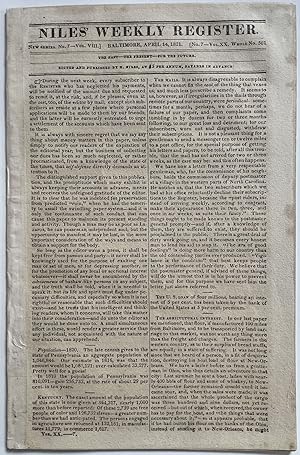
Two Issues of Niles' Weekly Register Newspaper, With Content on the War of 1812 and the Slave Trade
Edité par William Ogden Niles, Baltimore, Maryland, 1821
Vendeur : Stellar Books & Ephemera, ABAA, Carlsborg, WA, Etats-Unis
Membre d'association : ABAA ILAB
Évaluation du vendeur 4 sur 5 étoiles

Edition originale
EUR 61,55
EUR 6,83 shipping
Expédition nationale : Etats-UnisQuantité disponible : 1 disponible(s)
Ajouter au panierEtat : Very Good. Two Issues of Niles' Weekly Register Newspaper, With Content on the War of 1812 and the Slave Trade, William Ogden Niles, Baltimore, Maryland, 1815 and 1821, 6 x 9.25 inches. Contains No. 9 of Vol. IX, published October 28, 1815; and New series, No. 7 Vol. III published April 14, 1821. Both issues are very clean, with no edge wear and only light spotting; very good condition. The 1815 issue contains news on the just-concluded war of 1812; a reflection on Napoleon's letter to the prince regent of England which seemed to suggest that Napoleon was an enemy of France; a report on the newly formed Kingdom of the Netherlands; and more interesting content. The 1821 issue contains an article on the U.S. Navy, as well as a reprint of and commentary on a letter penned by the Seneca chief Red Jacket to Governor Clinton of New York, asking him to do something about the Christian preachers coming to Seneca communities and creating conflict and problems there. It also contains a long section condemning the Transatlantic Slave Trade in very strong terms. A compelling excerpt: "Your committee cannot perceive wherein the offence [sic] of kidnapping an unoffending inhabitant of a foreign country; of chaining him down. to the pestilential hold of a slave ship; of consigning him, if he chances to live out the voyage, to perpetual slavery. differs in malignity from piracy, or why a milder punishment should follow the one, than the other crime. Its consequences to the victim, if he survives; to the country which receives him; and to that from which he is torn, are alike disastrous. this crime, considered in its remote as well as its proximate consequences, is the very darkest in the whole catalogue of human iniquities; and its authors should be considered as 'hostes humani generis.'" In other words, the author's opinion - presumably shared by the readers - was that slavers should be treated no different from pirates, and be tried and hung as such under maritime law.