
Clavius christopher (7 résultats)
 Autres images
- Couverture souple
- impression à la demande
Vendeur : Forgotten Books, London, Royaume-UniForgotten Books
Contacter le vendeurVendeur avec une évaluation de 4 étoilesEtat: Neuf
EUR 24,69
Frais de port gratuitsExpédition depuis Royaume-Uni vers Etats-UnisQuantité disponible : Plus de 20 disponibles
Paperback. Etat : New. Print on Demand. This book, first written in the 13th century and updated over several centuries since, is one of the earliest surviving works of Western science. The author remains unknown. The book is credited with laying the foundation of modern astronomy, promoting the concept of a spherical Earth with…in a cosmos governed by mathematical laws. The book covers a wide range of topics, including the shape and motion of the Earth, the nature of the celestial sphere, theories of planetary motion, timekeeping, and related subjects. Its insights provide a glimpse into the origins of modern scientific thought and the history of humanity's understanding of the universe. This book is a reproduction of an important historical work, digitally reconstructed using state-of-the-art technology to preserve the original format. In rare cases, an imperfection in the original, such as a blemish or missing page, may be replicated in the book. print-on-demand item.

Edité par London: J. Johnson; Oxford: Prince and Cooke, 1784
- Couverture rigide
Vendeur : Moroccobound Fine Books, IOBA, Lewis Center, OH, Etats-UnisMoroccobound Fine Books, IOBA
Contacter le vendeurVendeur avec une évaluation de 5 étoilesMembre d’une association professionnelle : IOBA
Etat: Occasion - Assez bon
EUR 473,69
EUR 5,03 expéditionExpédition nationale : Etats-UnisQuantité disponible : 1 disponible(s)
Hardcover. Etat : Very Good. Translated by George Anderson. (4), xvi, 63 pp. with folding plate. Hardcover, bound in full calf, rebacked. Modest worming to the preliminary leaves; early ink notation at the bottom margin of xv, else the text unmarked. [Bas-C8-S2].
 Autres images
Edité par Rome, apud Bartholomaeum Grassium, Rome, 1589
- Couverture rigide
Vendeur : MEDA RIQUIER RARE BOOKS LTD, london, Royaume-UniMEDA RIQUIER RARE BOOKS LTD
Contacter le vendeurVendeur avec une évaluation de 4 étoilesEtat: Occasion - Satisfaisant
EUR 2 200,00
EUR 4,81 expéditionExpédition depuis Royaume-Uni vers Etats-UnisQuantité disponible : 1 disponible(s)
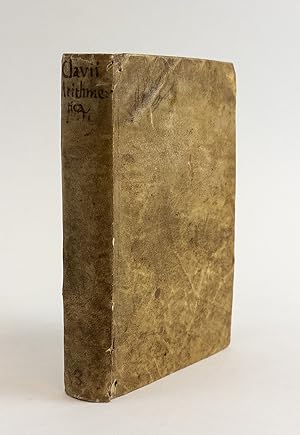
Etat : Good. 2 volumes, octavo (171×119mm). I: [8] leaves, 918 pages, [1] leaf. II: 959, [97] pages. Engraved title-pages, numerous woodcut diagrams and geometrical figures throughout the text; text within ruled border. Contemporary limp vellum binding with title lettered in manuscript on spine. Some browning and foxing, faint d…ampstaining on few leaves in second volume; spine slightly rubbed at extremities. A very good copy overall. Provenance: Spirito Nicolis de Robilant (1724?1801; manuscript ex-libris); erased manuscript note on title of first volume.The second and expanded edition of Clavius's commentary on Euclid. Christopher Clavius (1537?1612), a German Jesuit and professor of mathematics at the Collegio Romano, was among the leading mathematicians and astronomers of his time. His study and original commentary on the work of Euclid, first printed in 1574, was one of the most influential achievements of Renaissance mathematics, with numerous reprints in the following decades. Backer-Sommervogel II 1213; EDIT16 CNCE 18364. Book.
 Autres images
Edité par Ex Typographia Dominici Basæ, Romae, 1585
- Couverture rigide
Vendeur : Second Story Books, ABAA, Rockville, MD, Etats-UnisSecond Story Books, ABAA
Contacter le vendeurVendeur avec une évaluation de 4 étoilesEtat: Occasion
EUR 6 766,97
EUR 6,13 expéditionExpédition nationale : Etats-UnisQuantité disponible : 1 disponible(s)
Hardcover. Octavo, 323 pages, [13]. In Very Good condition. Bound in full contemporary vellum, with ink titling to spine. Boards show mild shelf wear and rubbing to vellum. Text block has a small red ink name stamp to front free end page, a small bookseller ticket to front pastedown, and small scattered early marginalia. Title v…ignette (Jesuit device). Errata on page 323. Pages 202, 203, 206, and 207 mis-numbered 102, 103, 106, and 107, respectively, with pages 206 and 207 hand-corrected. Extremely scarce. SP Consignment. Shelved in Case 3. The foremost early figure in Jesuit science, Christopher Clavius (1538-1612) was one of the chief architects and defenders of the 1582 calendar reform under Pope Gregory XIII, leading to the modern Gregorian Calendar. Pope Sixtus V said: "Had the Jesuit order produced nothing more than this Clavius, on this account alone the order should be praised". His Euclid Elementorum (Rome, 1589) was brought by Matteo Ricci to China and translated into Chinese. In his Astrolabium (Rome, 1593) he uses a dot to separate whole numbers from decimal fractions and is arguably the first to do so. His Gnomonices (Rome, 1602) contains every then-known principle concerning the measurement of time. Galileo was a frequent visitor to the Jesuit Roman College, and he and Clavius corresponded frequently. 1343886. Shelved Dupont Bookstore.
 Autres images
Langue : latin
Edité par Francesco Zanetti, Rome, 1581
- Couverture souple
- Édition originale
Vendeur : Milestones of Science Books, Ritterhude, AllemagneMilestones of Science Books
Contacter le vendeurVendeur avec une évaluation de 5 étoilesEtat: Occasion - Assez bon
EUR 4 500,00
EUR 45,00 expéditionExpédition depuis Allemagne vers Etats-UnisQuantité disponible : 1 disponible(s)
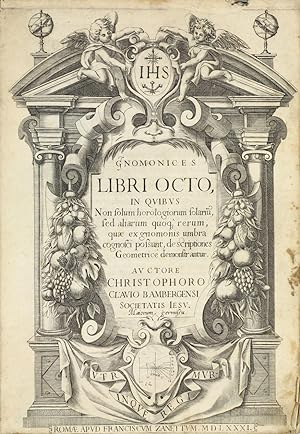
Soft cover. Etat : Very Good. 1st Edition. Folio (321 x 228 mm). [16], 654, [2] pp. Signatures: [cross]8 (A-E)6 F8 (G-GGg)6 HHh8. Engraved title, several woodcut diagrams and tables in text, decorated and historiated woodcut initials. Colophon and printer's woodcut device on final leaf 3H8r. Contemporary limp vellum, manuscript…title on spine (vellum soiled and browned, closed tear across spine, label removed from lower part of spine). Occasional minor spotting of text, dent at upper right margin through the first 130 pages well outside text area, top corner of leaf Kk6 torn not affecting text, few pages with light browning and foxing, but generally quite clean and bright. Provenance: Turin, Minorites of St. Thomas (library stamps on first page of dedication and inscription on free front endpaper). A very good, unstained and unmarked copy in untouched original binding. ---- Adams C-2098; BL/STC Italian p. 126; Houzeau-Lancaster 11383; Lalande p 112; Zinner, Astronom. Instrumente, 281. Honeyman 706; De Backer-S. II, 1220, 3; DSB III, 311. - FIRST EDITION of this masterwork on the theory and construction of sundials. Clavius considers the astronomical background, the geometrical theory and the various construction methods of the sundial, a topic which occupied many mathematicians in this period. The problems of sundial construction were related to those of the studies of perspective and shadows, which were also of interest to painters such as Albrecht Dürer. The Latin name Christopher Clavius is the only name known of this Jesuit mathematician and astronomer, whose given name in German has been lost to time. He was born in Bamberg, and joined the Jesuit order in 1555. He studied at the Collegio Romano, and in 1579 was assigned the task of determining a way to adjust the calendar to keep it in line with the actual seasons of the year. The result, built on the work of Erasmus Reinhold and Aloysius Lillius, was a reformed calendar that was endorsed by Pope Gregory XIII. Adopted in 1582, the Gregorian Calendar is still in use as the common calendar of the Western world today. "Sums up all that was known on gnomonics" (Honeyman), "le plus grand ouvrage existant sur la gnomonique" (Houzeau and Lancaster). Erste Ausgabe. - Hauptwerk des Christoph Clavius (1538-1612) über die Sonnenuhren, in dem der "Euklid seines Zeitalters" seine astronomischen Forschungen über den Sonnenstand und die daraus resultierende Zeitmessung und Kalenderrechnung darlegt sowie Anleitungen zur Konstruktion von Sonnenuhren gibt. "Er trat in den Jesuitenorden, studirte in Coimbra (wo er 1596 eine Sonnenfinsterniss beobachtete, bei der nach seiner Angabe die Dunkelheit so gross war, dass er seine Schritte nicht hat sehen können), war 14 Jahre Lehrer der Mathematik am Collegium seines Ordens in Rom, stand wegen seiner Gelehrsamkeit in hohem Ansehen und stieg bis zum Cardinal empor. Er wurde . vom Papst Gregor XIII zur Kalenderverbesserung berufen . und (hat) über die Verbesserung einen erbitterten Streit mit Scaliger, Calvisius und Maestlin geführt" (ADB IV, 298). - Die zahlreichen Textholzschnitte zeigen Sonnenuhren, Sonnenräder, Messtabellen und Instrumente, Schemen zu Planetenbahnen, Strahlenreflexionen und vieles mehr. - Visit our website for additional images and information.
 Autres images
Edité par Giovanni Battista Ciotti,, "Cologne" [= Venice],, 1591
Vendeur : ASHER Rare Books, t Goy Houten, Pays-BasASHER Rare Books
Contacter le vendeurVendeur avec une évaluation de 5 étoilesEtat: Occasion
EUR 2 500,00
EUR 25,00 expéditionExpédition depuis Pays-Bas vers Etats-UnisQuantité disponible : 1 disponible(s)
2 parts in 1 volume. Early Latin edition of the Elementorum, one of the most successful textbooks ever written. The present edition contains the complete enunciations of all fifteen books, and the demonstrations, and has been illustrated with hundreds of geometrical woodcut figures. As the foundational text of both geometry and…number theory, the work covers plain geometry, proportions, number theory and solid geometry. The present edition has been edited by Christopher Clavius (1536-1612), or "the Euclid of the 16th century" (DSB).Clavius was a German Jesuit mathematician and astronomer, who was instrumental in the Vatican's adoption of the Gregorian calendar, a pioneer of the use of the decimal point, and, in his lifetime, the most highly respected astronomer in Europe. His edition of the Elementorum is his main work. His version is not a translation, but "contains a vast quantity of notes collected from previous commentators and editors, as well as some good criticisms and elucidations of his own. Among other things, Clavius made a new attempt at proving the "postulate of parallels"."(DSB). His edition first appeared in Rome in 1574, and again in 1589. The present edition is the third. There is some confusion in the literature about the place of printing, as the printer, Giovanni Ciotti (1560-1625), mainly worked in Venice, but the present title page mentions Cologne. According to Thomas-Stanford, the work was most likely printed in Venice, but sold by Ciotti's branch in Cologne.With a later manuscript owner's inscription on the front pastedown ("Carl Hollweide, Halle 1802"), the same inscription underneath which has been removed, and an owner's inscription from mathematician Moritz Wilhelm Drobisch (1802-1896) on the recto of the first flyleaf ("M. W. Drobisch. 1824"), all in brown ink. The vellum is somewhat scratched, scuffed, and stained, the corners of the boards are bumped. The vignette has been cut out of the title page, but the hole has been repaired with paper and bears a manuscript note in pencil, the title page and the first blank flyleaf have been reinforced with paper in the lower outer corner, the title page is slightly dust soiled, some occasional stains, a large tear in the bottom margin of leaves G6 in part 1, and Kk4-Kk6 in part 2. Otherwise in good condition.l Adams E 988; De Backer-Sommervogel II, col. 1213-1214; Thomas-Stanford 23; USTC 654843; VD 16 E 4161 (part 1) and VD 16 ZV 5466 (part 2); cf. DSB 3, pp. 311-312 (Clavius); DSB 4, pp. 414-459 (Euclid); Poggendorff I, p. 455 (Clavius). Later blind-tooled overlapping vellum, sewn on 5 supports laced through the joints, with the manuscript author, title, and year of publication on the spine, remnants of closing ties. The title page of each part is set within an elaborate woodcut border, with woodcut decorated initials (at least 3 series), headpieces built up from typographical ornaments, numerous woodcut mathematical figures in the text, large woodcut ornamental tailpieces, and a woodcut printer's device on the otherwise blank verso of the last leaf of both parts. Pages: [15], [1 blank], 359, [1 blank]; 355, [1 blank], [40] pp. Including: Posteriores libri IX.
 Autres images
Vendeur : Liber Astronomiae Antiquus, Dosrius, B, EspagneLiber Astronomiae Antiquus
Contacter le vendeurVendeur avec une évaluation de 5 étoilesEtat: Occasion - Assez bon
EUR 4 500,00
EUR 14,50 expéditionExpédition depuis Espagne vers Etats-UnisQuantité disponible : 1 disponible(s)
Etat : Bueno. EDICIÓN. 1611 Edición postuma de Clavius, donde describe los descubrimientos astronómicos realizados por Galileo. Ambos científicos se conocieron cuando Galileo visitó Roma en 1587 y desde entonces mantuvieron correspondencia ocasional sobre cuestiones matemáticas. Cuando Clavius publicaba un libro, siempre envia…ba una copia a su amigo Galileo. 1610, Clavius era un anciano y tuvo que ser extremadamente difícil comprender estos nuevos descubrimientos tanto desde un punto de vista científico como religioso. Como científico principal del Colegio Romano, se le pidió que emitiera un juicio sobre Galileo. Aún desde hace algún tiempo no disponía de un telescopio de calidad suficiente para realizar sus propias observaciones. Sin embargo, en la edición final de In sphaeram Ioannis de Sacro Bosco Commentarius, abordó los problemas: - "No quiero esconder al lector que no hace mucho tiempo se llevó cierto instrumento de Bélgica. Tiene la forma de un largo tubo en cuyas bases se colocan dos cristales, o más bien lentos, por los que los objetos lejanos de nosotros parecen mucho más cercanos. que las cosas mismas. nebulosas de Cáncer y Orión, en la Vía Láctea y otros lugares. y cuando la Luna está en cuarto creciente o medio lleno, parece tan notablemente fracturado y áspero que no puedo maravillarme que haya tal irregularidad en el cuerpo lunar. Nuncius, que describe varias observaciones de las estrellas hechas por él por primera vez. Lejos de lo menos importante de las cosas que se ven con este instrumento es que Venus recibe su luz del Sol al igual que la Luna, por lo que a veces se parece más a una media luna, a veces menos, según su distancia al Sol. En Roma he observado esto, en presencia de otras, más de una vez. Saturno le ha unido dos estrellas más pequeñas, una al este y otra al oeste. Siendo así las cosas, los astrónomos deberían considerar cómo se pueden disponer los orbes celestes para salvar estos fenómenos.".


