Montant total (1 article articles) :
Destination de la commande :

leaf manuscript (81 résultats)
Passer aux résultats principaux de la recherche
Filtres de recherche
Type d'article
- Tous les types de produits
- Livres (73)
- Magazines & Périodiques (Aucun autre résultat ne correspond à ces critères)
- Bandes dessinées (Aucun autre résultat ne correspond à ces critères)
- Partitions de musique (Aucun autre résultat ne correspond à ces critères)
- Art, Affiches et Gravures (Aucun autre résultat ne correspond à ces critères)
- Photographies (Aucun autre résultat ne correspond à ces critères)
- Cartes (Aucun autre résultat ne correspond à ces critères)
- Manuscrits & Papiers anciens (8)
Etat En savoir plus
- Neuf (Aucun autre résultat ne correspond à ces critères)
- Comme neuf, Très bon ou Bon (1)
- Assez bon ou satisfaisant (13)
- Moyen ou mauvais (Aucun autre résultat ne correspond à ces critères)
- Conformément à la description (67)
Reliure
- Toutes
- Couverture rigide (6)
- Couverture souple (Aucun autre résultat ne correspond à ces critères)
Particularités
- Ed. originale (6)
- Signé (1)
- Jaquette (Aucun autre résultat ne correspond à ces critères)
- Avec images (71)
- Sans impressions à la demande (81)
Langue (3)
Livraison gratuite
- Livraison gratuite à destination de Etats-Unis (Aucun autre résultat ne correspond à ces critères)
Pays
Evaluation du vendeur
-
Letters to Merline, 1919-1922
Langue: anglais
Edité par Methuen & Co, London, 1951
Vendeur : Dorley House Books, Inc., Hagerstown, MD, Etats-Unis
Évaluation du vendeur 4 sur 5 étoiles

Edition originale
EUR 13,53
Expédition à EUR 7,58
Expédition nationale : Etats-UnisQuantité disponible : 1 disponible(s)
Ajouter au panierHardcover. Etat : Very Good. No Jacket. foldout facsimilie of a manuscript leaf with drawing in color. (illustrateur). 1st. First Edition, First Englisg Printing; blue c w/gilt titles; , sunned psine; 149 clean, unmarked pages.
-

Portrait of Chaucer from Hoccleve's Poem 'De Regimine Principum'- - - Facsimile of an Illuminated Leaf
Langue: anglais
Date d'édition : 1880
Vendeur : K Books Ltd ABA ILAB, York, YORKS, Royaume-Uni
Membre d'association : ABA ILAB PBFA
Évaluation du vendeur 5 sur 5 étoiles

EUR 18,13
Expédition à EUR 22,89
Expédition depuis Royaume-Uni vers Etats-UnisQuantité disponible : 1 disponible(s)
Ajouter au panierNo Binding. Etat : Very Good. A facsimile of an illuminated leaf from a Mediaeval Manuscript. Mounted - matted - and ready to frame. Mount size approx 12 x 10 inches . Very good condition. Circa 1880. Shows - in colour - a leaf from a Mediaeval Manuscript - Portrait of Chaucer and text from Thomas Hoccleve's Poem ' De Regimine Principum@ - - rich colouring - from a MS in the British Museum.
-
Illuminator Presenting a Manuscript to a Patron - a Facsimile of a Leaf from the Illuminated Manuscript
Langue: anglais
Date d'édition : 1880
Vendeur : K Books Ltd ABA ILAB, York, YORKS, Royaume-Uni
Membre d'association : ABA ILAB PBFA
Évaluation du vendeur 5 sur 5 étoiles
EUR 18,13
Expédition à EUR 22,89
Expédition depuis Royaume-Uni vers Etats-UnisQuantité disponible : 1 disponible(s)
Ajouter au panierNo Binding. Etat : Very Good. A splendid original antique scene Mounted - matted - and ready to frame. Excellent condition . A facsimile leaf from an . illuminated manuscript leaf Shows . a page of illuminated illustration entitled .'Illuminator presenting Manuscript to Patron' the Harleian M.S.7026 British Museum.
-
Lydgate Presenting His Poem to the King - - - Facsimile of an Illuminated Leaf
Langue: anglais
Date d'édition : 1880
Vendeur : K Books Ltd ABA ILAB, York, YORKS, Royaume-Uni
Membre d'association : ABA ILAB PBFA
Évaluation du vendeur 5 sur 5 étoiles
EUR 18,13
Expédition à EUR 22,89
Expédition depuis Royaume-Uni vers Etats-UnisQuantité disponible : 1 disponible(s)
Ajouter au panierNo Binding. Etat : Very Good. A facsimile of an illuminated leaf from a Mediaeval Manuscript. Mounted - matted - and ready to frame. Mount size approx 12 x 10 inches . Very good condition. Circa 1880. Shows - in colour - a leaf from a Mediaeval Manuscript - Lydgate presenting his poem to the King - rich colouring - from the Harleian MS in the British Museum.
-
Aelfric - Facsimile of an Illuminated Leaf
Langue: anglais
Date d'édition : 1880
Vendeur : K Books Ltd ABA ILAB, York, YORKS, Royaume-Uni
Membre d'association : ABA ILAB PBFA
Évaluation du vendeur 5 sur 5 étoiles
EUR 18,13
Expédition à EUR 22,89
Expédition depuis Royaume-Uni vers Etats-UnisQuantité disponible : 1 disponible(s)
Ajouter au panierNo Binding. Etat : Very Good. A facsimile of an illuminated leaf from a Mediaeval Manuscript. Mounted - matted - and ready to frame. Mount size approx 12 x 10 inches . Very good condition. Circa 1880. Shows - in colour - a leaf from Aelfric - 'The Paraphrase of the Pentateuch .
-
Canterbury Pilgrims - - - Facsimile of an Illuminated Leaf
Langue: anglais
Date d'édition : 1880
Vendeur : K Books Ltd ABA ILAB, York, YORKS, Royaume-Uni
Membre d'association : ABA ILAB PBFA
Évaluation du vendeur 5 sur 5 étoiles
EUR 18,13
Expédition à EUR 22,89
Expédition depuis Royaume-Uni vers Etats-UnisQuantité disponible : 1 disponible(s)
Ajouter au panierNo Binding. Etat : Very Good. A facsimile of an illuminated leaf from a Mediaeval Manuscript. Mounted - matted - and ready to frame. Mount size approx 12 x 10 inches . Very good condition. Circa 1880. Shows - in colour - a leaf from a Mediaeval Manuscript - text and fine illustration of Canterbury Pilgrims - - rich colouring - from a MS in the British Museum.
-
Layamon - - Facsimile of an Illuminated Leaf
Langue: anglais
Date d'édition : 1880
Vendeur : K Books Ltd ABA ILAB, York, YORKS, Royaume-Uni
Membre d'association : ABA ILAB PBFA
Évaluation du vendeur 5 sur 5 étoiles
EUR 18,13
Expédition à EUR 22,89
Expédition depuis Royaume-Uni vers Etats-UnisQuantité disponible : 1 disponible(s)
Ajouter au panierNo Binding. Etat : Very Good. A facsimile of an illuminated leaf from a Mediaeval Manuscript. Mounted - matted - and ready to frame. Mount size approx 12 x 10 inches . Very good condition. Circa 1880. Shows - in colour - a leaf from Layamon's Brut. - from the Cotton Ms.
-
Sir John Mandeville -- - Facsimile of an Illuminated Leaf
Langue: anglais
Date d'édition : 1880
Vendeur : K Books Ltd ABA ILAB, York, YORKS, Royaume-Uni
Membre d'association : ABA ILAB PBFA
Évaluation du vendeur 5 sur 5 étoiles
EUR 18,13
Expédition à EUR 22,89
Expédition depuis Royaume-Uni vers Etats-UnisQuantité disponible : 1 disponible(s)
Ajouter au panierNo Binding. Etat : Very Good. A facsimile of an illuminated leaf from a Mediaeval Manuscript. Mounted - matted - and ready to frame. Mount size approx 12 x 10 inches . Very good condition. Circa 1880. Shows - in colour - a leaf from a Mediaeval Manuscript - an illustrations from Mandeville's 'Travels' - - rich colouring - from a MS in the British Museum.
-
Tibetan Leaf Manuscript.
Edité par [20th Century]., [Tibet].
Vendeur : Asia Bookroom ANZAAB/ILAB, Canberra, ACT, Australie
Membre d'association : ANZAAB ILAB
Évaluation du vendeur 5 sur 5 étoiles
EUR 47,04
Expédition à EUR 18,61
Expédition depuis Australie vers Etats-UnisQuantité disponible : 1 disponible(s)
Ajouter au panier18 loose leaves from a Tibetan leaf manuscript, each 8.2 x 25cm, most with Tibetan script both sides, top edge of several leaves pierced, edgewear and browning, a few leaves wormed, in sound condition. An interesting assemblage from an unidentified Tibetan black ink leaf manuscript. Acquired in Tibet in the 1960s.
-
Illuminated Leaf on fine vellum.
Edité par 15th Century?
Vendeur : Michael S. Kemp, Bookseller, Sheerness, KENT, Royaume-Uni
Membre d'association : PBFA
Évaluation du vendeur 4 sur 5 étoiles
EUR 270,80
Expédition à EUR 46,95
Expédition depuis Royaume-Uni vers Etats-UnisQuantité disponible : 1 disponible(s)
Ajouter au panierSingle leaf, vellum, corner cut away, illuminated both sides in colour and gilt. 175 x 130 mm.
-
The Winning Of The West
Edité par G.P. Putnam's Sons / The Knickerbocker Press, New York, 1900
Vendeur : The First Edition Rare Books, LLC, Cincinnati, OH, Etats-Unis
Membre d'association : ABAA ILAB IOBA MWABA
Évaluation du vendeur 5 sur 5 étoiles
Signé
EUR 16 239,11
Expédition à EUR 5,26
Expédition nationale : Etats-UnisQuantité disponible : 1 disponible(s)
Ajouter au panierLeather bound. Etat : Near fine. The Daniel Boone Edition of The Winning of the West by Theodore Roosevelt, with a manuscript leaf in Roosevelt's hand. (illustrateur). Daniel Boone Edition. Octavo, [four volumes], [xxvii], [1], 352pp, [map]; [vii], [3], 427pp, [2pp maps]; [ix], [3], 339pp, [map]; [xi], 363pp, [2pp ads]. Publisher's half green levant morocco, marbled boards, raised bands, title stamped in gilt, "Daniel Boone Edition" in gilt on each spine. Marbled endpapers, top edge gilt, silk bookmark in each volume, detached but present in Volume III. Uncut. Solid text blocks, all appear unread. Free of restoration or archival repairs. Light sunning to the spines, as is typical with this edition. Touch of rubbing along margins of boards. From the library of Charles L. Gilcrest, with his bookplate on the second free endpaper of each volume. Frontispiece portrait with tissue cover in each volume, complete, with captioned tissue guards. Includes five fold-out maps, affixed to rear panel of each volume, printed on Japanese vellum. (Wheelock, 13) (Cole & Vail, A11.1) (Howes R433) From a limited edition of 200 sets, this being number 185, matching limitation in each volume. Includes a manuscript leaf in Roosevelt's hand from Volume IV, page 18, regarding the failed frontier campaigns of Gov. Arthur St. Clair and George Washington's decision to recall Gen. Anthony Wayne to command U.S. forces in the Northwest Indian War. The original manuscript leaf reads as follows: [The newly created Government of the United States]."was very reluctant to make formal war on the northwestern Indians. Not only were President Washington and the National Congress honorably desirous of peace, but they were hampered for funds, and dreaded any extra expense. Nevertheless they were forced into war. Throughout the years 1789 and 1790 an increasing volume of appeals for help came from the frontier countries. The governor of the Northwestern Territory, the brigadier-general of the troops on the Ohio, the members of the Kentucky Convention, and all the county lieutenants of Kentucky, the lieutenants of the frontier counties of Virginia proper, the representatives from the counties, the field officers of the different districts, the General Assembly of Virginia, all sent bitter complaints." [and long catalogues of injuries to the President, the Secretary of War, and the two Houses of Congress; complaints which were redoubled after Harmar's failure. With heavy hearts, the national authorities prepared for war.] This work was issued in full levant for $100 and half levant for $60. The full levant sold quickly, and the price was raised to $200 per set. The handwritten manuscript leaves all came from Volume III and IV, with the manuscript for Volume I now held at the New York Public Library. Signed.
-
[Mythological scenes on palm leaves].
Edité par Lombok, 19th century.
Vendeur : Antiquariat INLIBRIS Gilhofer Nfg. GmbH, Vienna, A, Autriche
Membre d'association : ILAB PADA VDA VDAO
Évaluation du vendeur 5 sur 5 étoiles
Manuscrit / Papier ancien
EUR 2 000
Expédition à EUR 30
Expédition depuis Autriche vers Etats-UnisQuantité disponible : 1 disponible(s)
Ajouter au panierOblong, 220 x 35 mm. 5 ff. Balinese on palm leaf. Balinese script in inscriped black ink. Illustrated with five hand-inscribed scenes. Wooden boards with delicately carved designs. Five mythological scenes hand-inscribed on the dried leaves of the lontar palm, each with a line on the reverse in Balinese script. Similar palm-leaf manuscripts from Lombok, today part of Indonesia, show scenes from Hindu or Muslim mythologies. These include the Ramayana, Adi Parva from the Mahabharata, the story of the Prophet Yusuf (Joseph), and Bharatayuddha. An illustrated copy of the latter, similar to the present manuscript, is held at the British Library (Or 13379, f. 6r). - The illustrations of this manuscript are clearly meant to be read together, similar to comic strips, with one scene following another to tell a short section of a story. To create this manuscript, a scene was first painstakingly inscribed by hand into the delicate palm leaf, and then ink was rubbed into the scored lines to finish the drawing. Unlike paper, palm leaves are ideal for hot, humid climates like that of Lombok, and have been used in Southeast Asia for thousands of years. - Faintly toned. In very good condition. - Cf. London, British Library, Or 13379, f. 6r.
-
[Cover title:] In Memoriam Baron Maurice de Hirsch. May 31, 1896, Boston, Massachusetts, U. S. A.
Edité par Boston, 1896
Vendeur : Földvári Books, Budapest, Hongrie
Membre d'association : ILAB MAE
Évaluation du vendeur 5 sur 5 étoiles
Manuscrit / Papier ancien
EUR 24 200
Expédition à EUR 19,50
Expédition depuis Hongrie vers Etats-UnisQuantité disponible : 1 disponible(s)
Ajouter au panierCalligraphed manuscript in ink, by H. C. Kendall (signed on the verso of the first leaf). Each page written in different calligraphy style. Text in English. With a mounted portrait, transferred on porcelain, of Baron Hirsch on the second leaf (illustrateur). Manuscript book. Calligraphed manuscript in ink, by H. C. Kendall (signed on the verso of the first leaf). Each page written in different calligraphy style. Text in English. With a mounted portrait, transferred on porcelain, of Baron Hirsch on the second leaf. Manuscript book. In original black leather by Frank J. Barnard (signed on the recto of the last leaf), with clasp, gilt title on front panel, gilt edges, gilt turn-ins. Pastedowns and flyleaves are covered with white moiré. A memorial album commemorating the death of the greatest Jewish philanthropist of the nineteenth century, Baron Maurice de Hirsch, offered by the Jews of Boston to his widow and family. This delicate memorial album, signed by twenty-two representatives of Jewish associations of Boston, was prepared by the commission of the Boston Jews under the auspices of the American Committee (here Society) for Ameliorating the Condition of Russian Refugees, an umbrella organization of various groups concerned with the welfare of the immigrants (co-founded by the Hirsch Fund), and was offered to the widow and the family of Baron de Hirsch. The album is a piece of very fine craftsmanship, calligraphed by H. C. Kendall an "artist penman" and Principal of the Normal Writing Institute in Boston, and bound by Frank J. Barnard, the industry leader bookbinder in Massachusetts. The text consists of profound quotes about human greatness from William Dean Howells and Julia C. R. Dorr, and the eulogy delivered at Temple Ohabei Shalom. Baron Maurice de Hirsch (1831-1896) was a German Jewish financier and philanthropist, born into a wealthy landowner and banker family in Bavaria. In 1855, Hirsch married Clara Bischoffsheim, daughter of a Belgian banker, and became associated with his father-in-law's banking house. He amassed a large fortune and became one of the top five richest individuals in Europe at the time. Baron de Hirsch set up charitable foundations promoting Jewish education especially in Russia, and after an unsuccessful offer of 50,000,000 francs to the Russian government to be used for purposes of Jewish education, in 1891 he founded the Jewish Colonization Association, the greatest charitable trust in the world, to provide the funds for extensive Jewish immigration to Argentina. In the same year, he established the Hirsch Fund to help the Russian Jewish immigrants in the States and provided the finances for agricultural colonies and trades schools in the US. Through his Galician Foundation, he realized the establishment of primary and technical schools for Jewish pupils in Galicia and the Bukowina. "It is impossible to form an accurate estimate of the amount of money Baron de Hirsch devoted to benevolent purposes. That, including the large legacy (amounting to $45,000,000) left to the Jewish Colonization Association, it exceeded $100,000,000 is an estimate justified by the amounts given by him from time to time to the foundations already referred to. There were, besides, many gifts to individuals of which there is no record." (Jewish Encyclopedia) Baron Maurice de Hirsch died suddenly, presumably of a heart attack at the age of 64, on 21 April 1896, at the country house of a friend near his own recently purchased estate of Ógyalla in Hungary (now part of Slovakia). His widow continued the Baron's charitable work. Clara died in Paris in 1899 and left the remaining family assets to her adopted son, Maurice Arnold de Forest. . Moiré detached from the flyleaves, discolored at the rear. Some of the tracing paper leaves are creased, few with closed tears. Stains to the gutter at the rear, no effect on text. Binding slightly rubbed, with three small, barely visible holes. Overall in very good condition. In original black leather by Frank J. Barnard (signed on the recto of the last leaf), with clasp, gilt title on front panel, gilt edges, gilt turn-ins. Pastedowns and flyleaves are covered with white moiré.
-
[Finely Illuminated Vellum Manuscript Signature in Latin, perhaps France, ca. late 15th Century].
Edité par ca. 15th Century]., [No location given:
Vendeur : Jeff Weber Rare Books, Neuchatel, NEUCH, Suisse
Membre d'association : ABAA ILAB VEBUKU
Évaluation du vendeur 5 sur 5 étoiles
EUR 811,96
Expédition à EUR 25
Expédition depuis Suisse vers Etats-UnisQuantité disponible : 1 disponible(s)
Ajouter au panier22 x 21.75 cm. Double-columned, double-sided single signature, 32 lines. The leaf features 69 gilt initials with embellished pen-work, 2 of them larger with blue backgrounds and the rest smaller with beige or dark brown (matching text ink) backgrounds, with some additional red lettering and the heading "Psalms." 4 pp. Fine vellum; some initials faintly faded with gilt and colors otherwise bright and text clear. Fine. Although not fully translated, this signature was likely once part of a psalter. It features part of a litany from the Book of Hoursâ"Psalm 70 in its entirety, moving into a call-and-response from with red letters marking the call v. the response, beginning with "V: Salvos fac servos tuos" and cutting off at "R: aeternam dona eis. . ." Due to the structure of books, the page opposite the beginning of this litany is not the page that should numerically follow it were it still bound, and so it is broken early. The leaf also features almost all of Psalm 37," ending with "Qui retribuunt mala pro. . .".
-
Attractively written leaf from a Manuscript in Latin,
Date d'édition : 1730
Vendeur : Sophie Dupre ABA ILAB PADA, Calne, Royaume-Uni
Membre d'association : ABA ILAB
Évaluation du vendeur 2 sur 5 étoiles

Manuscrit / Papier ancien
EUR 64,19
Expédition à EUR 4,81
Expédition depuis Royaume-Uni vers Etats-UnisQuantité disponible : 1 disponible(s)
Ajouter au panierfrom a treatise on the Old Testament High Priest and Priesthood ('De Pontifice & Sacerdotibus'), here discussing the meaning of the Hebrew 'segen' which the writer takes to be a general word for 'deputy', quoting from the O.T. and from Lardner's 'Credibility of the Gospel History', Selden, Preland, and Maimonides, sides numbered 35 & 36, sections 104-112, English, no place, no date, circa.
-

Clementine.
Edité par ca., 1480
Vendeur : Michael Steinbach Rare Books, Wien, Autriche
Membre d'association : ILAB VDA VDAO
Évaluation du vendeur 5 sur 5 étoiles
EUR 100
Expédition à EUR 19,50
Expédition depuis Autriche vers Etats-UnisQuantité disponible : 1 disponible(s)
Ajouter au panier44 : 29 cm. One leaf with 11 lines handwritten. um 304 (?) 1 in Köln in Nordrhein-Westfalen. Altar mit vielen Reliquien in der "Goldenen Kammer" in der Ursula-Kirche in Köln. Clementine befand sich unter den Gefährtinnen der Ursula. Die Reliquien von Clementine und die von Gefährtinnen werden in Modena.
-
A Prince and His Mistress.
Edité par c.1710?, 1710
Vendeur : William Matthews/The Haunted Bookshop, Sidney, BC, Canada
Membre d'association : ABAC ILAB
Évaluation du vendeur 5 sur 5 étoiles
EUR 207,14
Expédition à EUR 15,77
Expédition depuis Canada vers Etats-UnisQuantité disponible : 1 disponible(s)
Ajouter au panierInk, watercolor, and gold, on paper. The image measures about 5 x 8 inches, in a frame with glass measuring 10.5 x 13.5 inches. Calligraphic writing at top and bottom, and on the reverse in 9 rectangular panels. This is a leaf from a manuscript. Finely executed, in very nice condition. (Not examined out of the frame). [This is an oversize item, and normal postage rates do not apply. Large framed artworks are sometimes available for pickup only.].
-
An Illuminated Manuscript Leaf from a Book of Hours.
Edité par [Likely France, 1480-1500]., 1500
Vendeur : William Matthews/The Haunted Bookshop, Sidney, BC, Canada
Membre d'association : ABAC ILAB
Évaluation du vendeur 5 sur 5 étoiles
EUR 350,54
Expédition à EUR 15,77
Expédition depuis Canada vers Etats-UnisQuantité disponible : 1 disponible(s)
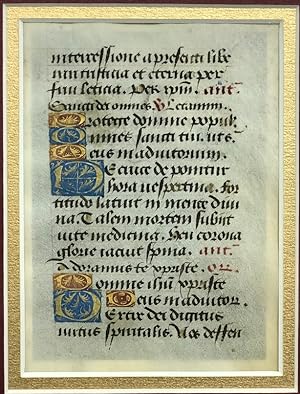
Ajouter au panierA single leaf from a French Book of Hours, produced ca.1480-1500. Executed on paper (we believe). Some wrinkling at the edges, fine condition . Leaf size is about 9 x 12 cm., in a frame measuring 22 x 26 cm. Attractively matted and framed in a reversible frame, so that both sides of the leaf are visible. Eighteen lines of Latin text in black & red, with seven illuminated capitals; the verso bears seven lines of text, one initial and a small illuminated panel. This leaf was the end of a section, the verso being only partly lettered. The text is from the Hours of the Cross at Vespers, including the hymn "De cruce deponitur". The Latin text of the hymn begins with the blue initial 'D': "De cruce deponitur hora vespertina. fortitudo latuit in mente divina. Talem mortem subiit vitæ medicina. heu corona gloriæ iacuit supina." An English translation is approximately: "At the hour of eventide Christ from his cross was taken. In whose soul his fortitude did covertly remain. Such a death vouchsafed to take of life the medicine sound. Glory's crown alas the while lay grovelling on the ground.".
-
An Illuminated Manuscript Leaf from a Book of Hours.
Edité par [Likely France, 1480-1500]., 1500
Vendeur : William Matthews/The Haunted Bookshop, Sidney, BC, Canada
Membre d'association : ABAC ILAB
Évaluation du vendeur 5 sur 5 étoiles
EUR 366,47
Expédition à EUR 15,77
Expédition depuis Canada vers Etats-UnisQuantité disponible : 1 disponible(s)
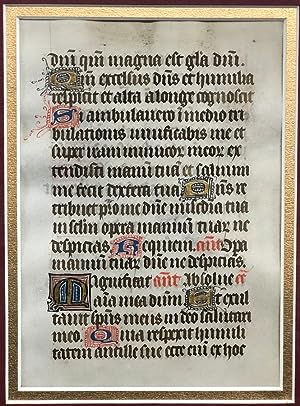
Ajouter au panierA single leaf from a French Book of Hours, produced ca.1480-1500. Executed on paper (we believe). Some wrinkling at the edges, fine condition . Leaf size is about 9 x 12 cm., in a frame measuring 22 x 26 cm. Attractively matted and framed in a reversible frame, so that both sides of the leaf are visible. Seventeen lines of Latin text in black & red, with eight illuminated capitals on the recto; seven illuminated capitals on the verso. The text on this leaf includes "Quia fecit in magna qui potens est" from the canticle Magnificat, or The Song of Mary, and was set to music by Bach in 1723, his "Magnificat". The Magnificat is usually sung or recited during the main evening prayer service, at Vespers in the Catholic and Lutheran churches, and Evening Prayer (Evensong) in the Anglican Church. In Eastern Christianity, the Magnificat is sung at Matins.
-

FROM A BOOK OF HOURS IN LATIN
Edité par ca. 1440, Paris, 1440
Vendeur : Phillip J. Pirages Rare Books (ABAA), McMinnville, OR, Etats-Unis
Membre d'association : ABAA ILAB
Évaluation du vendeur 3 sur 5 étoiles

EUR 398,76
Expédition à EUR 8,76
Expédition nationale : Etats-UnisQuantité disponible : 1 disponible(s)
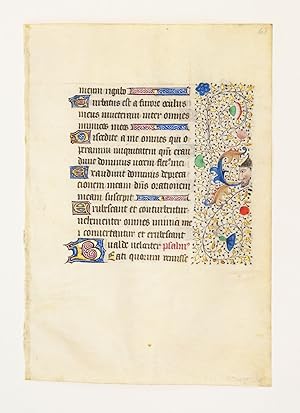
Ajouter au panier121 x 89 mm. (4 3/4 x 3 1/2"). Single column, 15 lines of text in a very fine gothic book hand. Rubrics in red, with multiple one-line initials and line fillers, all in blue, maroon, and burnished gold, and with two-line initials in the same colors and gold but also enclosing charming flowers on scrolling stems, with marginal extension in the form of gilt ivy leaves on sinuous stems, and WITH A FINE SWIRLING PANEL BORDER ON EACH SIDE featuring flowers, leaves, strawberries, and many burnished gold ivy leaves on hairline stems. IN FINE CONDITION, with the paint and gold bright, fresh, and entirely intact. This is a lovely little leaf from a fragment of a Book of Hours that obviously was produced for a client of considerable means by skilled craftsmen in a Parisian studio probably a little before the middle of the 15th century. This was clearly intended to be put into a book that could be carried easily on one's person, and part of what makes it so charming is this portable size.
-
TEXT IN LATIN
Edité par 14th century, Germany
Vendeur : Phillip J. Pirages Rare Books (ABAA), McMinnville, OR, Etats-Unis
Membre d'association : ABAA ILAB
Évaluation du vendeur 3 sur 5 étoiles
EUR 445,67
Expédition à EUR 8,76
Expédition nationale : Etats-UnisQuantité disponible : 1 disponible(s)
Ajouter au panier132 x 164 mm. (5 1/4 x 6 3/8"). Double column, 12 extant lines in a gothic book hand. Rubrics and four-line staves in red, capitals touched in red, four large initials in red or blue. Spine with two old paper labels, one with ink titling. Vellum a bit soiled, a couple small holes, ink a little faded on verso, paper remnants on verso obscuring a few lines, but still a good specimen demonstrating use and reuse of Medieval manuscripts. From a noted Missal that had outlived its use, this manuscript leaf was later repurposed as a cover for a 17th century printed book. The spine label indicates it was a copy of Jacob Bidermann's "Herodiados libri tres," a lengthy Latin poem relating the story of John the Baptist and Herod, first published in 1622.
-
FROM A LARGE BOOK OF HOURS, WITH TEXT IN LATIN
Edité par 3rd quarter of 15th century, France (probably Besançon)
Vendeur : Phillip J. Pirages Rare Books (ABAA), McMinnville, OR, Etats-Unis
Membre d'association : ABAA ILAB
Évaluation du vendeur 3 sur 5 étoiles
EUR 562,96
Expédition à EUR 8,76
Expédition nationale : Etats-UnisQuantité disponible : 1 disponible(s)
Ajouter au panier239 x 165 mm. (9 3/8 x 6 1/2"). Single column, 15 lines in an elegant gothic book hand. Rubrics in dark pink, line enders in pink and blue with white tracery and gold bezant, several one-line initials and one two-line initial in burnished gold on dark pink and blue ground with white tracery, each side with a panel border composed of hairline vines with gold ivy and bezants, a few colorful flowers, and EACH FEATURING THE FACE OF A MAN EMITTING ACANTHUS LEAVES FROM HIS MOUTH. ?A few tiny marginal spots, one of the faces slightly rubbed, otherwise IN BEAUTIFUL CONDITION. In addition to the floral decoration and vines often found in the borders of Books of Hours, this leaf features a duo of delightful inhabitants in the form of faces emitting colorful acanthus from their mouths. Each figure is individualized, the face on the recto with dark hair, flushed cheeks, and a prominent nose; on the verso is a face with a much paler complexion, a tonsured hairstyle, a large but very short nose, and fine, gray whiskers. This kind of imaginative work, together with luxurious touches such as the many gilt initials, several dozen gilt bezants and ivy leaves in each panel border, and the unusually wide margins, point to this manuscript having been a costly production. For additional leaves from this same manuscript at different price points, please check our website.
-
WITH TEXT FROM DEUTERONOMY
Edité par late 11th or early 12th century, Italy
Vendeur : Phillip J. Pirages Rare Books (ABAA), McMinnville, OR, Etats-Unis
Membre d'association : ABAA ILAB
Évaluation du vendeur 3 sur 5 étoiles
EUR 4 503,65
Expédition à EUR 8,76
Expédition nationale : Etats-UnisQuantité disponible : 1 disponible(s)
Ajouter au panier485 x 124 mm. (19 1/8 x 12 3/4"). Measured at widest part. Double column, 53 lines, in a rounded proto-gothic hand. Running titles in red. With contemporary or slightly later marginal notations; later inscriptions from its reuse as binding scrap dated 1557 and 1560, noting the volume "no. 181." Recovered from a binding and thus the vellum somewhat wrinkled, soiled, and with multiple folds, some dark staining affecting legibility of several lines--though sense easily recoverable on one side, and with effort on the other--a few tiny holes and two larger ones (slightly affecting the text). Showing the usual problems associated with re-use, but a grand and greatly appealing leaf nevertheless, with its handsome script and imposing presence readily apparent. Partly because of its re-use in what obviously would have been a very large binding, and more especially because of its age and early script, this vast Romanesque Bible leaf is of (there is no other way to say it but) immense interest. Measuring nearly 20 inches tall, it is almost large enough to be considered a so-called "Atlantic Bible" leaf, a distinctive (modern) designation reserved for massive Bibles produced in the 11th and 12th centuries. The script here consists of a highly legible proto-gothic book hand with elegant rounded letter forms. Its overall appearance has much in common with Caroline miniscule, including clubbed ascenders, a strong "st" ligature, and an "f" that extends below the baseline. In addition, there are very few abbreviations, and the ampersand symbol is used exclusively (rather than the Tironian "et" favored in later scripts). The text here is from Deuteronomy 20:5-23:24, containing the final laws that Moses gives to the Israelites before entering the Promised Land. These "second laws," as they are often called, include an array of statutes pertaining to sexual relations, marriage, divorce, slavery, warfare, and inheritance, as well as rules for agriculture, clothing, and diet. Our leaf previously belonged to the renowned Schøyen Collection, one of the largest and most distinguished private manuscript collections in the world. Started in the 1920s by Norwegian engineer M. O. Schøyen and expanded by his son Martin, the collection is particularly strong in paleography and biblical texts. Among its many unique and important manuscript pieces are treasures such as the St. Cecilia Bible (the only Carolingian Bible in private hands), and fragments of the Dead Sea Scrolls. 485 x 124 mm. (19 1/8 x 12 3/4"). Measured at widest part.
-
TEXT FROM THE GOSPEL LESSONS
Edité par ca. 1500, Paris, 1500
Vendeur : Phillip J. Pirages Rare Books (ABAA), McMinnville, OR, Etats-Unis
Membre d'association : ABAA ILAB
Évaluation du vendeur 3 sur 5 étoiles
EUR 1 688,87
Expédition à EUR 8,76
Expédition nationale : Etats-UnisQuantité disponible : 1 disponible(s)
Ajouter au panier165 x 115 mm. (6 1/2 x 4 1/2"). Single column, 18 lines, in a gothic book hand. Rubrics in red, two one-line initials and one two-line initial in blue or pink on burnished gold ground, verso with panel border of colorful flowers, acanthus, gilt bezants, and a small bird, recto with A SEVEN-LINE MINIATURE OF ST. MARK, and a three-quarter border of acanthus, flowers, gilt bezants, a bird, and a monkey sampling grapes. Minor soiling to vellum, miniature with light chipping in a couple places, one corner clipped (not touching decoration), but a very well-preserved leaf in excellent condition overall. This charming little miniature is an intimate portrait of St. Mark writing his Gospel, accompanied, as usua by his attribute, the lion, standing at his side. St. Mark's facial features here are excellent, with molding and shading that produce convincing three dimensionality and emotional resonance. The leaf contains another especially delightful detail: a small monkey perched in the border, eating grapes from a nearby vine. Modern commentators are generally unsure why such whimsical additions appear so inappropriately in Medieval manuscripts which feature sober spiritual content. But we can say with some certainty that monkeys were often used to suggest improper behavior, foolishness, and even the devil. In the present case, the monkey could be seen as Mark's foil: whereas the saint is depicted as a model of industry and conviction, the monkey puts earthly appetite above the sober production exemplified by the Evangelist.
-
WITH TEXT FROM EXODUS
Edité par second half of 11th, or opening of 12th century, Italy
Vendeur : Phillip J. Pirages Rare Books (ABAA), McMinnville, OR, Etats-Unis
Membre d'association : ABAA ILAB
Évaluation du vendeur 3 sur 5 étoiles
EUR 4 222,17
Expédition à EUR 8,76
Expédition nationale : Etats-UnisQuantité disponible : 1 disponible(s)
Ajouter au panier497 x 294 mm. (19 5/8 x 11 5/8"). Double column, 58 lines in a late Caroline hand. Running titles in red, three two-line initials in red. Recovered from a binding, and thus with some general soiling and staining to vellum, recto illegible except for part of the headline, modern reinforcement to the gutter and margins (affecting a couple of letters at the end of a number of lines), but the verso quite legible in most places and easily recoverable in the few places where it's not. This impressive leaf was once part of an immense lectern Bible that would have been prominently displayed at a church or monastery ca. 1075-1100. Measuring just under 500 mm. tall, its dimensions are almost big enough to be considered an "Atlantic Bible," a distinctive (modern) designation reserved for massive Bibles produced in the 11th and 12th centuries. Despite the loss of legibility on one side due to the leaf's reuse as binding material, the other side displays a lovely rounded Caroline hand with few abbreviations. The text comes from Exodus 23:11-24:18, expounding parts of civil law and Moses' journey to Mount Sinai. Our leaf was most recently part of the renowned Schøyen Collection, one of the largest and most distinguished private manuscript collections in the world. Started in the 1920s by Norwegian engineer M. O. Schøyen and expanded by his son Martin, the collection is particularly strong in paleography and biblical texts. Among its many unique and important manuscript pieces are treasures such as the St. Cecilia Bible (the only Carolingian Bible in private hands), and fragments of the Dead Sea Scrolls.
-
TEXT FROM "OBSECRO TE."
Edité par ca. 1500, Paris, 1500
Vendeur : Phillip J. Pirages Rare Books (ABAA), McMinnville, OR, Etats-Unis
Membre d'association : ABAA ILAB
Évaluation du vendeur 3 sur 5 étoiles
EUR 3 049,34
Expédition à EUR 8,76
Expédition nationale : Etats-UnisQuantité disponible : 1 disponible(s)
Ajouter au panier165 x 115 mm. (6 1/2 x 4 1/2"). Single column, verso with 18 lines, in a gothic book hand. Rubrics in red, one three-line initial in blue filled with foliage on burnished gold ground, verso with panel border of colorful flowers, a vase, and acanthus, recto with A MINIATURE OF THE VIRGIN AND CHILD flanked by two angels, framed by gold and painted bars on three sides and A FULL BORDER of acanthus, flowers, a vase, and gold bezants. Minor soiling to vellum, but in excellent condition, the miniature especially well preserved. This especially intimate and tender scene shows the so-called Virgo Lactans (or Nursing Madonna), the Virgin suckling the infant Christ; it accompanies the text for "Obsecro te," a popular Marian prayer appealing to the Virgin for protection and intercession. The prayer is not always accompanied by a miniature, and the present illustration, being rather large and skillfully done, is a particularly appealing example. The Virgin's facial features are especially excellent, with beautiful molding and shading that give her visage deep complexity and emotional resonance. The use of gold in this miniature adds to its richness; delicately highlighted garments, tresses, and angel wings catch the light and seem to shimmer as one moves the page. The high-quality illumination, liberal use of gold, and robust borders all suggest that the original manuscript must have been the product of an accomplished workshop.
-
TEXT FROM COMPLINE
Edité par ca. 1500, Paris, 1500
Vendeur : Phillip J. Pirages Rare Books (ABAA), McMinnville, OR, Etats-Unis
Membre d'association : ABAA ILAB
Évaluation du vendeur 3 sur 5 étoiles
EUR 5 629,56
Expédition à EUR 8,76
Expédition nationale : Etats-UnisQuantité disponible : 1 disponible(s)
Ajouter au panier163 x 115 mm. (6 1/2 x 4 1/2"). Single column, 18 lines in a gothic book hand. Rubrics in red, line fillers in blue and pink with gold bezant, six one-line initials in burnished gold on pink and blue ground, two two-line initials in blue on gold ground with a flower in the center, one three-line initial in blue filled with ivy on gold ground, verso with panel border of colorful flowers and acanthus, recto with A LARGE ARCH-TOPPED MINIATURE OF THE CORONATION OF THE VIRGIN with an "L" shaped frame of burnished gold and painted flowers, and A FULL BORDER of acanthus, flowers, a man playing a bagpipe, and a hybrid creature wearing a hat, all on a painted gold ground. Very minor wrinkling to vellum, but the leaf IN LOVELY CONDITION, with the gold everywhere gleaming brightly. From a luxuriously appointed Book of Hours, this leaf features a handsome miniature of the Coronation of the Virgin attributed to the workshop of Jean Pichore (fl. ca. 1502-20), a major figure among illuminators of the period and one of the most sought-after artists in France at the turn of the 16th century. Executed with imagination and delicacy, the miniature features the traditional subject associated with the hour of Compline, showing the Virgin being crowned Queen of Heaven, following her Death and Assumption. The composition here is quite intimate, with the Virgin kneeling before her son as she accepts, with humility, the crown he lays upon her head. Christ is depicted barefoot and slightly bowed toward his mother in a gentle display of respect. The artist creates a wonderful backdrop for this scene, composed entirely of seraphim painted gold, blue, light pink, and green, closely packed together. Two of the seraphim hold up light pink draperies behind the central figures, as if to shield this tender moment from prying eyes. The borders here are a source of delight, featuring a figure wearing a jester-like cap and playing the bagpipe as well as a creature with the body of a bird and the face of a human, donning a rather fashionable bycocket cap. The illumination here is of high quality, features a liberal use of gold, and contains unique marginal details, suggesting that the original manuscript must have been a costly commission for a wealthy patron.
-
TEXT FROM TERCE
Edité par ca. 1500, Paris, 1500
Vendeur : Phillip J. Pirages Rare Books (ABAA), McMinnville, OR, Etats-Unis
Membre d'association : ABAA ILAB
Évaluation du vendeur 3 sur 5 étoiles
EUR 5 160,43
Expédition à EUR 8,76
Expédition nationale : Etats-UnisQuantité disponible : 1 disponible(s)
Ajouter au panier165 x 117 mm. (6 1/2 x 4 5/8"). Single column, 18 lines in a gothic book hand. Rubrics in red, line fillers in blue and pink with gold bezant, five one-line initials in burnished gold on pink and blue ground, one two-line initial in blue on gold ground with a flower in the center, one three-line initial in blue filled with ivy on gold ground, recto with panel border of colorful flowers, vase, and acanthus, verso with A LARGE ARCH-TOPPED MINIATURE OF THE ANNUNCIATION TO THE SHEPHERDS, surrounded by A FULL BORDER of acanthus, flowers, and two birds, all on a painted gold ground. Slight soiling to vellum, but a very well-preserved leaf in fine condition. From what was surely a costly Book of Hours, this leaf features a charming and skillfully painted miniature of the Annunciation to the Shepherds, attributable to the workshop of Jean Pichore (fl. ca. 1502-20), a major figure among illuminators of the period and one of the most sought-after artists in France at the turn of the 16th century. Depicting the traditional subject associated with the hour of Terce, our miniature portrays, as usual, an angel appearing to shepherds tending their flock, bringing news of the birth of Christ. Although the biblical narrative suggests that the shepherds were startled by the angel's appearance, the three figures in this miniature appear remarkably unmoved--in fact, only one of them seems to take any notice at all. The first shepherd sits on the ground, looking straight ahead; the second holds his hands in prayer but looks little more than, well, prayerful at the angel in the sky; and a third figure maintains a slightly aloof expression, taking no particular interest in the unfolding miraculous event. What may seem to be indifference can be explained easily enough by the artist's successful portrayal of nighttime cold! All three shepherds are thickly dressed, one with his arms pressed tightly against his chest, another with a hood partly covering his face, and the sheep are tightly huddled together into one woolly white cluster. Another manifestation of the artist's success here is seen in the particularly well done molding of the faces, with subtle shading, attractively rendered features, and clear individuation. Moreover, although the shepherds seem essentially unmoved, their garments are dusted with a glistening gold radiance from above, a further subtle touch revealing a high level of achievement on the part of the painter. Finally, the borders are one last source of delight, with a small bird shown in mid-flight, and a second one investigating a single strawberry that seems to have been placed there just for him. All of these indications of sophistication suggest that the original manuscript must have been commissioned by a patron able to pay a premium for the work of a highly skilled atelier.
-
TEXT FROM LACTANTIUS' "DE OPIFICIO DEI."
Edité par 15th century, Italy
Vendeur : Phillip J. Pirages Rare Books (ABAA), McMinnville, OR, Etats-Unis
Membre d'association : ABAA ILAB
Évaluation du vendeur 3 sur 5 étoiles
EUR 2 111,08
Expédition à EUR 8,76
Expédition nationale : Etats-UnisQuantité disponible : 1 disponible(s)
Ajouter au panier264 x 200 mm. (10 3/8 x 7 7/8"). Single column, 41 lines, in a neat humanist hand. With two two-line initials in blue. One corner torn away (not affecting text), a few marginal wormholes, vellum a bit soiled and with a few small stains, but a very good example, the text entirely legible, and overall clean and presentable. Containing text by an author who was much admired during the Renaissance, this leaf is a lovely example of the humanistic script that emerged in Italy during the 15th century. The elegance and legibility of humanistic script derives from Caroline miniscule, the predominant style of writing in Western manuscripts from the ninth through 12th centuries. Both scripts favor clear, rounded letter forms, wider spacing between letters, and few abbreviations, resulting in manuscripts that are extremely attractive and easy to read. The text here comes from a work titled "De Opificio Dei," exploring the handiwork of God, with a concentration on the marvels of the human body and soul. The present leaf includes chapters 8-10, which discuss the human head, including especially the seats of the senses: eyes, ears, nose, and tongue. Our author, Lactantius (ca. 260-340), was a late-in-life Christian who became one of the ablest defenders of the faith in its early centuries. He was held in high esteem by Renaissance intellectuals, and was one of the earliest authors to be printed, first appearing in 1465.
-
WITH TEXT IN LATIN FROM THE "SENTENTIAE" OF PETER LOMBARD
Edité par late 12th or early 13th century, Germany(?)
Vendeur : Phillip J. Pirages Rare Books (ABAA), McMinnville, OR, Etats-Unis
Membre d'association : ABAA ILAB
Évaluation du vendeur 3 sur 5 étoiles
EUR 3 002,43
Expédition à EUR 8,76
Expédition nationale : Etats-UnisQuantité disponible : 1 disponible(s)
Ajouter au panier335 x 224 mm. (13 1/4 x 8 7/8"). Double column, 29 lines, in an elegant proto-gothic book hand. Rubrics in red, several two-line initials in red. Recovered from a binding and so the vellum a bit soiled, creased, and wavy, recto with a lighter patch (where a title label was once situated), light stains and glue and paper residue on the verso, but overall the leaf remarkably clean, entirely legible, and surprisingly well preserved. Once serving as a cover for a later book, this leaf comes from a nearly contemporaneous copy of Peter Lombard's "Sentences," considered the most important theological book of the 12th century. Written between 1155 and 1158 and arranged topically, Lombard's "Sententiae" summarize past learning about Christian doctrine by quoting authorities in an attempt to resolve textual disagreement by dialectical analysis. As a source collection that continued to spark discussion, Lombard's great work enjoyed sustained success as a theological textbook until the 17th century and inspired numerous commentaries, including those of Aquinas and Luther. This leaf comes from Book IV, "On the Doctrine of Signs," which is primarily concerned with the seven sacraments: Baptism, Confirmation, the Eucharist, Penance, Extreme Unction, Sacred Orders, and Matrimony. The script is an upright and very legible proto-gothic book hand with a few distinctive letter forms and abbreviations that may help determine a more definitive point of origin (these include a "g" with a downward cross on its tail, and a conjoined "qe" for "que"). It is unusual (and very lucky) that this leaf survives completely intact, as Medieval manuscripts used in later bindings were often cut down in size to make smaller covers or used as waste paper for pastedowns or other binding elements.


![Image du vendeur pour [Mythological scenes on palm leaves]. mis en vente par Antiquariat INLIBRIS Gilhofer Nfg. GmbH](https://pictures.abebooks.com/inventory/md/md32247953026.jpg)
![Image du vendeur pour [Cover title:] In Memoriam Baron Maurice de Hirsch. May 31, 1896, Boston, Massachusetts, U. S. A. mis en vente par Földvári Books](https://pictures.abebooks.com/inventory/md/md31053157125.jpg)
![Image du vendeur pour [Finely Illuminated Vellum Manuscript Signature in Latin, perhaps France, ca. late 15th Century]. mis en vente par Jeff Weber Rare Books](https://pictures.abebooks.com/inventory/md/md30931089244.jpg)