Montant total (1 article articles) :
Destination de la commande :

painted binding (7 résultats)
Passer aux résultats principaux de la recherche
Filtres de recherche
Type d'article
- Tous les types de produits
- Livres (7)
- Magazines & Périodiques (Aucun autre résultat ne correspond à ces critères)
- Bandes dessinées (Aucun autre résultat ne correspond à ces critères)
- Partitions de musique (Aucun autre résultat ne correspond à ces critères)
- Art, Affiches et Gravures (Aucun autre résultat ne correspond à ces critères)
- Photographies (Aucun autre résultat ne correspond à ces critères)
- Cartes (Aucun autre résultat ne correspond à ces critères)
- Manuscrits & Papiers anciens (Aucun autre résultat ne correspond à ces critères)
Etat En savoir plus
- Neuf (Aucun autre résultat ne correspond à ces critères)
- Comme neuf, Très bon ou Bon (1)
- Assez bon ou satisfaisant (2)
- Moyen ou mauvais (Aucun autre résultat ne correspond à ces critères)
- Conformément à la description (4)
Particularités
- Ed. originale (1)
- Signé (1)
- Jaquette (Aucun autre résultat ne correspond à ces critères)
- Avec images (6)
- Sans impressions à la demande (7)
Langue (1)
Prix
- Tous les prix
- Moins de EUR 20 (Aucun autre résultat ne correspond à ces critères)
- EUR 20 à EUR 45 (Aucun autre résultat ne correspond à ces critères)
- Plus de EUR 45
Livraison gratuite
- Livraison gratuite à destination de Etats-Unis (Aucun autre résultat ne correspond à ces critères)
Pays
Evaluation du vendeur
-
Circa 1930 Typed Manuscript Book of Poetry & Essays in a Hand Painted Binding
Edité par Not Published, Germany, Europe, 1930
Vendeur : Certain Books, ABAA, Las Cruces, NM, Etats-Unis
Membre d'association : ABAA ESA ILAB
Évaluation du vendeur 3 sur 5 étoiles

Edition originale
EUR 112,90
Expédition à EUR 9,65
Expédition nationale : Etats-UnisQuantité disponible : 1 disponible(s)
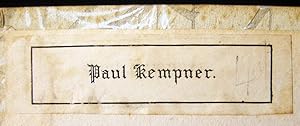
Ajouter au panierHand Painted. Etat : Very Good. Typescript. 118 pages; printed one side only; German text throughout. With a few small corrections and additions, some typed, some penciled-in. The essays section at back titled "Perugia" and "Der Geigenspieler Von Sebastiano del Piombo." Small previous owner bookplate-ticket of Paul Kempner on front endpaper; not dated; circa 1930; printed on heavy paper stock. Approx. 9" x 11 1/4" size; bound in hand-painted paper-covered boards, side-bound with string. Some edge, tips wear and soiling to binding; contents clean and in very good condition.
-
The Merchant Of Venice By W. Shakespeare .
Edité par Venice: S Rosen - Publisher Piazza S Marc MDCCCCVI, 1906
Vendeur : CHILTON BOOKS, SUDBURY, Royaume-Uni
Membre d'association : PBFA
Évaluation du vendeur 3 sur 5 étoiles
EUR 181,35
Expédition à EUR 46,95
Expédition depuis Royaume-Uni vers Etats-UnisQuantité disponible : 1 disponible(s)
Ajouter au panierScarce miniature book with hand-painted decoration. 2.75" x 2.25" x 0.5" (7.2cm x 5.8cm x 1.4cm). pp.256. Soiled vellum binding in very good condition. Both boards and spine with hand-painted decoration. Original leather tie still attached. Patterned endpapers. Gift inscription in red to front free-endpapers: "Of great value. Hand painted cover. From Father, brought from Venice July 1909. A.D. To Ailen Mary Danby." Portrait frontis. Clean English text throughout, plus a further 3 full-page illustrations. VG .
-
Prize notebook for a Maria van Halen at St. Leonhard's Girls' School, Aachen.
Edité par Aachen, 1857
Vendeur : SOPHIE SCHNEIDEMAN RARE BOOKS, ABA, ILAB, LONDON, Royaume-Uni
Membre d'association : ABA ILAB PBFA
Évaluation du vendeur 5 sur 5 étoiles

Signé
EUR 1 088,11
Expédition à EUR 30,52
Expédition depuis Royaume-Uni vers Etats-UnisQuantité disponible : 1 disponible(s)
Ajouter au panierOriginal prize portfolio of dark brown straight grain morocco (20.4 x 14 cm), with an inset painting on silk including an image of Aachen, including the school with an angel holding a banner "Beati omnes qui timent Dominum, qui ambulant in viis ejus" and with the words "Memory of St. Leonhard" at the bottom, gilt ruling round the edges, original clasp engraved with the word "Preis (prize)" and '1857'. Inserted through a string thread internally is the original blank notebook of 14 leaves of variously coloured paper (pink, yellow, cream and green) in glazed patterned paper wrappers, the back is a weekly calendar in French printed in gilt on glazed paper for writing on with a stylus then erasing, this forms the top of a pocket. In excellent condition. A label on the front pastedown presents this prize for German to Maria van Halen on 2nd Sept. 1857 and signed by Paula van Houtem. St. Leonhard's in Aachen was founded in 1625 by Sepulchrine nuns as a girls' school with boarding house and secularised in 1802. By the time of this prize it was run by Ursuline sisters as a school and a place for training teachers.
-
Étrennes plaisantes, ou Almanach nouveau contenant les plus jolies Chansons sur différens sujets comiques et sérieux; avec des proverbes chantans. Par un auteur réformé
Edité par Cuissard, ?Au Parnasse,? et se trouve à Paris, 1762
Vendeur : Musinsky Rare Books, New York, NY, Etats-Unis
Membre d'association : ABAA ILAB
Évaluation du vendeur 4 sur 5 étoiles

EUR 11 854,40
Expédition à EUR 13,15
Expédition nationale : Etats-UnisQuantité disponible : 1 disponible(s)
Ajouter au panier24mo (binding size 96 x 55 mm). [80] pp. Rule page borders (fore-edges cut close, some borders shaved, small hole in title). Text block stitched into a contemporary gold-embroidered case binding with two original watercolor drawings: both covers with large asymmetrical curving goldwork design couched on a gold basketwork ground, embroidered on a plain textile (visible at board edges), the design incorporating an abstract plant or cornucopia, and framing on each cover a different watercolor emblem of fidelity, painted on glazed paper (or possibly vellum): on the front cover a putto holds a bow and arrow, while a dog rests behind him, below a neat manuscript caption in majuscules, ?Fidel jusqu?à la mort?; on the rear cover a blindfolded putto with his quiver on his back is led by a dog on a pink leash through a coastal landscape, with caption ?La Fidelité me conduit?; the covers edged with vermeil strips, spine with sinuous couched goldwork band, edges gilt, dark purple silk liners; housed in a contemporary two-part morocco pull-off case, lined in color-blocked paper. In near-perfect condition (very slight darkening of some of the goldwork on lower cover).*** A superb example of one of the earliest and most sought-after types of French luxury almanac bindings. A single, probably Parisian atelier, active in the 1760s, seems to have been responsible for a group of innovative small bindings featuring small painted love-emblems on vellum, enclosed in glowing rococo frames composed of padded fretwork covered in gold-wrapped thread which entirely hides the plain textile cover. These inventive and successful bindings inspired emulators, paving the way for an explosion of imaginative almanac bindings over the next three decades, incorporating silk, embroidery, paintings, glass, mica, metal foil, and other materials, as well as the more traditional leathers, arranged in an enticing variety of patterns and designs and creating a full-fledged industry of these little books, produced by stationer-binders, who sub-contracted their textile bindings to professional embroiderers. It may seem extraordinary that such an elaborate binding would be used for a small, cheap publication like the present almanac, printed by Léonard Cuissart soon after 5 November 1762 (date of the printing permission on the last page). Containing songs, proverbs, and a calendar of Saints? days, it is an unillustrated precursor to the more elaborate almanachs galants produced during the next few decades. Like them, it would have been given as a New Year?s gift (étrenne), and indeed a love-gift. This fact explains the apparent paradox of such a labor-intensive production method for the cover decoration of an ephemeral publication: ?The status of gifts held by these little works . quickly conferred upon them, in the eyes of an elite clientele, the double role of bibelot [bauble] and of an object of gallantry likely to become a precious souvenir, and thus worthy of receiving a decoration formerly reserved only for the most precious publications? (Fabienne le Bars, no. 35b, Éloge de la rareté, trans.). It was in the 1760s that the fashion for such palm-sized treasure books first surfaced. A few later imitations of this ?goldwork? style are known, of somewhat inferior workmanship, on almanacs from the 1770s (see, for example, no. 35b in the Bibliothèque nationale de France 2014 exhibition catalogue Eloge de la rareté). The frequent misattribution of this type of goldwork binding to the Low Countries seems to be based on a few examples of those emulative bindings from the 1770s, found on almanacs from Liège (see, for example, Livres en broderie, no. 176). Whether or not those later imitations were indeed produced in or near Liège, the original examples of these goldwork bindings, such as this one, were almost certainly produced in Paris, as is evident from the almanacs they cover: see, for example, a group of four such almanacs, offered by Patrice Rossignol, in his catalogue 1.
-
The Book of Common Prayer, and Administration of the Sacraments, and Other Rites and Ceremonies of the Church, According to the Use of the Church of England; Together with the Psalter or Psalms of David, Pointed as They are to be Sung or Said in Chur
Edité par ches; and the Form or Manner of Making Ordaining and Consecrating of Bishops Priests and Deacons London Oxford and Cambridge: Riviingtons, 1866
Vendeur : Geoffrey Jackson, Royal Wootton Bassett, WILTS, Royaume-Uni
Évaluation du vendeur 5 sur 5 étoiles
EUR 876,53
Expédition à EUR 20,54
Expédition depuis Royaume-Uni vers Etats-UnisQuantité disponible : 1 disponible(s)
Ajouter au panierHardcover. Etat : Near Fine. Special Edition. 24mo., [iv], 405 pages, title-page and text printed in red and black, also specially bound in are 6 unique finely hand-painted pictorial illuminations on vellum paper (see illustations), marbled endpapers, all edges blocked in gilt, specially bound in full contemporary red morocco with both covers and spine covered in repeating gilt fleur-de-lys des patterns, all within gilt-ruled double borders and a further outer gilt decorated border together with decorative inner gilt dentelles. A near fine copy in a most handsome binding with only light occasional minimal wear to some extremities which contains 6 unique finely hand-painted illuminated drawings on vellum paper which have been professionally bound into this fine work. With a neat Presentation inscription to blank front endpaper, 'Florence V. Higginson from Edgar Selright, June 27. 1882' "In Memoriam". The Book of Common Prayer is the name given to a number of related prayer books used in the Anglican Communion and by other Christian churches historically related to Anglicanism. The first prayer book, published in 1549 in the reign of King Edward VI of England, was a product of the English Reformation following the break with Rome. The work of 1549 was the first prayer book to include the complete forms of service for daily and Sunday worship in English. In 1604, James I ordered some further changes, the most significant being the addition to the Catechism of a section on the Sacraments; this resulted in the 1604 Book of Common Prayer. Following the tumultuous events surrounding the English Civil War, when the Prayer Book was again abolished, another revision was published as the 1662 prayer book. That edition remains the official prayer book of the Church of England, although throughout the later twentieth century, alternative forms which were technically supplements have largely displaced the Book of Common Prayer for the main Sunday worship of most English parish churches.
-

A Tribute: The Destiny of a tiny piece of tapestry in a Medieval City
Vendeur : Sanctuary Books, A.B.A.A., New York, NY, Etats-Unis
Membre d'association : ABAA ILAB
Évaluation du vendeur 5 sur 5 étoiles
EUR 90,32
Expédition à EUR 4,38
Expédition nationale : Etats-UnisQuantité disponible : 1 disponible(s)
Ajouter au panierHardcover. Etat : Very Good. Published circa 1900 (gift inscription dated 1908). 22 pp. Little book, measuring apx. 5.5" x 3". Presumably very scarce. The binding is lovely: full vellum with both front and rear panels painted in colors and heightened with gold. Light wear.
-
Poems
Edité par London: John Lane: The Bodley Head, 1898, 1898
Vendeur : David Brass Rare Books, Inc., Calabasas, CA, Etats-Unis
Membre d'association : ABAA ILAB
Évaluation du vendeur 5 sur 5 étoiles
EUR 406,44
Expédition à EUR 8,77
Expédition nationale : Etats-UnisQuantité disponible : 1 disponible(s)
Ajouter au panierA Charming Hand-Painted Binding in the Pre-Raphaelite Style [PAINTED BINDING]. PHILLIPS, Stephen. Poems. London: John Lane: The Bodley Head, 1898. Second edition. Small octavo (7 9/16 x 4 5/8 inches; 192 x 118 mm.). viii, 108, [2, Some Press Notices]. A few leaves slightly browned., otherwise excellent. Full parchment, front cover with a 'Pre-Rahaelite' woman' in ink and watercolor, highlighted in gilt and with a leafy twining border in watercolor and gilt. Rear cover with two gilt borders with small watercolor fleurons. Spine with watercolor and gilt twining leaf, lettered in gilt, edges uncut. Ex libris Virginia House, Richmond with their stamp on front paste-down. Ink signature "A. & V. Waddell / Virginia / 1925" on font free endpaper. A charming little binding which was hand painted by an unidentified artist somewhere between 1898 and 1925. Stephen Phillips (1864-1915) was an English poet and dramatist who enjoyed considerable popularity early in his career. In 1890, a slender volume of verse was published at Oxford titled Primavera, which contained contributions by him, his cousin Laurence Binyon, and others. In 1894, he published Eremus, a long poem of loose structure in blank verse with a philosophical complexion. In 1896, he published Christ in Hades, forming one of the slim paper-covered volumes of Elkin Mathews's Shilling Garland. This poem caught the eye of critics, and when it was followed by a collection of Poems in 1897, Phillips's position as a new poet of exceptional gifts was generally recognized. This volume contained a new edition of Christ in Hades, together with Marpessa, The Woman with the Dead Soul, The Wife, and shorter pieces, including To Milton, - Blind. The volume won the prize of £100 offered by the Academy newspaper for the best new book of its year, ran through half a dozen editions in two years, and established Phillips's rank as a poet, which was sustained by the publication of his poem Endymion in the Nineteenth Century in 1898. Provenance: Alexander Weddell (1876-1948) and Virginia Chase Steedman (1874-1948). The couple first met in Calcutta, India, in 1923 where Mr. Weddell was serving as U.S. consul-general. Alexander was a bachelor in his forties from Richmond, Virginia, and Virginia was a wealthy widow from St. Louis, when they were introduced by friends. Mr. Weddell accompanied Virginia Steedman and her companions back to the United States by cruise ship. Virginia's letters from the period first are addressed to "Mr. Weddell," but soon moved to the more personal "Alex." Four months later, on May 31, 1923, they were married at the Cathedral of St. John the Divine in New York City. The couple combined their passions and resources to build Virginia House in Richmond.